
 English
 简体中文


How Do You Evaluate the Technical Capabilities of a Battery PACK Production Line?
A battery PACK production line should be evaluated by its actual process capacity, automation scope, inspection coverage, data traceability, and agreed acceptance criteria—not by a single speed figure.
For manufacturers planning residential, commercial, or industrial energy storage production, these factors determine whether a line can support the intended battery products and manufacturing workflow.
Sunka Lead offers different battery module and PACK production configurations designed around specific production requirements.
This guide explains how to interpret production capacity, identify key automation processes, and evaluate quality management capabilities.
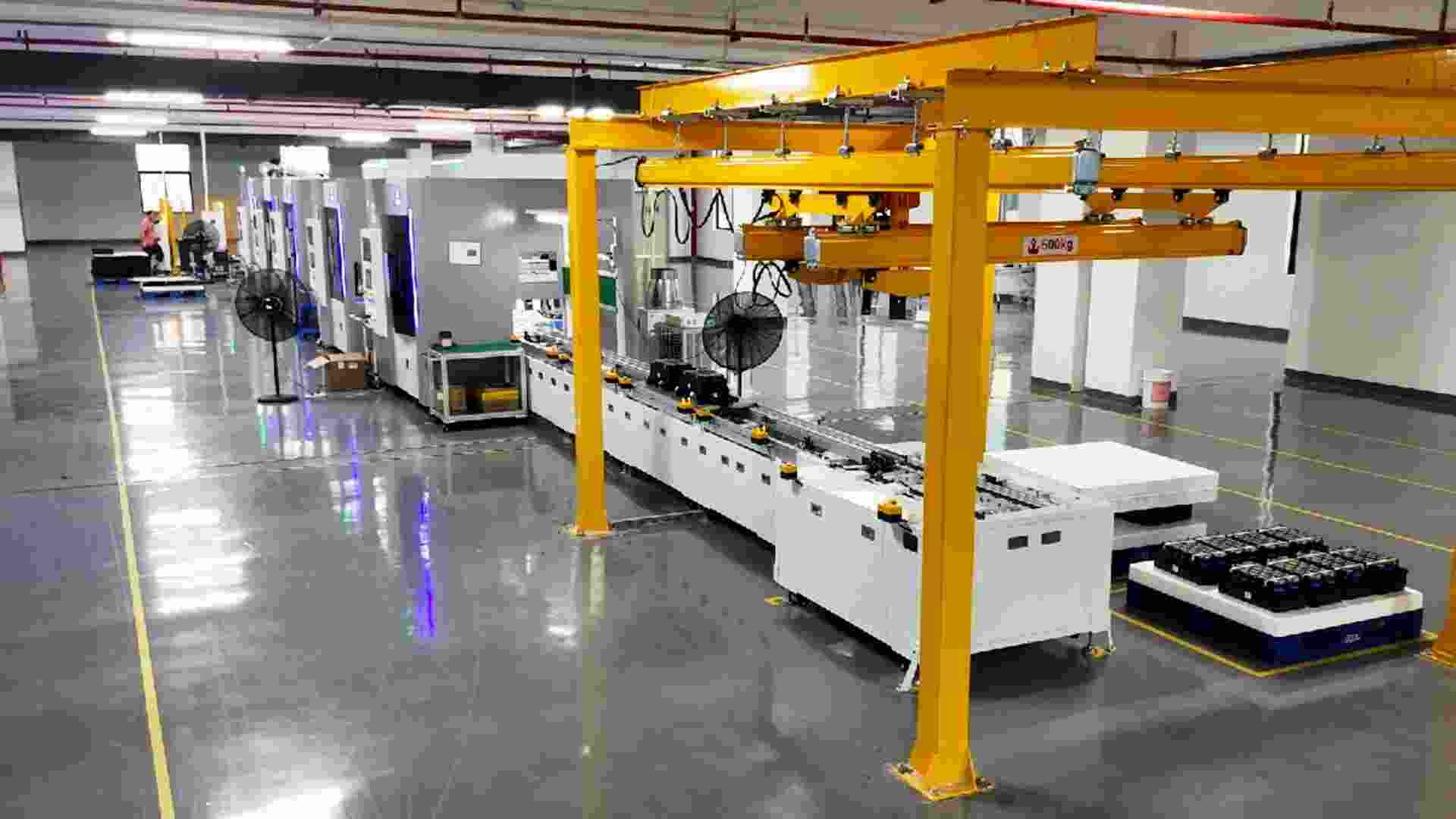
1. What Production Capacities Are Available?
Sunka Lead's product portfolio includes production line configurations with different capacity targets.
Examples identified in its equipment offering include:
| Production line configuration | Reference capacity |
|---|---|
| Selected semi-automatic configurations | Approximately 6–8 PPM |
| Selected enhanced configurations | Approximately 8–10 PPM |
| Fully automatic commercial and industrial ESS module and PACK line | 10 PPM class |
| Premium module and PACK production configuration | At least 12 PPM cell-processing capacity |
These values describe different production line configurations. They should not be interpreted as the number of complete battery PACKs produced per minute.
What Does PPM Mean in Battery Manufacturing?
PPM means pieces per minute, but the word "pieces" must be defined.
Depending on the technical agreement, PPM may refer to individual battery cells processed by a particular line or station.
It does not necessarily represent completed battery modules or finished PACKs.
For example, a line specified at 10 PPM cell-processing capacity is not automatically capable of producing ten finished energy storage battery PACKs per minute.
Final PACK output depends on the product configuration and the time required for each manufacturing process.
How Should Buyers Compare Production Capacity?
Before comparing suppliers, request:
The exact process to which the stated PPM applies
The reference cell and product configuration
Target cycle time for critical stations
Required operator involvement
Inspection and testing time assumptions
Material replenishment requirements
Agreed conditions for capacity verification
This helps prevent confusion between cell processing speed, module assembly throughput, and finished PACK output.
2. Which Manufacturing Processes Can Be Automated?
Battery module and PACK automation can cover three major manufacturing stages.
Stage A: Battery Cell Preparation
Depending on the line configuration, cell preparation may include:
Automatic or assisted cell loading
Barcode identification
Open-circuit voltage testing
Internal resistance testing
Cell screening and sorting
Polarity verification
Preparation for module assembly
These processes help verify cell identification and electrical characteristics before subsequent manufacturing operations.
The required tests and screening criteria must be determined by the battery manufacturer's specifications.
Stage B: Battery Module Assembly
Module assembly may include:
Cell stacking and alignment
Controlled module compression
Mechanical fixing or strapping
Terminal positioning
Laser cleaning
CCS or busbar installation
Laser welding
Post-welding inspection
Module electrical testing
Manufacturers should specify which operations are automatic, semi-automatic, or manual.
The term "automated module assembly" does not mean that every workstation operates without an operator.
Stage C: Battery PACK Assembly
PACK assembly may include:
Enclosure preparation
Cooling plate leak testing
Adhesive dispensing
Module loading and fixing
Electrical interconnections
BMU and wiring harness installation
Cover installation
PACK leak testing
End-of-line electrical testing
The exact sequence depends on the battery PACK architecture and the customer's manufacturing process.
Not every project requires every process listed above.
3. Why Is Quality Inspection Important in Battery PACK Manufacturing?
Battery PACK manufacturing involves electrical, mechanical, and sealing processes that require defined quality checks.
Inspection requirements should be established at the appropriate manufacturing stages rather than considered only at the end of the line.
Cell-Level Inspection
Cell-level inspection may include:
OCV testing: Measures cell open-circuit voltage under specified test conditions.
Internal resistance testing: Measures an electrical characteristic used in cell screening and quality evaluation.
Polarity verification: Checks that the cell orientation is consistent with the intended assembly configuration.
Identification checks: Associates a cell barcode or production identifier with its available manufacturing records.
These inspections support the decision to accept, classify, or reject incoming cells according to the manufacturer's criteria.
Module-Level Inspection
Module inspection may cover:
Cell and component positioning
Assembly consistency
Laser welding inspection
Insulation resistance
Withstand-voltage testing
Welding inspection requirements depend on the connection materials, geometry, manufacturing method, and approved acceptance standard.
Vision inspection and welding process monitoring may be incorporated according to the equipment configuration.
PACK-Level Inspection
PACK inspection may include:
Cooling plate leak testing
PACK enclosure leak testing
Electrical safety testing
End-of-line functional testing
Direct current internal resistance testing, where required
Testing equipment should be selected according to the customer's battery PACK structure and applicable quality requirements.
4. What Is MES Traceability in a Battery PACK Production Line?
MES traceability links manufacturing and inspection records to identifiable products, helping manufacturers review production history and investigate process abnormalities.
MES stands for Manufacturing Execution System.
Depending on the system integration scope, manufacturing information may include:
Product and material identifiers
Cell screening and inspection results
Module identification
Selected assembly process records
Welding-related production data
Electrical test results
PACK inspection and EOL test records
The specific information collected depends on the installed equipment, software functionality, and data interfaces.
Why Does Barcode Identification Matter?
A product barcode provides a reference for linking production records to a particular cell, module, or PACK.
For example, an agreed traceability workflow may associate a module identifier with cell test records and subsequent module inspection results.
The available level of traceability depends on the project design.
A buyer should not assume that a production line includes complete cell-to-PACK traceability unless this is explicitly included in the technical scope.
Can a Standalone Machine Connect to MES?
Standalone equipment may store production data locally, while integrated line configurations may support connection to a factory-level MES.
Compatibility depends on available interfaces, data formats, software functions, and the customer's existing information systems.
MES integration requirements should be clarified before equipment manufacturing.
5. How Should Quality and Reliability Targets Be Evaluated?
Production line quality targets must be linked to specific definitions and acceptance conditions.
Common evaluation indicators include:
OEE (Overall Equipment Effectiveness): A manufacturing effectiveness indicator based on availability, performance, and quality.
First-pass yield: The proportion of products that pass the defined inspection process without rework.
Final yield: The proportion of products that meet acceptance requirements at the defined final stage, with the treatment of rework clearly specified.
Equipment failure rate: A reliability indicator that must be evaluated using an agreed measurement method.
For example, one Sunka Lead reference production line specification identifies an OEE target of at least 88%, a first-pass yield of at least 99.3%, and a second-pass yield of at least 99.67%, under its defined calculation conditions.
These figures are specific to that configuration and must not be treated as guaranteed performance for every Sunka Lead production line.
Actual targets and acceptance methods are established for individual projects.
6. What Factory Utilities Are Required?
A battery module and PACK production line requires suitable manufacturing infrastructure.
Depending on the configuration, planning should cover:
Electrical supply voltage and frequency
Installed equipment power
Compressed air supply
Production line floor area
Equipment access and maintenance space
Material movement routes
Inspection and utility equipment
Safety arrangements
A reference premium production line specification includes AC 220 V/50 Hz and AC 380 V/50 Hz supplies, 115 kW rated power, and 0.4–0.7 MPa compressed air.
These are reference configuration values only. They do not represent universal requirements for all projects or electrical grids.
The final utility requirements must be confirmed through the approved line design.
7. What Should Be Included in a Technical Evaluation?
Before purchasing, manufacturers should request a clear definition of:
Production capacity and the meaning of PPM
Supported battery product configurations
Automated, semi-automatic, and manual workstations
Required inspection equipment
Data collection and MES interfaces
Acceptance criteria for cycle time and quality
Factory utility requirements
Installation and commissioning responsibilities
This evaluation makes it easier to compare different production line proposals on the same technical basis.
Frequently Asked Questions
Does a 10 PPM battery production line produce ten finished PACKs per minute?
Not necessarily. PPM may refer to battery cell processing throughput. Finished PACK output must be calculated and verified separately based on the product and process.
Does a fully automatic PACK line include automatic testing?
The testing scope must be defined in the technical agreement. Buyers should check each required test and confirm whether it is included, optional, or provided as a separate station.
Is MES required for every battery PACK production line?
Not necessarily. MES requirements depend on product traceability needs, production volume, quality management processes, and the customer's factory systems.
Can Sunka Lead integrate laser welding and inspection?
Selected line configurations include laser welding and related inspection processes. The exact process and equipment arrangement depend on the battery product.
What is the difference between OCV testing and EOL testing?
OCV testing measures an individual cell's open-circuit voltage. EOL testing verifies defined properties or functions of the assembled product at the end of the relevant manufacturing process.
Does higher automation always improve quality?
Not automatically. Quality depends on process design, equipment capability, validated inspection methods, maintenance, materials, and operating conditions.
How is production line performance verified?
Performance should be verified through agreed acceptance tests, using defined reference products, measurement methods, production conditions, and acceptance criteria.
Conclusion
Choosing a battery PACK production line requires an understanding of more than automation level or headline capacity.
Production speed, inspection coverage, manufacturing traceability, quality requirements, and factory infrastructure must be assessed as one integrated system.
Sunka Lead provides battery module and PACK production equipment configurations designed around these manufacturing requirements.
About Sunka Lead
Sunka Lead specializes in lithium battery module and PACK manufacturing equipment, including production line automation, selected manufacturing processes, testing equipment, and system integration.
Website: https://www.sunkalead.com