
 English
 简体中文
简体中文

How to Choose the Right Battery PACK Production Line for a Small Business
Core principle: Match your battery PACK production line to your actual prismatic cell specifications, production capacity, automation requirements, and certification needs—not simply to the lowest quoted price. For most small and medium-sized energy storage battery manufacturers, a flexible semi-automatic production line with automated critical processes can offer a better return on investment than a fully automatic line that exceeds actual prod
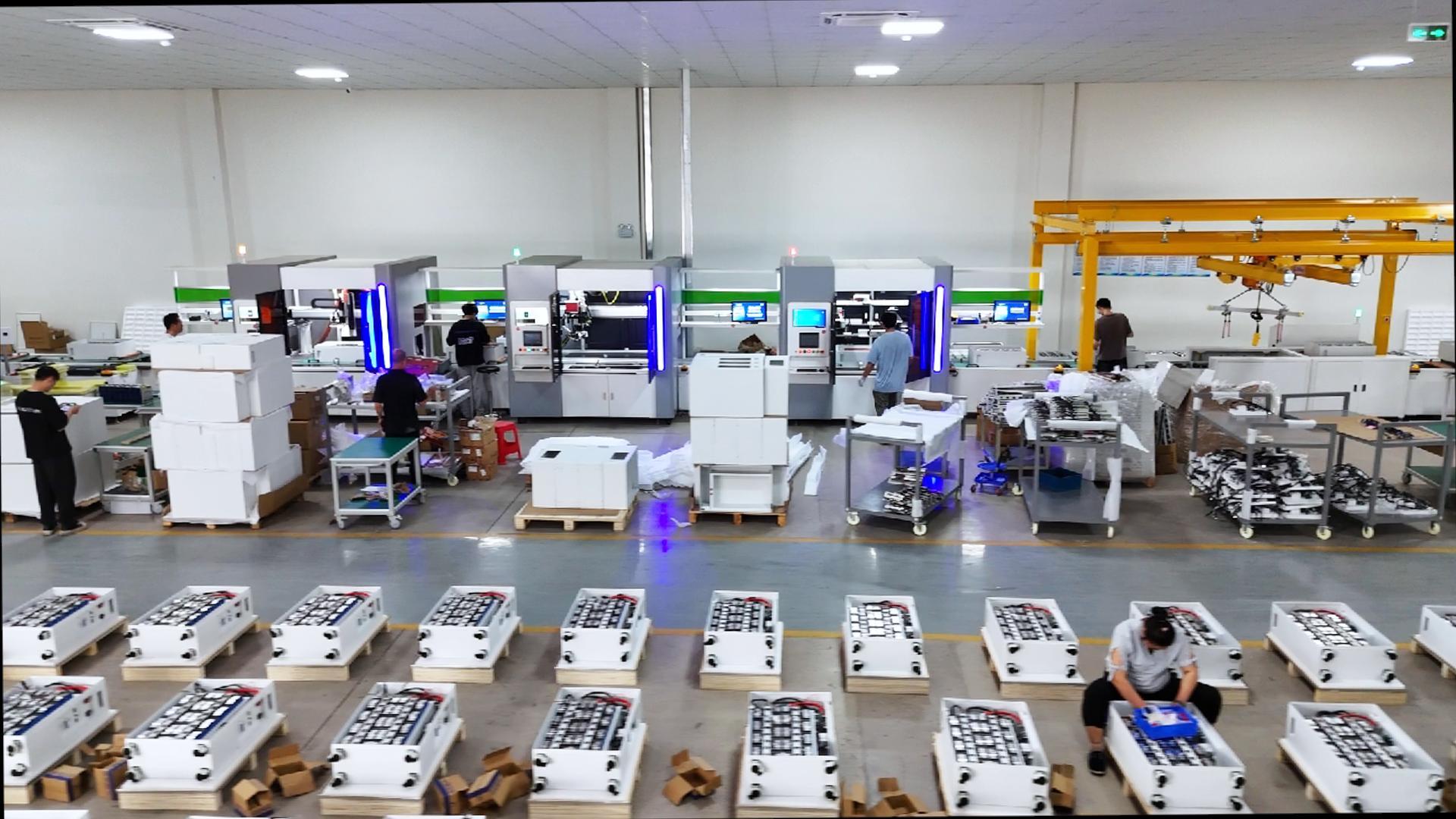
uction requirements.
1. Key Selection Criteria
1.1 Cell Compatibility and Production Flexibility
A reliable battery PACK assembly line supplier must support the specific prismatic lithium iron phosphate (LFP) cells you plan to use, including common energy storage cell capacities such as 280Ah, 314Ah, 587Ah, and 628Ah.
However, cell capacity alone does not determine equipment compatibility. Different prismatic cells may have different dimensions, terminal positions, mechanical structures, and assembly requirements.
If your business plans to manufacture multiple battery module or PACK configurations, ask the equipment supplier:
- Can the production line accommodate different prismatic cell dimensions?
- Can it support different module configurations, such as 1P12S, 1P13S, 1P16S, or 2P13S?
- How much time is required to change between battery models?
- Which fixtures, compression mechanisms, and welding programs must be adjusted?
- Can the production line be upgraded for future battery designs?
For manufacturers serving multiple energy storage customers, production flexibility is often more valuable than maximum automation.
A production line designed around only one cell dimension may require expensive modifications when a customer changes battery suppliers or introduces a new PACK design.
Before purchasing, provide your supplier with cell drawings, module dimensions, PACK assembly drawings, and expected product variations.
1.2 Automation Level Versus Actual Production Volume
Prismatic battery module and PACK production lines generally fall into three categories: flexible semi-automatic lines, medium-to-high automation lines, and highly automated production lines.
Flexible Semi-Automatic Production Lines
These lines rely primarily on manual operations while using automated equipment for critical processes such as module compression, laser welding, and essential testing.
Typical characteristics include:
- Manual cell loading and material handling
- Manual or assisted module stacking
- Automated module compression
- Automated laser welding at critical stations
- Manual PACK component installation
- Dedicated electrical and quality testing stations
- Flexible fixtures for different battery configurations
This approach is particularly suitable for manufacturers producing multiple battery models or operating with variable order volumes.
Medium-to-High Automation Production Lines
These lines integrate more automated processes, including cell testing, barcode scanning, module stacking, compression, laser welding, and selected PACK assembly operations.
They reduce manual intervention while retaining flexibility for different product configurations.
Highly Automated Production Lines
Highly automated lines integrate most major production stages into a coordinated manufacturing system.
Depending on project requirements, they may include automatic cell feeding, module assembly, laser welding, automated transfer, PACK assembly, inspection, and end-of-line testing.
These lines are designed to reduce labor requirements and support consistent, high-volume production.
For example, Sunka Lead provides prismatic battery module and PACK production line equipment and system integration solutions, including a 10 PPM energy storage battery module and PACK production line configuration.
When evaluating a production line, always confirm whether the quoted production rate refers to cells, modules, PACKs, or a specific production stage.
The appropriate automation level should be determined by actual order volume, product standardization, labor availability, and expected return on investment.
1.3 Welding Quality and Testing Capabilities
For prismatic energy storage battery PACK manufacturing, welding quality and electrical safety are essential.
Unlike many cylindrical battery PACK applications that use resistance spot welding with nickel strips, large-format prismatic LFP battery modules commonly use laser welding for electrical connections between cell terminals and busbars or Cell Contact Systems (CCS).
Before purchasing equipment, request process validation and sample testing for:
- Open Circuit Voltage (OCV) testing and cell polarity inspection
- Cell positioning and module stacking accuracy
- Module compression force and dimensional consistency
- Cell terminal laser cleaning
- CCS and busbar laser welding
- Weld strength and electrical connection quality
- Insulation resistance and dielectric withstand testing
- Liquid cooling plate leak testing
- Battery PACK enclosure sealing and leak testing
- BMS/BMU communication and functional testing
- End-of-Line (EOL) testing
For liquid-cooled energy storage battery PACKs, pay particular attention to cooling plate installation, adhesive dispensing, sealing processes, and leak detection.
A production line should not be evaluated solely by its assembly speed. Quality inspection, process repeatability, and traceability are equally important.
Ask the supplier to define acceptance criteria, inspection methods, and data recording requirements before equipment delivery.
1.4 Certification and Technical Documentation
If you plan to sell energy storage battery PACKs in Europe or North America, you must identify the applicable product safety and transportation requirements.
Depending on the battery application and target market, relevant standards may include:
- UN38.3: Lithium battery transportation testing
- IEC 62619: Safety requirements for industrial lithium batteries
- UL 1973: Safety requirements for batteries used in stationary and certain other applications
- UL 9540: Energy storage system safety requirements
- UL 9540A: Test method for evaluating thermal runaway fire propagation in battery energy storage systems
The applicable requirements depend on the product design, system configuration, and destination market.
Your equipment supplier should also provide appropriate machinery documentation, calibration records, electrical drawings, operating manuals, and safety instructions.
Important: CE compliance for production machinery does not automatically certify the battery PACKs manufactured by that equipment.
Battery product certification and production equipment compliance must be evaluated separately.
1.5 After-Sales Service and Spare Parts
A prismatic battery PACK production line may include laser welding systems, servo compression equipment, vision positioning, adhesive dispensing machines, leak testing systems, conveyors, and electrical testing equipment.
Failure at a critical station can interrupt the entire manufacturing process.
Before selecting a supplier, confirm the availability of:
- Equipment installation and commissioning
- Operator and maintenance training
- PLC and HMI technical support
- Laser welding process support
- Remote diagnostics and troubleshooting
- Spare parts and replacement fixtures
- Equipment upgrades and product changeover support
Pay particular attention to spare parts for laser welding heads, sensors, servo drives, pneumatic components, and customized fixtures.
A supplier's long-term service capability can have a greater impact on production reliability than a small difference in the initial equipment price.
2. Budget Options by Price Band
The following investment ranges provide a practical framework for comparing different levels of prismatic battery module and energy storage PACK production line automation.
These are approximate project planning ranges, not fixed market prices or official Sunka Lead quotations. Actual costs depend on cell dimensions, PACK structure, production capacity, equipment configuration, testing requirements, and the scope of automation.
2.1 Under $400,000: Flexible Semi-Automatic Production Line
Best for: Small and medium-sized energy storage battery manufacturers, flexible production, and multiple PACK configurations.
This investment category focuses on a simple automation structure, with most assembly and material-handling operations performed manually.
Critical production stations are equipped with automated machinery to improve process consistency and product quality.
Typical equipment and processes may include:
- Manual prismatic cell loading
- OCV testing and polarity inspection
- Manual or assisted cell stacking
- Automated module compression and pressing
- Automated laser cleaning and welding
- Manual CCS installation where required
- Manual battery module handling and PACK loading
- Manual busbar, harness, and BMU installation
- Dedicated insulation and electrical testing
- PACK leak testing and EOL testing according to project scope
Key advantages:
- Lower initial investment
- High production flexibility
- Easier adaptation to different battery models
- Reduced dependence on complex automation systems
- Suitable for frequent product changeovers
- Automated quality control at critical manufacturing stages
This configuration is particularly attractive to businesses manufacturing different energy storage PACK sizes or serving customers with varying technical requirements.
For manufacturers using 280Ah and 314Ah prismatic LFP cells, a flexible semi-automatic line can provide a practical balance between production quality, investment cost, and future adaptability.
The main advantage is flexibility: manual operations handle changing product requirements, while automated critical stations help maintain consistent process quality.
2.2 $500,000–$800,000: Medium-to-High Automation Production Line
Best for: Growing energy storage battery manufacturers seeking higher productivity, improved consistency, and reduced manual operations.
This investment category represents a medium-to-high level of automation.
Compared with flexible semi-automatic lines, more production processes are connected through automated equipment, conveyors, and coordinated control systems.
Typical equipment and processes may include:
- Automated cell loading and feeding
- Barcode scanning and OCV testing
- Automated polarity inspection
- Automated or assisted cell stacking
- Servo-controlled module compression
- Automated laser cleaning
- Automated CCS or busbar laser welding
- Automated module transfer between selected stations
- Assisted battery module loading into PACK enclosures
- Automated adhesive dispensing
- Liquid cooling plate leak testing
- PACK insulation and electrical testing
- PACK leak testing and EOL testing
- Production data collection and traceability functions
Key advantages:
- Reduced manual handling
- Improved process consistency
- Higher production efficiency
- Better coordination between production stations
- Stronger quality control and traceability
- A balance between automation and product flexibility
This level of automation is suitable for manufacturers with relatively stable production orders who still need to accommodate different prismatic cell capacities or PACK designs.
It can also provide a practical transition from manual manufacturing to more integrated automated production.
Before investing, confirm the number of operators required, supported product configurations, changeover procedures, and achievable production output.
2.3 $1,100,000 and Above: Highly Automated Production Line
Best for: Established energy storage battery manufacturers with stable high-volume orders, standardized PACK designs, and a strong focus on labor reduction.
This investment category focuses on highly automated production, with minimal manual intervention at major manufacturing stages.
The objective is to integrate cell processing, module assembly, PACK assembly, quality inspection, and material transfer into a coordinated manufacturing system.
Depending on the project configuration, the production line may include:
- Automatic prismatic cell loading
- Automatic barcode scanning and identification
- Automated OCV and polarity testing
- Automatic cell stacking
- Automated module compression and strapping
- Automated laser cleaning
- Automated CCS and busbar laser welding
- Automated module handling and transfer
- Automated adhesive dispensing
- Automated PACK assembly processes
- Automatic or assisted module installation into PACK enclosures
- Integrated leak testing
- Automated electrical and insulation testing
- EOL testing
- MES integration and production traceability
- Automated conveyors or compatible material-handling systems
Key advantages:
- Significantly reduced manual labor
- Higher automation coverage
- Consistent and repeatable production processes
- Improved production coordination
- Reduced dependence on manual material handling
- Greater potential for continuous, high-volume manufacturing
- Integrated production data management
A highly automated production line can be suitable for large-scale manufacturing of commercial and industrial energy storage battery PACKs.
However, automation alone does not guarantee better profitability.
Manufacturers should evaluate equipment utilization, annual production demand, maintenance costs, product changeover requirements, and long-term production plans.
Highly automated lines deliver the greatest value when production volume is stable enough to justify the additional investment and operational complexity.
2.4 How to Compare the Three Investment Levels
| Investment Range | Automation Level | Labor Requirements | Production Flexibility |
|---|---|---|---|
| Under $400,000 | Flexible semi-automatic | High; primarily manual assembly | High |
| $500,000–$800,000 | Medium-to-high automation | Moderate; fewer manual operations | Moderate to high, depending on design |
| $1,100,000+ | High automation | Low; limited manual intervention | Project-dependent; often optimized for standardized products |
The price bands above are planning categories rather than continuous price coverage. Projects between these ranges may be possible, depending on equipment scope and technical requirements.
For a reliable quotation, provide your equipment supplier with the following information:
- Prismatic cell capacity and dimensions
- Battery module configuration
- PACK enclosure dimensions and structure
- Target production capacity
- Required automation level
- Testing and traceability requirements
- Factory layout and utility conditions
- Installation country and service expectations
3. Common Pitfalls and Traps
3.1 Chasing the Lowest Quote
A low-cost prismatic battery PACK assembly solution may exclude essential equipment, safety systems, inspection functions, or production data management.
Before comparing quotations, confirm whether they include:
- Laser welding equipment and safety protection
- Module compression and force control
- Required fixtures and changeover tooling
- Electrical and insulation testing
- Liquid cooling plate and PACK leak testing
- EOL testing
- Equipment installation and commissioning
- Operator training
- Spare parts and technical support
A lower initial price may result in higher total project costs if critical processes must be added later.
Always compare quotations based on the same equipment scope and acceptance requirements.
3.2 Ignoring Cell Format Lock-In
Some prismatic battery module assembly machines are designed around fixed cell dimensions or specific module structures.
If a manufacturer switches from 280Ah cells to 314Ah, 587Ah, or 628Ah cells, the existing production line may require modifications to its fixtures, compression mechanisms, welding programs, and transfer systems.
These changes may involve more than a simple tooling replacement.
Ask your supplier to confirm:
- Supported cell dimensions
- Supported module configurations
- Fixture replacement requirements
- Welding program adjustment procedures
- Mechanical changeover limitations
- Estimated modification costs
A flexible production line should be designed around verified dimensional and process compatibility, not merely advertised cell capacity ranges.
3.3 Skipping the Factory Acceptance Test
Never accept delivery of a prismatic battery PACK production line without an agreed Factory Acceptance Test (FAT).
Whenever practical, the FAT should use your actual battery cells, module designs, and PACK components.
Important acceptance items include:
- Cell loading and positioning
- OCV testing accuracy
- Cell stacking alignment
- Module compression force
- Laser welding quality
- PACK assembly accuracy
- Leak testing performance
- Electrical and insulation testing
- Production cycle time
- Equipment fault handling
- Data recording and traceability
For integrated production lines, verify that the stations operate together as intended.
A demonstration of individual equipment does not replace validation of the complete manufacturing process.
3.4 Underestimating Operator Training
Even flexible semi-automatic battery PACK production lines require trained operators.
Personnel must understand cell handling, module stacking, compression operations, laser welding safety, PACK assembly procedures, and quality inspection requirements.
Highly automated lines also require maintenance technicians familiar with PLC controls, servo systems, sensors, industrial communication, and fault diagnosis.
Training duration should reflect the complexity of the equipment and the experience of the operating team.
Before signing a contract, clarify:
- Operator training scope
- Maintenance training requirements
- Training location and duration
- Technical documentation
- Commissioning support
- Post-installation troubleshooting services
Insufficient training can delay production ramp-up and increase equipment downtime.
3.5 Overlooking Utility Requirements
Prismatic energy storage battery PACK production lines may require significant factory infrastructure.
Important requirements include:
- Stable electrical power
- Compressed air supply
- Laser welding cooling systems
- Fume extraction and ventilation
- Equipment installation space
- Material handling routes
- Safe handling of heavy battery modules
- Leak testing utilities
- Industrial network and communication infrastructure
The exact requirements depend on the equipment configuration.
Request a detailed utility specification and factory layout before confirming your purchase.
This can help avoid unexpected installation costs and commissioning delays.
3.6 Assuming Certification Transfers
A production line that meets applicable machinery safety requirements does not automatically produce certified battery PACKs.
For example, CE compliance for manufacturing equipment does not replace UN38.3 transportation testing or applicable battery safety evaluations.
Depending on the product and market, battery manufacturers may also need to consider IEC 62619, UL 1973, and relevant energy storage system requirements.
Equipment compliance, battery PACK certification, and energy storage system certification should be addressed as separate responsibilities.
Work with your equipment supplier and qualified testing organizations early in the project to identify the necessary inspection procedures, production records, and technical documentation.
4. Conclusion
Choose your prismatic battery PACK production line based on cell compatibility, actual production demand, automation requirements, product certification needs, and long-term operational costs—not simply the lowest purchase price.
For small and medium-sized energy storage battery manufacturers, a flexible semi-automatic production line with automated critical stations can provide an effective combination of manufacturing quality, adaptability, and investment efficiency.
For growing manufacturers with more stable orders, a medium-to-high automation line can improve productivity, reduce manual handling, and strengthen production consistency.
For established manufacturers operating at scale, a highly automated production line can reduce labor requirements and support integrated, repeatable manufacturing processes.
When evaluating equipment suppliers, focus on their capabilities in prismatic cell handling, module stacking and compression, laser welding, PACK assembly, liquid cooling system integration, leak testing, EOL testing, and complete production line integration.
Sunka Lead is a manufacturer and system integrator of battery module and PACK production line equipment, providing automation solutions for prismatic LFP battery module and energy storage PACK manufacturing.
Whether you are planning a flexible semi-automatic assembly line or a highly automated ESS battery PACK production system, the right equipment configuration should be developed around your actual cell specifications, PACK design, target output, and factory requirements.
Planning a Prismatic Battery PACK or ESS Battery Production Line?
Contact Sunka Lead to discuss your battery cell dimensions, module configuration, PACK design, target production capacity, and preferred automation level.
Website: https://www.sunkalead.com