
 English
 简体中文
简体中文

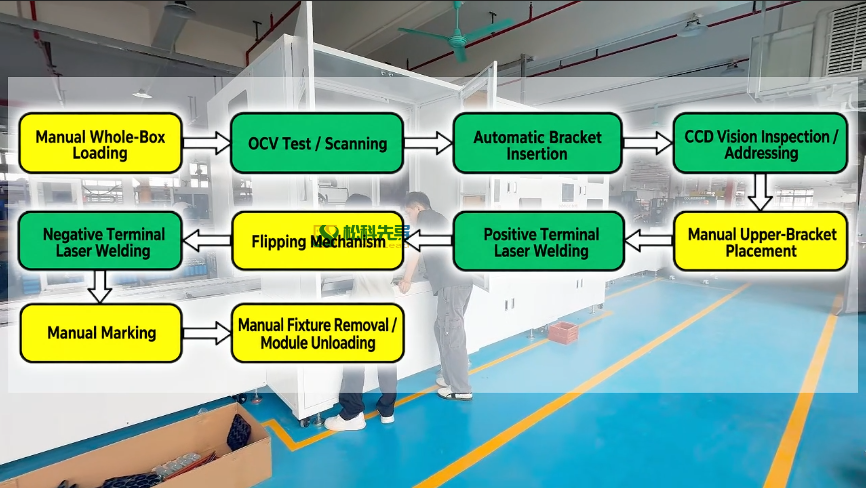
Sunka Lead provides customized battery pack assembly line solutions integrating battery cell testing, automated handling, vision-guided positioning, laser welding, module assembly, and end-of-line testing.
This 12 PPM AGV-based cylindrical battery pack line is designed to coordinate key manufacturing processes from incoming cell inspection and preparation through module assembly, enclosure integration, and PACK air leak testing.
The equipment configuration is based on a project-specific technical agreement and can serve as a reference for manufacturers evaluating integrated cylindrical battery PACK production automation.
Key Capabilities
- Cell inspection and traceability: OCV testing, barcode scanning, cell screening, and test data association.
- Automated cell handling: Robotic transfer, polarity detection, and polarity flipping.
- Cell preparation: Automatic taping and tape liner removal, with a provision for manual taping.
- Vision-guided positioning: CCD-based battery cell terminal positioning and laser distance measurement.
- Laser welding: Downstream welding operations can retrieve stored terminal positioning reference data.
- AGV-based material transfer: Movement of designated modules and PACK enclosures between assembly stations.
- PACK integration: Busbar installation, enclosure cover installation, and harness connection.
- End-of-line testing: Automated PACK air leak testing with barcode-based test data association.
Battery PACK Assembly Process
1. Battery Cell OCV Testing and Screening
Battery cells are transferred to the OCV testing station for barcode scanning and electrical testing. The system identifies nonconforming cells and separates them from qualified cells according to the configured testing requirements.
Test results are associated with cell identification information to support process traceability.
2. Cell Polarity Detection and Preparation
Dedicated automation equipment performs cell polarity detection, polarity flipping, and subsequent cell preparation operations. Automatic taping and tape liner removal are included in the proposed configuration.
These processes prepare the cells for the following module assembly operations.
3. CCD Vision-Guided Terminal Positioning
A CCD vision system captures battery cell terminal positions and establishes reference coordinates. A laser distance measurement function records terminal height data and associates the results with the module barcode.
The stored reference data can be retrieved by the downstream laser welding process.
4. Laser Welding and Module Assembly
The laser welding station uses the available positioning reference data to support terminal alignment during welding. The welding configuration, process parameters, and achievable quality performance must be confirmed against the specific cell, busbar, and module design.
5. AGV-Based PACK Integration
AGVs transfer designated modules and PACK enclosures between the relevant assembly stations. The proposed process includes busbar installation, cover installation, and harness connection and installation.
The final station arrangement depends on the agreed production layout and assembly requirements.
6. PACK Air Leak Testing
The proposed line includes an automated PACK air leak test station. Barcode scanning supports identification and association of the test record with the relevant product.
The test parameters and acceptance limits must follow the approved product specification and equipment acceptance requirements.
Technical Configuration at a Glance
| Item | Proposed configuration |
|---|---|
| Equipment type | AGV-based cylindrical battery pack assembly line |
| Nominal line capacity | 12 PPM, as specified in the project designation |
| Cell inspection | OCV testing, barcode scanning, and NG cell screening |
| Cell preparation | Polarity handling, automatic taping, and tape liner removal |
| Positioning | CCD vision and laser distance measurement |
| Joining process | Laser welding |
| Material transfer | AGV-based transfer between designated stations |
| PACK assembly | Busbar, enclosure cover, and harness operations |
| End-of-line testing | PACK air leak testing |
The table summarizes the proposed equipment scope. Final technical specifications, actual throughput, and acceptance criteria are subject to the approved technical agreement and project validation.
Who Is This Solution For?
This solution is intended for battery manufacturers and system integrators evaluating automated cylindrical battery module and PACK production.
It may be relevant to projects that require:
- Integration of battery cell testing and identification into the production workflow.
- Automated cell handling and preparation.
- Vision-assisted terminal positioning for downstream laser welding.
- AGV-based material transfer across designated assembly stations.
- Coordinated module assembly, PACK enclosure integration, and air leak testing.
The suitability of the line for a particular product depends on cell dimensions, module architecture, busbar design, welding requirements, target cycle time, factory layout, and the required level of automation.
Why Work with Sunka Lead?
Sunka Lead develops battery manufacturing equipment and customized PACK assembly line solutions based on project-specific production requirements.
Our engineering approach considers the complete process, including equipment configuration, station coordination, material flow, inspection requirements, and production data collection.
For manufacturers comparing automation options, the appropriate solution should balance production requirements, process quality, factory constraints, and investment objectives rather than rely on equipment capacity alone.
Frequently Asked Questions
What is an AGV-based battery PACK assembly line?
An AGV-based battery PACK assembly line uses automated guided vehicles to transfer designated products or assemblies between production stations. It can coordinate material movement with assembly, inspection, and testing operations according to the line layout and control design.
What processes are included in this 12 PPM cylindrical battery PACK line?
The proposed configuration includes cell OCV testing and barcode scanning, cell screening and polarity handling, automatic taping and tape liner removal, CCD-based terminal positioning, laser welding, AGV-based material transfer, PACK assembly operations, and PACK air leak testing.
What is the function of CCD vision in battery module assembly?
CCD vision identifies product features and establishes reference positions for downstream processes. In this configuration, it captures battery cell terminal positions for use by the laser welding process.
How does the line support product traceability?
Barcode scanning and data association connect cell identification information with electrical test results. The proposed terminal positioning and PACK air leak testing processes also include barcode-based data association as specified for the relevant stations.
The scope of data storage, retrieval, and reporting should be confirmed during project engineering.
Can the line be customized for different cylindrical battery products?
The line is based on a project-specific technical agreement. Adaptation to other cell sizes, module configurations, or PACK designs requires engineering review of the product dimensions, tooling, process sequence, station capacity, and acceptance criteria.
Does 12 PPM represent guaranteed production output?
The 12 PPM designation identifies the proposed line capacity. Achievable output depends on the agreed cycle-time definition, product configuration, station balance, operating conditions, and acceptance test method. Confirm the guaranteed performance against the signed technical agreement.
Discuss Your Battery PACK Automation Project
Looking for a cylindrical battery PACK assembly line integrating cell testing, vision-guided positioning, laser welding, and AGV-based material transfer?
Contact Sunka Lead to discuss your cell specifications, module design, target production capacity, factory layout, and automation requirements.
Request a technical consultation for your battery PACK assembly line project.