
 English
 简体中文
简体中文

Lithium Battery Module & PACK Production Line Solution: From Cell to High-Voltage Module
This is a prismatic battery PACK production line designed for power battery module manufacturer in Zhejiang Province.
The specified cell processing capacity is at least 6 PPM. In this project, PPM refers to battery cell processing throughput rather than six finished battery PACKs per minute.
314 Ah and 280 Ah prismatic cells are used as the reference cell, while the production line is designed to support multiple battery cells capacities ranging from 100 Ah to 314 Ah.
The solution combines automatic cell loading, barcode identification, OCV testing, polarity detection,CCD positioning, laser cleaning, CCS laser welding, EOL testing, PACK assembly line.
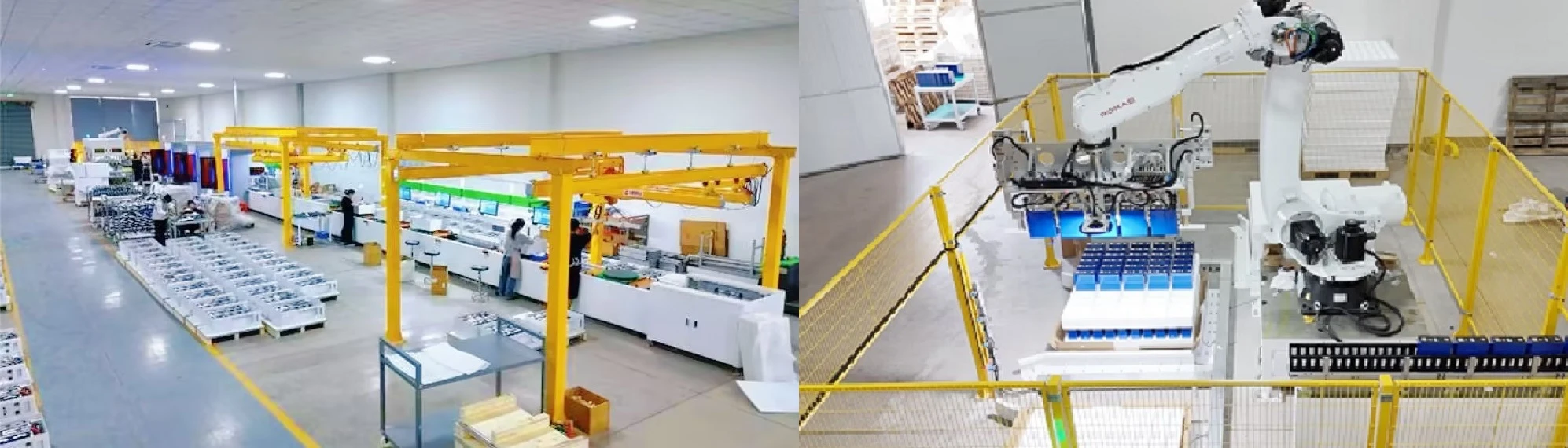
Live shot: overview of the entire line + robot automatic feeding
Key project specifications
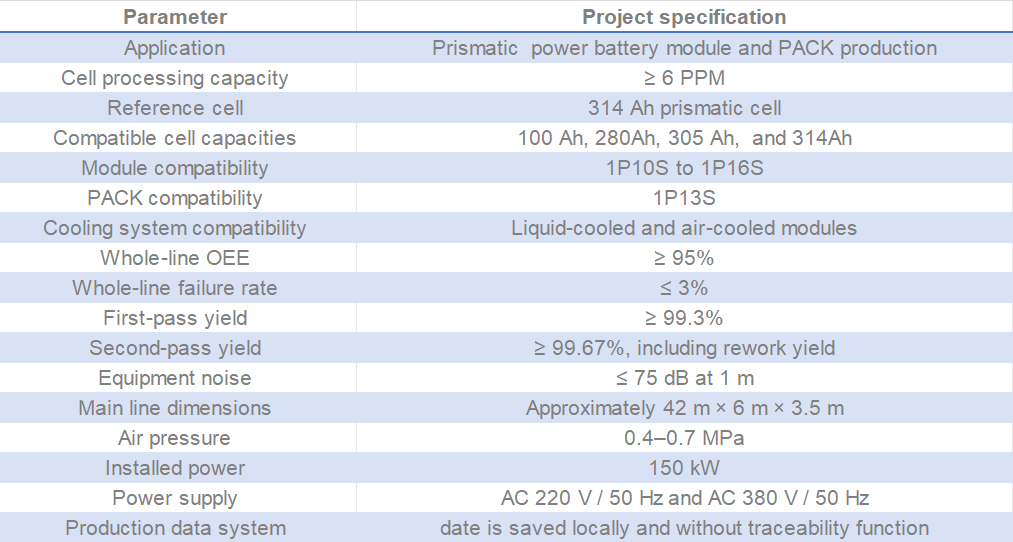
Key specifications: The line is designed for ≥6 PPM cell processing, with compatibility for100 Ah, 280 Ah, 305 Ah, and 314 Ah prismatic cells. It supports 1P13S modules, with a whole-line OEE of ≥95%.
Equipment layout

2D layout plan
Production flow chart
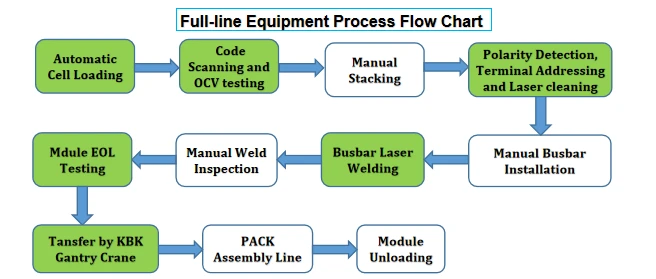
The production line is divided into three interconnected sections: cell processing, module assembly and welding, and PACK assembly.

Production line features
1. Throughput was matched to actual demand.
The ≥6 PPM capacity was selected according to the customer's production requirement rather than an unnecessary higher nominal output.
2. Automation was concentrated on critical processes.
Robot handling, inspection, positioning, cleaning, welding and EOL Testing were automated, while selected assembly operations remained manual.
3. Three processes were integrated into one workstation.
Polarity inspection, terminal positioning and laser cleaning were combined because the required throughput allowed these processes to share one station, reducing equipment count and investment.
4. The data architecture remains upgradeable.
The current project uses local data storage without a full MES platform, while reserving communication interfaces for future integration.
Together, these decisions create a production line designed around the customer's actual manufacturing requirements rather than a standardized maximum-automation configuration.
Frequently asked questions
1.What is the production capacity of this power battery module line?
The specified cell processing capacity is at least 6 PPM. The capacity was selected according to the customer's planned production volume rather than by maximizing the nominal throughput of the equipment.
2.Why is the production rate not designed higher?
A higher production rate would require additional equipment and automation that were not necessary for this project's planned output. The line was therefore optimized around production demand and investment efficiency.
3.Why are polarity inspection, terminal positioning and laser cleaning integrated into one station?
At the required throughput, the three consecutive processes can be completed within one workstation. Integrating them reduces the number of separate machines, equipment footprint and investment while still satisfying the required production capacity.
4.Is the production line fully automatic?
No. It uses right-sized automation. Quality-critical processes such as cell testing, polarity inspection, positioning, laser cleaning, laser welding and EOL Testing are automated, while selected assembly processes remain manual.
5.Does the production line use MES?
No full MES platform was deployed for the current project. Production and test data are stored locally.
6.Can MES be added later?
Yes. Data communication interfaces are reserved so that data transmission, export or future MES integration can be implemented according to later production requirements.
7.Which cells can the line support?
The project was designed around 280 Ah and 314 Ah reference cells and can support multiple prismatic cell capacities including 100 Ah, 280 Ah, 305 Ah and 314 Ah, subject to the final product dimensions and process requirements.
8.What information is required to design a similar production line?
To develop a customized proposal, the main inputs normally include cell type and dimensions, cell capacity, module configuration, target PPM, module and PACK drawings, required automation level, testing requirements, data traceability requirements and available factory layout.
9.How much automation is necessary for a 6 PPM battery module line?
It depends on labor cost, product structure, quality requirements and investment budget. In this project, automation was concentrated on handling, testing, positioning, cleaning and welding.
10.Can this production line be upgraded to higher automation later?
The line can reserve interfaces and equipment positions for future automation or data-system upgrades, subject to the final project design.
About Sunka Lead
Sunka Lead is the brand of Guangdong Songke Leading intelligent equipment Co., Ltd., a provider of lithium battery module and PACK production equipment and intelligent manufacturing solutions.
The company focuses on prismatic, cylindrical ,pouch and blade battery module and PACK production equipment and provides customized automated production line solutions for global battery and energy storage manufacturers.
Its solutions integrate technologies such as automated assembly, industrial robotics, machine vision, laser processing, AGV material handling, automated inspection and production data management.
Sunka Lead aims to help customers build more efficient, flexible and reliable lithium battery manufacturing systems.