
 English
 简体中文


Choosing the right battery cell sorting machine is essential for maintaining consistent cell quality before module and PACK assembly.
A suitable sorting machine should match the cell format, electrical testing requirements, sorting criteria and production-line capacity.
Selecting equipment based only on the number of sorting channels can lead to an unsuitable configuration. Manufacturers should evaluate the complete testing and sorting requirements before making a purchasing decision.
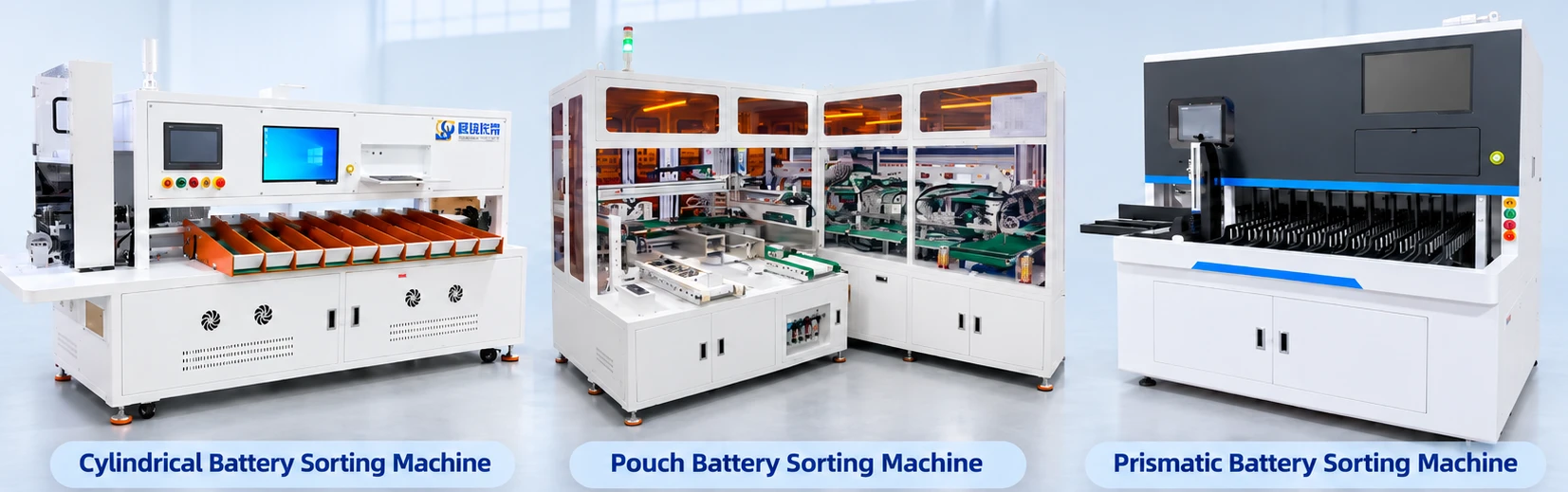
1. Confirm the Battery Cell Format
The first step is to identify the battery cell type and dimensions.
| Cell Type | Key Compatibility Information |
|---|---|
| Cylindrical Cells | Cell model, diameter, length and terminal orientation |
| Prismatic Cells | Cell length, width, height and terminal design |
| Pouch Cells | Cell dimensions, tab configuration and suitable handling fixtures |
A sorting machine designed for one cell format should not automatically be considered compatible with another.
Fixture design, feeding methods and positioning accuracy must be evaluated.
2. Understand the Required Testing Functions
Different sorting requirements involve different electrical testing methods.
| Testing Function | Purpose |
|---|---|
| OCV Testing | Measures open-circuit voltage |
| IR / ACIR Testing | Evaluates internal resistance using the specified test method |
| Capacity Grading | Classifies cells according to measured charge/discharge capacity |
| Barcode Identification | Associates cell identification with test results |
| NG Sorting | Separates cells outside the defined acceptance criteria |
An important distinction is that OCV and internal resistance sorting are not the same as battery capacity grading.
If your production process requires actual capacity classification, confirm whether the equipment includes the necessary charge/discharge testing functions.
3. How Many Sorting Channels Do You Need?
Sorting channel configuration should be evaluated according to the number of required grading levels and production throughput.
| Configuration | Selection Consideration |
|---|---|
| 5-Channel Sorter | Suitable when the required grading arrangement matches the available channel configuration |
| 10-Channel Sorter | Considered for production processes requiring more grading categories |
| 11-Channel Sorter | Used where the specified sorting arrangement requires additional channels |
One important purchasing detail is whether the quoted channel number represents accepted grading channels, receiving bins or total channels including NG handling.
The manufacturer should clarify this before quotation and technical confirmation.
4. Important Technical Parameters to Evaluate
| Parameter | Why It Matters |
|---|---|
| Cell Compatibility | Ensures the machine can handle the specified battery format |
| Voltage Measurement Range | Must match the cell electrical specifications |
| Resistance Measurement Range | Must match the required internal resistance test |
| Measurement Accuracy | Affects grading consistency |
| Sorting Throughput | Must match the upstream and downstream production capacity |
| NG Handling | Defines how nonconforming cells are separated |
| Barcode and Data Storage | Supports product identification and traceability |
| Line Integration | Determines whether the machine can operate independently or connect to the production line |
The actual test range, accuracy and throughput should be confirmed against the selected machine and agreed acceptance conditions.
5. Battery Cell Sorting Equipment from Sunka Lead
Sunka Lead's single-machine catalogue includes sorting equipment for cylindrical and prismatic lithium battery cells.
The product range includes:
| Equipment Type | Application |
|---|---|
| 5-Channel Cylindrical Battery Sorting Machine | Cylindrical cell classification |
| 11-Channel Cylindrical Battery OCV and IR Sorting Machine | Electrical testing and sorting |
| 10-Channel Prismatic Battery Sorting Machine | Prismatic cell classification |
The appropriate model depends on the battery format, required test functions, grading criteria and production requirements.
For integration projects, Sunka Lead can also evaluate the relationship between cell sorting, barcode identification, material handling and subsequent PACK assembly processes.
6. What Information Should You Send for a Quotation?
| Required Information | Purpose |
|---|---|
| Cell Model and Dimensions | Confirm mechanical compatibility |
| Required Test Functions | Define OCV, IR or capacity grading |
| Number of Sorting Grades | Determine channel configuration |
| Target Throughput | Match production demand |
| Barcode Requirements | Confirm identification and data handling |
| Standalone or In-Line Operation | Determine equipment integration scope |
FAQ
Is a 10-channel battery sorter always better than a 5-channel machine?
No. The correct choice depends on the required grading categories, NG handling, measurement performance and production volume.
Can a battery cell sorting machine be connected to an existing PACK line?
It may be possible. Conveyor arrangements, PLC signals, communication interfaces and data requirements must be confirmed during project evaluation.
Does an OCV and IR sorting machine perform battery capacity grading?
Not necessarily. Capacity grading requires appropriate charge/discharge testing functions. OCV and IR measurement alone do not establish actual capacity.
The right battery cell sorting machine should be selected according to cell compatibility, electrical testing requirements, sorting criteria and production-line integration.
Sunka Lead provides battery testing and sorting equipment for cylindrical and prismatic battery manufacturing, supporting both standalone equipment requirements and broader PACK production solutions.
About Sunka Lead
Sunka Lead is the international brand of Guangdong Songke Leading Intelligent Equipment Co., Ltd., specializing in lithium battery manufacturing equipment and turnkey automation solutions for battery module, PACK and Battery Energy Storage System (BESS) production.
Our solutions cover the cell-to-container manufacturing value chain — from cell testing and sorting to module and PACK assembly, laser welding, EOL Testing, and PACK-to-container integration, including automated BESS container assembly lines for commercial & industrial (C&I) and utility-scale energy storage applications.
For project inquiries, share your battery cell specifications, module/PACK drawings, BESS container requirements, target production capacity, automation level, and factory conditions. Sunka Lead develops customized production line solutions around your product architecture and manufacturing goals.