
 English
 简体中文


The best EV battery module assembly line is not necessarily the one with the highest automation level or the shortest advertised cycle time. It is the line that consistently meets the required production output, battery architecture, quality standards and manufacturing budget.
For EV battery manufacturers, selecting the right production line requires evaluating automation, cycle time, line balancing, welding quality, product flexibility and long-term operating efficiency together.
1. What Determines the Best EV Battery Module Assembly Line?
The first consideration should be the battery module design rather than the equipment list.
Different battery formats require different handling, positioning and joining processes.
| Battery Format | Typical Assembly Considerations | Automation Requirements |
|---|---|---|
| Prismatic Cells | Cell positioning, stacking, compression and busbar connections | Automated handling, stacking, welding and inspection |
| Cylindrical Cells | Cell orientation, bracket installation and multiple electrical connections | High-speed feeding, polarity inspection and welding |
| Pouch Cells | Tab positioning, stacking, insulation and connection | Flexible handling, tab processing and laser welding |
A suitable production line should be designed around cell dimensions, module configuration, terminal structure, connection method and required product changeover.
2. How Much Automation Is Actually Necessary?
Automation should be selected according to production volume, process repeatability, labor requirements and investment objectives.
| Automation Level | Typical Configuration | Suitable Applications |
|---|---|---|
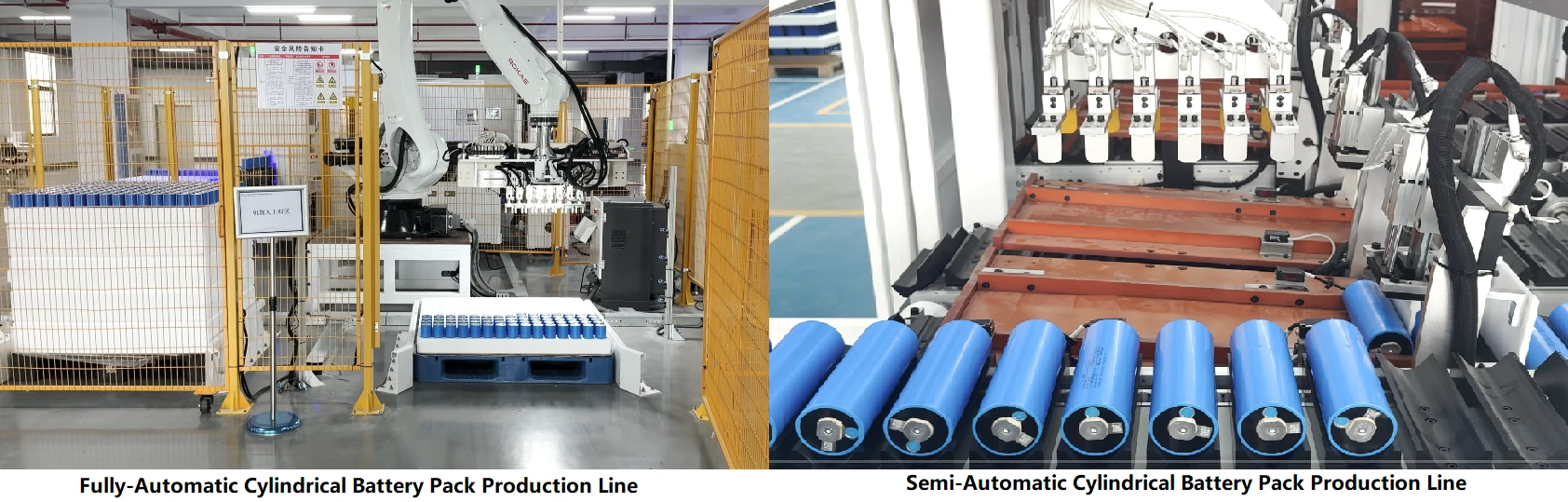
| Semi-Automatic | Automated testing and welding with operator-assisted assembly | Flexible production and multiple product models |
| Hybrid Automation | Automated feeding, handling, stacking and welding with selected manual operations | Medium-volume manufacturing |
| Fully Automatic | Integrated robotic handling, automated assembly, inspection and material transfer | High-volume and standardized production |
Fully automated systems can reduce manual handling and improve process consistency. However, they also require more sophisticated engineering, controls, maintenance and investment.
A hybrid configuration may offer a better balance when the battery design changes frequently.
3. Cycle Time vs. Takt Time: What Should Buyers Compare?
These two terms are often confused during equipment procurement.
| Metric | Definition | Why It Matters |
|---|---|---|
| Cycle Time | Time required for a workstation or process to complete one operating cycle | Measures process speed |
| Takt Time | Net available production time divided by required customer demand | Defines the production pace required |
| Line Throughput | Actual number of completed units produced within a given period | Measures production output |
| OEE | Overall Equipment Effectiveness | Evaluates availability, performance and quality |
For a single-stream workstation:
Theoretical hourly output = 3,600 ÷ bottleneck cycle time in seconds.
The overall line output is determined by the bottleneck process, not simply by the fastest individual machine.
Parallel workstations, buffer capacity, equipment downtime, changeover time and product quality must also be considered.
For reference, Bosch Manufacturing Solutions published one prismatic battery module assembly example with approximately 120 seconds per module and an annual output of 270 MWh. This is a specific configuration, not a universal industry benchmark.
4. Which Processes Should Be Automated?
A typical EV battery module assembly solution may include the following operations, depending on the battery architecture.
| Process | Main Function | Possible Automation |
|---|---|---|
| Cell Loading | Transfers cells into the production system | Robotic loading |
| Barcode Identification | Establishes product identity | Automatic scanning |
| OCV and IR Testing | Checks cell electrical characteristics | Automated testing |
| Cell Sorting | Groups cells according to defined criteria | Automatic sorting |
| Cell Stacking | Arranges cells into the module structure | Robotic stacking |
| Compression | Applies the specified assembly force | Automatic pressing |
| Terminal Positioning | Locates electrical connection points | Vision-assisted positioning |
| Laser Cleaning | Removes surface contamination before welding | Automated laser processing |
| Laser Welding | Connects tabs, terminals or busbars | Automated laser welding |
| Post-Weld Inspection | Checks welding quality | Visual inspection and testing |
| Electrical Testing | Verifies insulation and electrical performance | Automated inspection and EOL Testing |
Not every EV battery module line requires every operation. The final process flow must follow the actual product design.
5. How Should Buyers Evaluate Supplier Proposals?
A supplier quotation should contain more than a headline PPM figure.
| Evaluation Item | What Buyers Should Confirm |
|---|---|
| Product Compatibility | Cell format, dimensions and module configurations |
| Production Capacity | Rated output and actual accepted output |
| Cycle Time | Individual workstation and bottleneck cycle times |
| Automation | Automated, semi-automatic and manual operations |
| Changeover | Tooling, fixture replacement and model switching |
| Welding | Joint design, welding process and quality validation |
| Inspection | Electrical testing, visual inspection and traceability |
| OEE and Yield | Defined assumptions and acceptance criteria |
| Factory Requirements | Layout, power, compressed air and operating conditions |
| Future Expansion | Additional models and production capacity upgrades |
A technically attractive line may still be unsuitable if its bottleneck station cannot maintain the required production pace.
6. How Does Sunka Lead Approach Battery Module Automation?
Sunka Lead focuses on lithium battery module and PACK production equipment, serving energy storage and electric vehicle battery manufacturing applications.
Its engineering capabilities cover equipment integration, precision assembly, laser cleaning and welding, intelligent inspection, PLC control and MES-related production traceability.
The production solution can be configured according to:
Cell format and dimensional requirements.
Module architecture and electrical connection design.
Target production capacity and automation level.
Required welding, testing and inspection processes.
Factory layout and future product expansion.
Sunka Lead's published portfolio includes different prismatic, cylindrical and pouch battery production configurations. These demonstrate the importance of matching automation design to the actual battery format rather than applying one fixed cycle-time target to every project.
For EV-specific projects, the final cycle time and production capacity should be confirmed through product drawings, process evaluation and an approved technical proposal.
FAQ
Is a fully automatic EV battery module assembly line always better?
No. Fully automatic systems are suitable for stable, high-volume production, while hybrid and semi-automatic systems can provide greater flexibility and lower initial investment.
What determines the cycle time of a battery module assembly line?
The main factors include cell handling, stacking, compression, welding, fastening, inspection, workstation balancing and the number of parallel stations.
Can one battery module line manufacture different EV battery models?
It may be possible with suitable fixtures, tooling, process adjustments and changeover systems. Compatibility must be verified during engineering design.
What information should buyers provide when requesting a quotation?
Cell specifications, module drawings, electrical connection details, annual demand, target cycle time, quality requirements and factory layout are essential.
The best EV battery module assembly line is not defined by automation percentage alone.
It is defined by its ability to deliver the required production output, consistent assembly quality, flexible product compatibility and sustainable operating performance.
For manufacturers evaluating automation solutions, the most important step is to match the production line to the actual battery architecture and manufacturing objectives.