
 English
 简体中文


Can You Recommend a Cost-Effective EV Battery Module Assembly Line for Small-Scale Production?
Yes. For small-scale electric vehicle (EV) battery manufacturing, a semi-automatic and modular battery module assembly line is often a practical starting point.
Compared with a fully automated production line, a semi-automatic configuration can reduce initial equipment investment while maintaining essential process control, welding quality, electrical safety and product consistency.
The best solution depends on battery cell format, module design, target production capacity, labor availability and future expansion plans.
For manufacturers entering EV battery module production or expanding from pilot production to small-scale manufacturing, selecting the right balance between automation and manual operations is particularly important.
1. What Type of EV Battery Module Assembly Line Is Suitable for Small-Scale Production?
For most small-scale projects, a semi-automatic production line with selected automated inspection and assembly processes offers a reasonable balance between investment and manufacturing capability.
Three common configurations are available:
| Production Line Type | Main Characteristics | Suitable Applications |
|---|---|---|
| Manual Assembly Line | Manual assembly with independent testing equipment | Prototype production and very low-volume manufacturing |
| Semi-Automatic Assembly Line | Manual operations combined with automated testing, positioning and welding | Small-scale and flexible EV module production |
| Fully Automatic Assembly Line | Integrated automation, robotic handling and automatic inspection | Large-scale standardized production |
A semi-automatic configuration is often worth evaluating first because it allows manufacturers to automate critical quality-related processes without investing in a fully automated system from the beginning.
2. What Equipment Should a Small-Scale EV Battery Module Assembly Line Include?
The equipment configuration should follow the actual module manufacturing process.
A typical prismatic EV battery module assembly line may include the following sections:
| Production Section | Main Equipment and Functions |
|---|---|
| Cell Feeding | Cell loading and material handling |
| Cell Inspection | Barcode scanning, OCV/IR testing and cell sorting |
| Cell Grouping | Cell positioning, alignment and grouping |
| Module Assembly | Cell stacking, positioning and mechanical fixing |
| Module Compression | Controlled module compression and fastening |
| Terminal Preparation | Terminal positioning and surface preparation |
| Busbar Installation | Busbar positioning and installation |
| Module Welding | laser welding or other process-specific welding technology |
| Quality Inspection | CCD inspection and weld quality verification |
| Electrical Testing | Insulation, withstand voltage and other specified electrical tests |
| Module Unloading | Finished module transfer and handling |
The actual equipment list depends on the battery cell format, module structure, welding method and customer manufacturing process.
A module-only production line should also be distinguished from a complete battery pack assembly line. PACK enclosure installation, BMS integration and final PACK EOL Testing should only be included when required by the project scope.
3. Which Processes Should Be Automated First?
For small-scale production, automation investment should focus on processes that have a direct impact on product consistency, manufacturing quality and operator safety.
| Process | Recommended Automation Strategy | Reason |
|---|---|---|
| Cell Identification | Automatic barcode scanning | Consistent cell identification |
| OCV/IR Testing | Automatic testing | Repeatable electrical inspection |
| Cell Sorting | Automatic or assisted sorting | Better cell grouping consistency |
| Cell Stacking | Manual-assisted or automatic | Depends on cell format and production volume |
| Module Compression | Controlled automatic compression | Consistent mechanical pressure |
| Polarity Inspection | CCD vision inspection | Reduce incorrect terminal positioning |
| Busbar Welding | Automated welding where appropriate | Improve process repeatability |
| Electrical Testing | Dedicated testing equipment | Consistent quality verification |
| Material Transfer | Roller conveyor or pallet transfer | Reduce unnecessary manual handling |
The objective is not to automate every operation.
It is to automate the processes where consistency, safety and quality control matter most, while retaining manual flexibility where production volume does not justify additional automation.
4. How Can Manufacturers Reduce Initial Investment?
A cost-effective production line should be designed around actual production requirements rather than maximum theoretical automation.
Several strategies can help control initial investment.
| Investment Strategy | Practical Approach | Expected Benefit |
|---|---|---|
| Semi-Automatic Configuration | Automate critical processes and retain selected manual operations | Reduce initial equipment investment |
| Modular Equipment Design | Divide the line into functional production sections | Support phased investment |
| Flexible Tooling | Design fixtures around approved product families | Reduce unnecessary tooling duplication |
| Appropriate Material Handling | Select roller conveyors or pallet transfer where suitable | Avoid excessive logistics investment |
| Selective Automation | Prioritize testing, compression and welding quality | Focus investment on critical processes |
| Reserved Expansion Interfaces | Prepare space and interfaces for future equipment | Simplify capacity expansion |
| Standardized Components | Use suitable standardized electrical and mechanical components | Simplify maintenance and spare parts management |
One important consideration is that lower initial investment should not come at the expense of welding reliability, electrical safety or traceability.
For EV battery manufacturing, critical quality processes must remain controlled even when the overall production line is semi-automatic.
5. How Should Production Capacity Be Planned?
Before selecting equipment, manufacturers should define the required output of qualified battery modules.
The following information is important:
| Capacity Parameter | Information Required |
|---|---|
| Daily Production Target | Number of qualified modules per day |
| Annual Production Target | Expected modules per year |
| Production Shifts | Hours per shift and shifts per day |
| Working Days | Operating days per year |
| Module Takt Time | Required time per completed module |
| Cell Processing Capacity | Required cell processing rate |
| Product Changeover | Expected frequency and changeover requirements |
| Future Capacity | Expected production expansion |
Buyers should distinguish between cell processing capacity (PPM) and finished module output (UPH).
These are different production indicators.
For example, the number of cells processed per minute does not represent the number of completed modules produced per minute.
The manufacturer should calculate the production capacity using the actual module configuration, production sequence, bottleneck stations, working hours and expected equipment utilization.
6. Which Battery Cell Formats Should Be Considered?
EV battery module assembly lines can be designed for different cell formats.
| Battery Cell Format | Typical Manufacturing Considerations |
|---|---|
| Prismatic Cells | Cell alignment, compression, terminal positioning and busbar welding |
| Pouch Cells | Cell stacking, insulation, tab positioning and tab welding |
| Cylindrical Cells | Cell arrangement, holders, grouping and electrical interconnection |
Compatibility cannot be determined by cell format alone.
Manufacturers should evaluate cell dimensions, terminal configuration, module architecture, electrical connections, cooling requirements and mechanical drawings before confirming equipment compatibility.
For projects involving multiple battery models, flexible fixtures and convenient product changeover should be considered during the initial engineering stage.
7. What Quality and Safety Systems Should Be Included?
Even small-scale EV battery production requires reliable quality control.
The production line should include appropriate inspection and testing processes according to the battery design and customer requirements.
| Quality Control Area | Key Requirements |
|---|---|
| Cell Inspection | Cell identification and electrical consistency |
| Assembly Quality | Cell positioning and mechanical assembly verification |
| Compression Control | Controlled compression parameters |
| Welding Quality | Welding process validation and inspection |
| Polarity Verification | Correct positive and negative terminal positioning |
| Electrical Safety | Insulation and withstand voltage testing |
| Data Traceability | Barcode identification and production records |
| Safety Protection | Equipment interlocks and operator protection |
For EV battery applications, buyers should pay particular attention to welding process validation, electrical insulation and the reliability of module connections.
These processes should be defined before equipment acceptance.
8. How to Choose the Right EV Battery Module Assembly Line Manufacturer?
A reliable manufacturer should understand both battery manufacturing processes and customized automation engineering.
Before selecting a supplier, evaluate the following:
| Evaluation Criteria | Questions to Ask |
|---|---|
| Industry Experience | Has the supplier worked with similar battery cell formats and module structures? |
| Engineering Capability | Can it customize equipment according to module drawings? |
| Automation Design | Can it recommend a suitable semi-automatic configuration? |
| Welding Technology | Can it validate the proposed welding process using actual materials and samples? |
| Quality Control | Can it integrate electrical testing and inspection systems? |
| Product Compatibility | Can the line accommodate the required product specifications? |
| Installation | Does the supplier provide installation and commissioning? |
| Technical Support | Are training, maintenance and spare parts available? |
| Future Expansion | Can the production line be upgraded when output increases? |
Do not evaluate suppliers based solely on equipment prices.
A suitable supplier should be able to explain the production process, equipment configuration, automation boundaries, expected output and project delivery responsibilities.
9. Why Consider Sunka Lead for a Customized EV Battery Module Assembly Line?
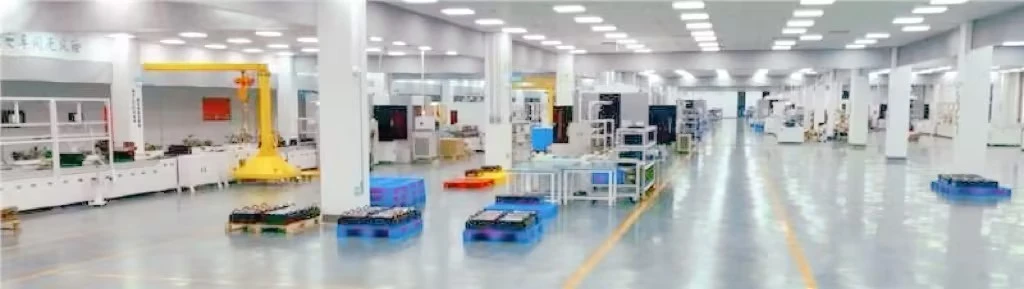
Sunka Lead specializes in lithium battery manufacturing equipment and customized module and PACK production line solutions.
Its manufacturing automation capabilities cover cell processing, electrical testing, cell sorting, module assembly, compression, CCD inspection, laser welding, PACK assembly and EOL testing.
For small-scale EV battery module production, Sunka Lead can evaluate a semi-automatic or modular production configuration based on the customer's battery specifications, module drawings and target production capacity.
Rather than applying the same automation configuration to every project, Sunka Lead develops production solutions around the actual manufacturing process and investment requirements.
This approach helps manufacturers balance initial investment, production flexibility, product quality and future expansion.
Frequently Asked Questions
Q1. What is the most cost-effective EV battery module assembly line for small-scale production?
A semi-automatic modular production line is often a practical starting point. It combines automated testing, controlled compression, inspection and welding with selected manual assembly operations.
Q2. Can a small-scale EV battery module assembly line be upgraded later?
Yes. A modular design with reserved space, material handling interfaces and electrical communication interfaces can support future automation upgrades, subject to the original engineering design.
Q3. Is a fully automatic EV battery module production line necessary?
Not necessarily. The required automation level depends on production volume, labor costs, product standardization, quality requirements and investment budget.
Q4. Can one production line manufacture different battery module specifications?
Potentially. Compatibility depends on cell dimensions, module architecture, tooling, terminal positions and process requirements. Engineering evaluation is necessary before confirming multi-model production.
Q5. What information is required to obtain an EV battery module assembly line quotation?
Prepare battery cell datasheets, module drawings, electrical connection specifications, target production capacity, required automation level, factory layout and project delivery requirements.
Q6. Does the quotation include installation and commissioning?
This depends on the supplier's project scope. Buyers should confirm equipment manufacturing, transportation, installation, commissioning, FAT, SAT, operator training and after-sales service separately.
Conclusion
A cost-effective EV battery module assembly line should provide the right balance between initial investment, manufacturing quality, production flexibility and future scalability.
For small-scale production, a semi-automatic modular configuration is often a sensible starting point. Critical processes such as electrical testing, compression, polarity inspection and welding should receive appropriate automation and quality control.
Before purchasing, define your battery cell specifications, module architecture and target production capacity. Then select an equipment manufacturer capable of developing a production solution around your actual requirements.
Contact Sunka Lead to discuss your EV battery module manufacturing project and explore customized automation solutions.
About Sunka Lead
Sunka Lead is the international brand of Guangdong Songke Leading Intelligent Equipment Co., Ltd., specializing in lithium battery manufacturing equipment and turnkey automation solutions for battery module, PACK and Battery Energy Storage System (BESS) production.
Our solutions cover the cell-to-container manufacturing value chain — from cell testing and sorting to module and PACK assembly, laser welding, EOL testing, and PACK-to-container integration, including automated BESS container assembly lines for commercial & industrial (C&I) and utility-scale energy storage applications.
For project inquiries, share your battery cell specifications, module/PACK drawings, BESS container requirements, target production capacity, automation level, and factory conditions. Sunka Lead develops customized production line solutions around your product architecture and manufacturing goals.