
 English
 简体中文
简体中文

Key stations in a prismatic battery PACK production line: cell sorting, stacking and compression, and leak testing/from Sunka Lead
A prismatic battery module and PACK production line typically includes cell loading, barcode scanning, OCV testing, cell sorting, module stacking, compression, laser cleaning, CCS installation, laser welding, PACK assembly, leak testing, and EOL Testing.
Among these processes, cell sorting, stacking and compression, and leak testing are three critical quality-control stages. They directly affect cell consistency, module assembly accuracy, and PACK sealing reliability.
1. Cell sorting: ensuring cell consistency
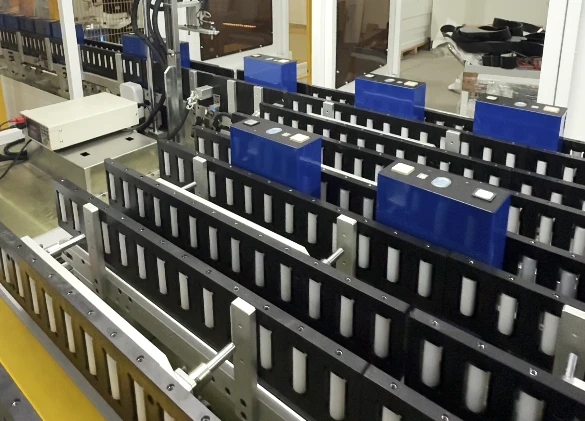
A battery PACK consists of multiple cells working together. Significant differences in voltage, internal resistance, or other key parameters can affect the consistency and performance of the finished module or PACK.
Before assembly, cells therefore typically undergo barcode scanning, OCV testing, polarity inspection, and other required checks.
| Inspection item | Main purpose |
Barcode scanning | Identifies each cell and links production data |
OCV testing | Measures open-circuit voltage |
Internal resistance testing | Evaluates electrical consistency between cells |
Polarity inspection | Confirms correct positive and negative terminal orientation |
Data binding | Establishes production traceability records |
In Sunka Lead prismatic battery module and PACK production lines, automatic cell loading, barcode scanning, OCV testing, and cell identification stations can be configured according to project requirements.
The purpose is to identify abnormal cells as early as possible in the production process and reduce the risk of rework at later assembly stages.
2. Stacking and compression: controlling module structure and dimensions
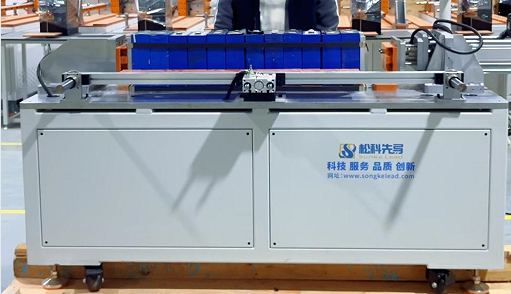
After inspection, qualified prismatic cells are arranged and stacked according to the specified module configuration.
Automated stacking involves more than simply placing cells side by side. The system must also control:
Cell position
Polarity orientation
Cell spacing
Insulation component placement
Module dimensions
Positioning accuracy for subsequent CCS installation and welding
After stacking, the module typically undergoes compression or dimensional forming.
In simple terms:
Stacking determines how the cells are arranged, while compression ensures that the assembled cells form a stable module with the required dimensions.
Compression force and final module dimensions must be defined according to the cell specification and module design. Insufficient pressure may affect structural stability, while improper pressure control may influence downstream assembly quality.
Sunka Lead can configure robotic stacking, module compression, and dedicated tooling according to cell dimensions, module structure, target throughput, and automation requirements.
3. Leak testing: verifying PACK sealing reliability
At the PACK assembly stage, leak testing is used to verify the sealing integrity of components such as the PACK enclosure, liquid-cooling plate, or cooling circuit.
Typical test objects include:
Liquid-cooling plates
Cooling pipelines
PACK enclosures
Seals and interface connections
Leak testing is commonly performed by pressurizing the component, holding the pressure for a defined period, and monitoring pressure variation or leakage rate.
Test pressure, allowable leakage rate, and test duration should be defined according to the specific product design and process requirements rather than applying one universal standard to all PACKs.
For liquid-cooled energy storage PACKs and EV battery PACKs, leak testing is an important quality-control process for ensuring the reliability of both the thermal management system and the PACK enclosure.
4. What does each station control?
| Station | Main control object | Core function |
Cell sorting | Individual cells | Controls cell consistency |
Stacking and compression | Battery module | Controls module dimensions and assembly condition |
Leak testing | PACK / liquid-cooling system | Detects sealing defects and leakage risks |
These three processes correspond to three different quality-control levels:
Cell quality → module assembly quality → PACK sealing reliability
5. Where are these stations located in the overall PACK production process?
A typical prismatic battery module and PACK production process may include:
Cell loading → barcode scanning → OCV testing → cell sorting → polarity inspection → cell stacking → module compression → laser cleaning → CCS installation → laser welding → module testing → PACK assembly → leak testing → EOL testing → finished product unloading
The exact station configuration and process sequence may vary depending on cell dimensions, module structure, PACK design, target throughput, and required level of automation.
For this reason, a prismatic battery pack production line is not simply a combination of standard machines. It is a customized manufacturing system designed around the customer's actual product and production requirements.
Sunka Lead prismatic battery module and PACK production lines
Sunka Lead specializes in lithium battery module and PACK production equipment and automated production line solutions.
For prismatic battery projects, the production line can be configured according to the customer's cell specifications, module structure, PACK design, target capacity, and automation requirements.
Available processes and systems can include:
Automatic or manual cell loading
Barcode scanning and OCV testing
Polarity inspection
Cell stacking and module compression
CCD vision positioning
Laser cleaning
CCS installation
Laser welding
AGV material handling
PACK assembly
Leak testing
EOL testing
MES-based production data traceability
For high-volume production with relatively stable product specifications, the system can be designed with a higher level of automation and optimized cycle time.
For multi-product manufacturing with frequent model changeovers, greater flexibility can be achieved through modular stations, replaceable tooling, and recipe-based production management.
FAQ
Why is cell sorting required before prismatic battery pack assembly?
Cell sorting is used to confirm whether cell voltage, internal resistance, and other key parameters meet production requirements. Detecting abnormal cells at an early stage helps reduce the risk of rework during module and PACK assembly.
Why are prismatic cells compressed after stacking?
Compression helps the module achieve the required dimensions and assembly condition while maintaining structural stability. It also provides a more consistent basis for subsequent CCS installation, welding, and module assembly.
What is typically checked during PACK leak testing?
Common test objects include the PACK enclosure, liquid-cooling plate, and cooling circuit. The purpose is to identify sealing defects and potential leakage risks.
Does a prismatic battery PACK production line need to be fully automated?
Not necessarily. The appropriate level of automation should be determined according to production capacity, product variety, changeover frequency, labor cost, process requirements, and investment budget.
Can one PACK production line support prismatic cells with different capacities?
Yes, a production line can be designed for flexible compatibility. However, compatibility depends not only on cell capacity but also on cell dimensions, weight, terminal position, module structure, gripping system, tooling, and downstream assembly processes.
Cell sorting, stacking and compression, and leak testing represent only part of a prismatic battery PACK production line, but they play a critical role in controlling cell consistency, module assembly stability, and PACK sealing reliability.
A high-quality PACK production line is not simply a collection of machines. Its real value lies in matching product design, manufacturing processes, automation level, and target production capacity.
By integrating automated assembly, industrial robotics, machine vision, laser processing, AGV material handling, automated inspection, and production data management, Sunka Lead provides customized prismatic battery module and PACK production line solutions for different cell formats, product structures, capacities, and automation requirements.
About the solution provider
Sunka Lead is the brand of Guangdong Songke Leading intelligent equipment Co., Ltd., a provider of lithium battery module and PACK production equipment and intelligent manufacturing solutions.
The company focuses on prismatic, cylindrical ,pouch and blade battery module and PACK production equipment and provides customized automated production line solutions for global battery and energy storage manufacturers.
Its solutions integrate technologies such as automated assembly, industrial robotics, machine vision, laser processing, AGV material handling, automated inspection and production data management.
Sunka Lead aims to help customers build more efficient, flexible and reliable lithium battery manufacturing systems.