
 English
 简体中文
简体中文

The specified cell processing capacity is at least 8 PPM. In this project, PPM refers to battery cell processing throughput rather than eight finished battery PACKs per minute.
A 314 Ah prismatic LFP cell is used as the reference product, while the production line is designed to support multiple energy storage cell capacities ranging from 280 Ah to 688 Ah.
The solution combines automated cell loading, barcode identification, OCV testing, polarity detection, module assembly, CCD positioning, laser cleaning, CCS laser welding, air leak testing, EOL Testing and MES-based production traceability.
Key project specifications
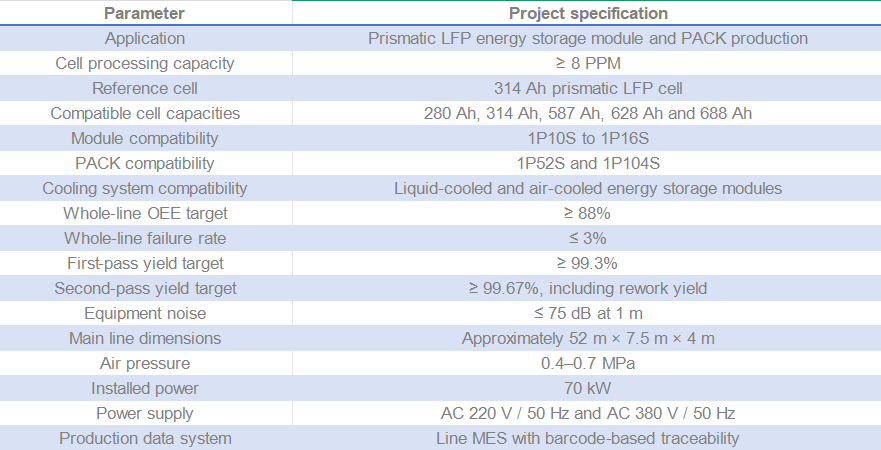
Key specifications: The line is designed for ≥8 PPM cell processing, with compatibility for 280 Ah, 314 Ah, 587 Ah, 628 Ah and 688 Ah prismatic LFP cells. It supports 1P10S–1P16S modules and 1P52S / 1P104S energy storage PACK configurations, with a whole-line OEE target of ≥88%.
Equipment layout
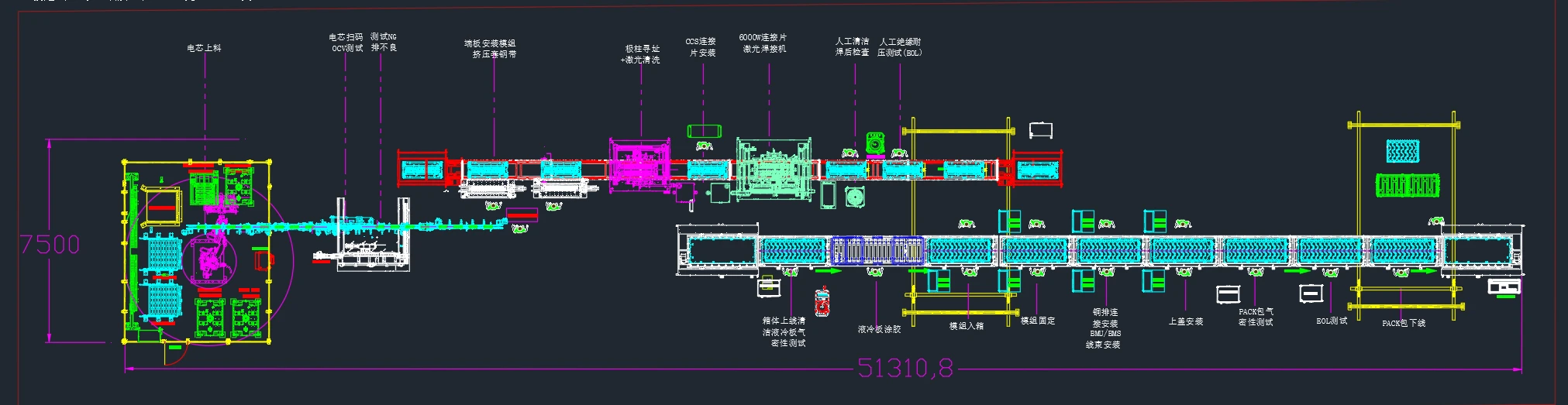
2D layout plan
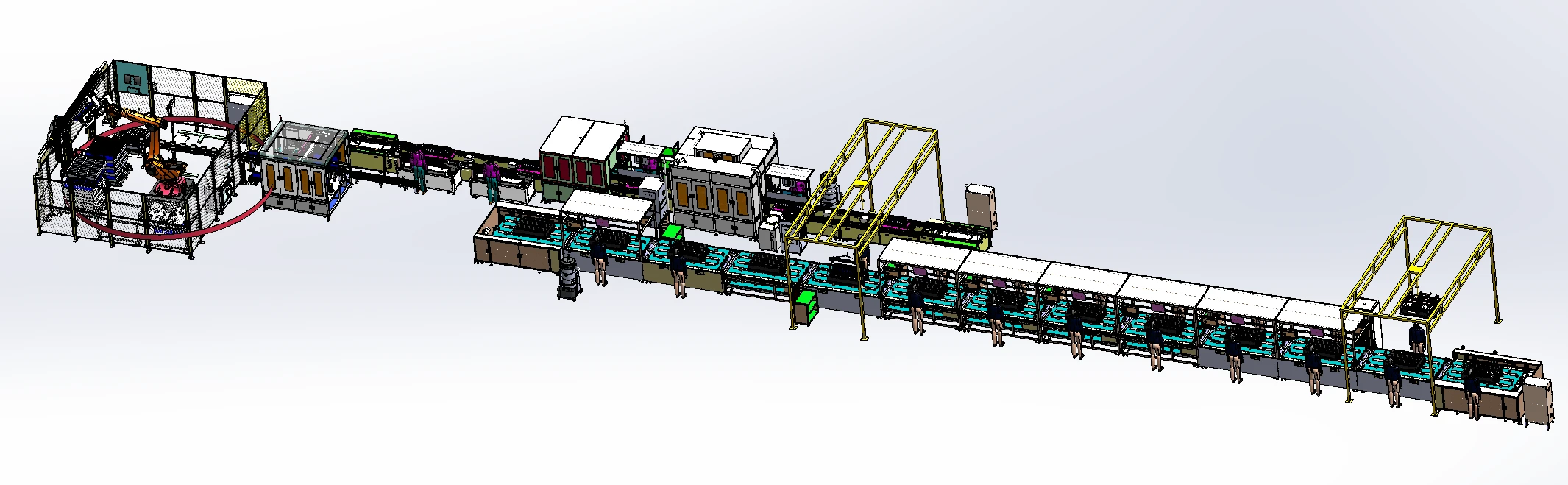
3D whole-line layout plan
Production flow chart
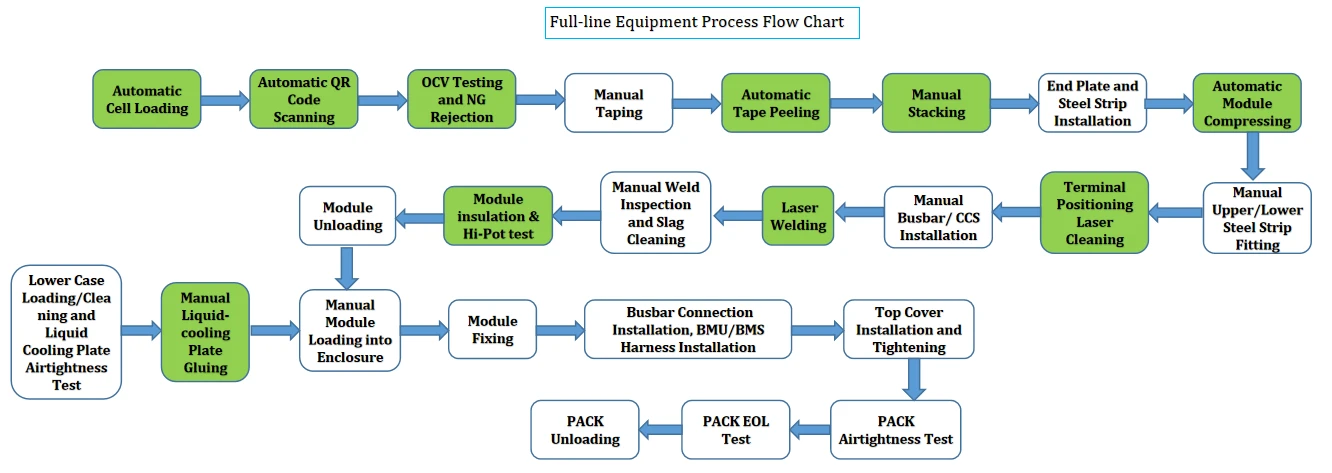
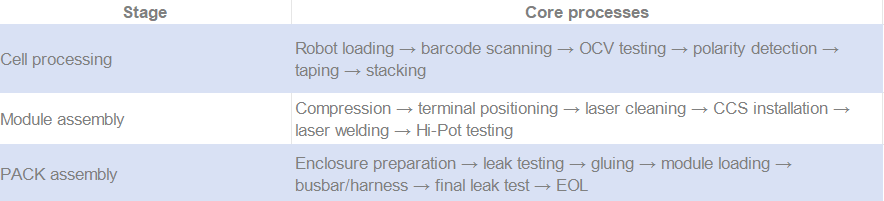
The production line is divided into three interconnected sections: cell processing, module assembly and welding, and PACK assembly.
Production line features
Cell-to-PACK MES traceability
The line supports barcode-based traceability from individual cells to modules and finished PACKs through the line MES.
Cell level: barcode + OCV + internal resistance data
Module level: cell binding + process + testing records
PACK level: module binding + air leak + EOL test data
Data can be stored locally and integrated with the customer's MES
This structure makes it possible to trace production information through product and material barcodes and provides a foundation for integration with the customer's factory-level manufacturing management system.
Compatible cells, modules and PACK configurations
A major design requirement of this project is product compatibility.
The reference product uses 314 Ah prismatic lithium iron phosphate cells, but the production line is designed to support 280 Ah, 314 Ah, 587 Ah, 628 Ah and 688 Ah prismatic energy storage cells.
Module configurations from 1P10S to 1P16S are supported.
At PACK level, the solution is designed for 1P52S and 1P104S configurations and can be adapted to both liquid-cooled and air-cooled energy storage module applications.
This allows manufacturers producing different energy storage platforms to use a common production-line architecture while adapting tooling and process parameters to the target product.
Roller conveyor and material handling system
The PACK production section uses a segmented roller conveyor architecture for product transfer between assembly stations.
Stations can be configured with independent conveying power, stopper mechanisms and manual or automatic control.
This structure allows individual assembly and testing operations to be integrated into one controlled production flow while maintaining station-level operating flexibility.
Carrier transfer, barcode identification and workstation control also provide the physical foundation for linking production equipment with the MES traceability system.
Turnkey battery PACK production line project scope
The project scope covers more than individual machines.
The complete solution includes production-line design, manufacturing, software and hardware integration, transportation, installation, commissioning, operator training, handover, acceptance support, equipment quality assurance and after-sales technical service.
This allows the equipment supplier and battery manufacturer to coordinate the complete project from product process requirements through final production-line commissioning.
Frequently asked questions
1.What type of battery is this 8 PPM PACK production line designed for?
The production line is designed for prismatic lithium iron phosphate energy storage battery cells, modules and PACKs.
2.Which prismatic battery cells are compatible with the line?
The specified compatibility range covers 280 Ah, 314 Ah, 587 Ah, 628 Ah and 688 Ah prismatic LFP energy storage cells, with 314 Ah used as the reference product.
3.Does 8 PPM mean eight finished battery PACKs per minute?
No. In this project specification, the ≥8 PPM capacity refers to battery cell processing throughput. Final module and PACK output depends on product configuration, process time and individual workstation takt time.
4.Which module configurations can be produced?
The production line is designed to support energy storagemodule configurations from 1P10S to 1P16S.
5.What production processes are included?
The battery cell processing section covers battery cell loading, barcode scanning, OCV testing (voltage, internal resistance, K value, and grade comparison), polarity detection, polarity flipping, and taping;
The module welding section covers battery cell stacking, steel strip pre-embedding, end plate installation, module compression and steel strip installation, terminal positioning, laser cleaning, manual CCS installation, CCS laser welding, sampling wire welding, post-welding inspection, dielectric withstand voltage test (Hi-Pot test), and module unloading.
The PACK assembly section covers PACK enclosure cleaning before loading, liquid-cooling plate air leak testing, automatic enclosure gluing, accessory installation, module loading into the enclosure, module fixing, copper busbar installation, BMU harness installation, cover installation, complete PACK air leak testing, PACK EOL testing, DCIR testing, and PACK unloading.
6.Does the production line include laser welding?
Yes. The module section includes terminal positioning, laser cleaning, CCS installation and 6,000 W laser welding. The welding system uses upstream positioning data to guide the welding process.
7.Does the production line support MES traceability?
Yes. Barcode-based production information can be associated with cell test data, module process records and PACK testing information. The line MES also reserves interfaces for integration with higher-level customer systems.
8.What final tests are included before PACK unloading?
The process includes complete PACK air leak testing and EOL testing. The EOL system can communicate through RS232, RS485, CAN and CAN FD and can upload test information to MES.
About the solution provider
Sunka Lead is the brand of Guangdong Songke Leading intelligent equipment Co., Ltd., a provider of lithium battery module and PACK production equipment and intelligent manufacturing solutions.
The company focuses on prismatic, cylindrical ,pouch and blade battery module and PACK production equipment and provides customized automated production line solutions for global battery and energy storage manufacturers.
Its solutions integrate technologies such as automated assembly, industrial robotics, machine vision, laser processing, AGV material handling, automated inspection and production data management.
Sunka Lead aims to help customers build more efficient, flexible and reliable lithium battery manufacturing systems.