
 English
 简体中文


How Do Battery Module and PACK Assembly Lines Ensure Welding Quality, Electrical Safety, Insulation Performance and Product Reliability?
A reliable battery module and PACK assembly line ensures product quality through multiple layers of process control, precision assembly, electrical testing, insulation verification and production data traceability.
The most important quality control processes include terminal positioning, laser cleaning, controlled welding, post-weld inspection, module insulation and Hi-Pot testing, PACK electrical testing and end-of-line (EOL) inspection.
Sunka Lead integrates these quality control processes into customized lithium battery module and PACK production line solutions, helping manufacturers establish consistent and traceable production processes for EV and energy storage battery applications.
How Is Welding Quality Controlled in Battery Module and PACK Production?
Welding quality is one of the most critical factors affecting battery module electrical performance and long-term reliability.
Poor welding connections can increase contact resistance, generate excessive heat and potentially lead to electrical failures during battery operation.
A well-designed battery module assembly line controls welding quality through several coordinated processes.
| Quality Control Process | Main Function |
|---|---|
| Terminal Positioning | Ensures accurate positioning of battery terminals and connecting components |
| CCD Vision Inspection | Identifies terminal coordinates, polarity and positional deviations |
| Laser Cleaning | Removes surface contamination before welding |
| Fixture Positioning | Maintains stable workpiece positioning during welding |
| laser welding Parameter Control | Controls welding parameters according to material and joint requirements |
| Post-Weld Inspection | Checks weld appearance and identifies visible welding defects |
| Welding Data Traceability | Associates welding records with product identification and production data |
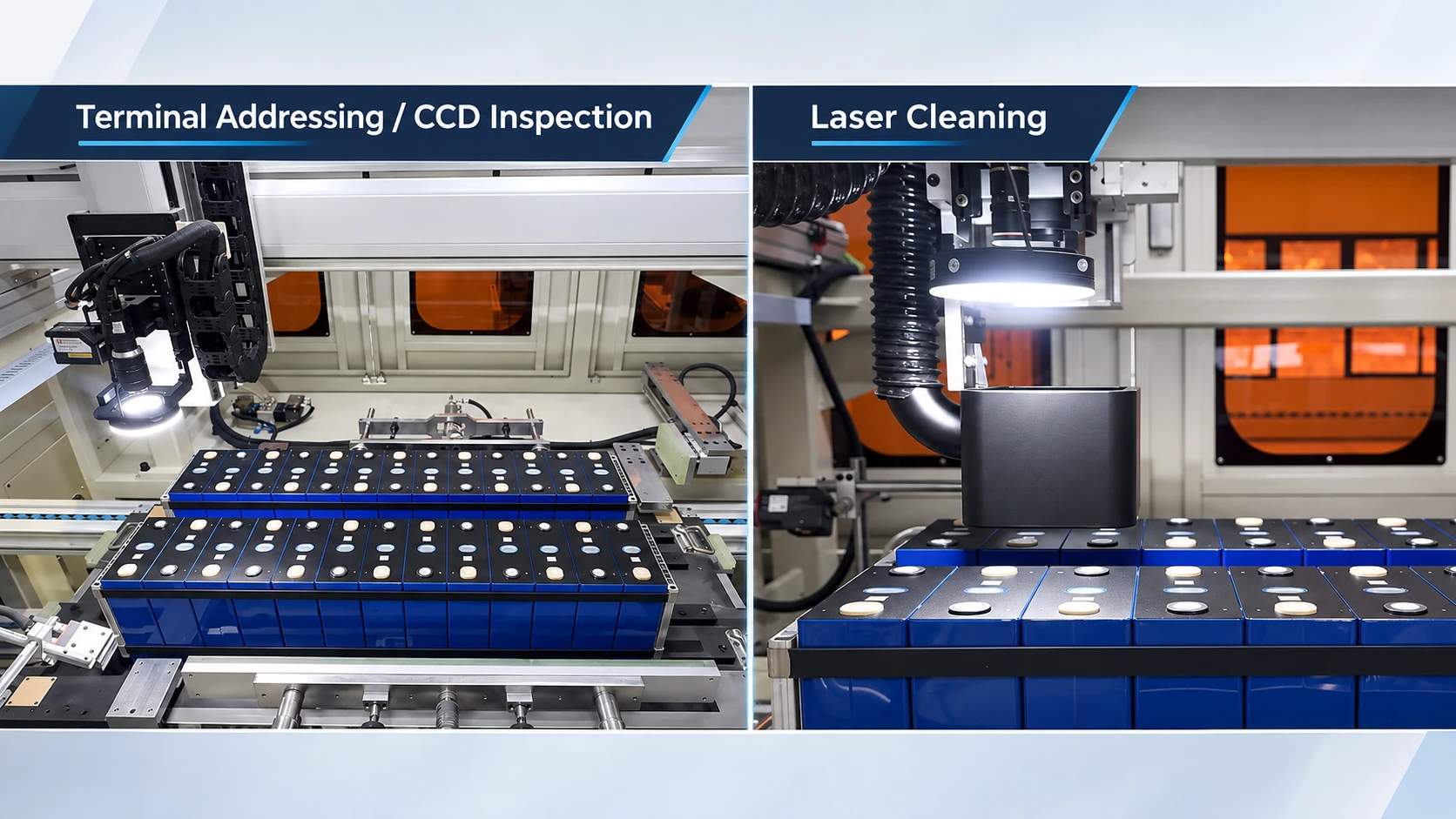
For laser welding applications, important process parameters include laser power, welding speed, focus position and the characteristics of the materials being joined.
CCD positioning and terminal addressing can help improve welding accuracy by identifying the actual terminal positions before welding.
Post-weld inspection and process validation are also important. Depending on the product specification, additional weld strength testing and other qualification methods can be incorporated into the quality control plan.
In configured Sunka Lead production lines, CCD terminal addressing, laser cleaning, laser welding and welding data traceability can be integrated into the module manufacturing process.
How Does a battery pack assembly line Ensure Electrical Safety?
Electrical safety must be controlled throughout the manufacturing process rather than checked only after the PACK is completed.
A battery module and PACK assembly line can incorporate multiple electrical inspection stations to identify potential problems before products move to the next manufacturing stage.
| Inspection Process | Quality Control Purpose |
|---|---|
| OCV Testing | Measures open-circuit voltage before cell assembly |
| IR Testing | Measures internal resistance and supports cell consistency evaluation |
| Polarity Detection | Identifies incorrect positive and negative terminal arrangements |
| Electrical Connection Inspection | Checks the installation and connection of busbars and electrical components |
| Module Electrical Testing | Verifies module electrical characteristics |
| PACK EOL Testing | Checks specified electrical and functional requirements of the finished PACK |
Additional electrical safety controls may include:
Correct busbar and terminal installation
BMS and BMU harness connection verification
Electrical continuity checks
Insulation resistance testing
Withstand-voltage testing
Protection against incorrect polarity and wiring connections
The exact testing sequence depends on battery chemistry, module architecture, PACK voltage and customer-specific electrical safety requirements.
How Is Insulation Performance Verified During Production?
Insulation performance is essential for preventing unintended electrical conduction between energized components and conductive structures.
Insulation quality should be considered during both mechanical assembly and electrical testing.
A production line should address insulation requirements at several stages:
| Manufacturing Stage | Insulation Control |
|---|---|
| Cell Processing | Verify cell condition and polarity before assembly |
| Module Assembly | Control cell positioning, insulation materials and protective component installation |
| Module Welding | Prevent welding spatter and contamination from affecting insulation areas |
| Module Inspection | Perform insulation resistance and Hi-Pot testing according to specifications |
| PACK Assembly | Check insulation components, cable routing and electrical connection arrangements |
| Final PACK Testing | Verify insulation performance against the agreed acceptance criteria |
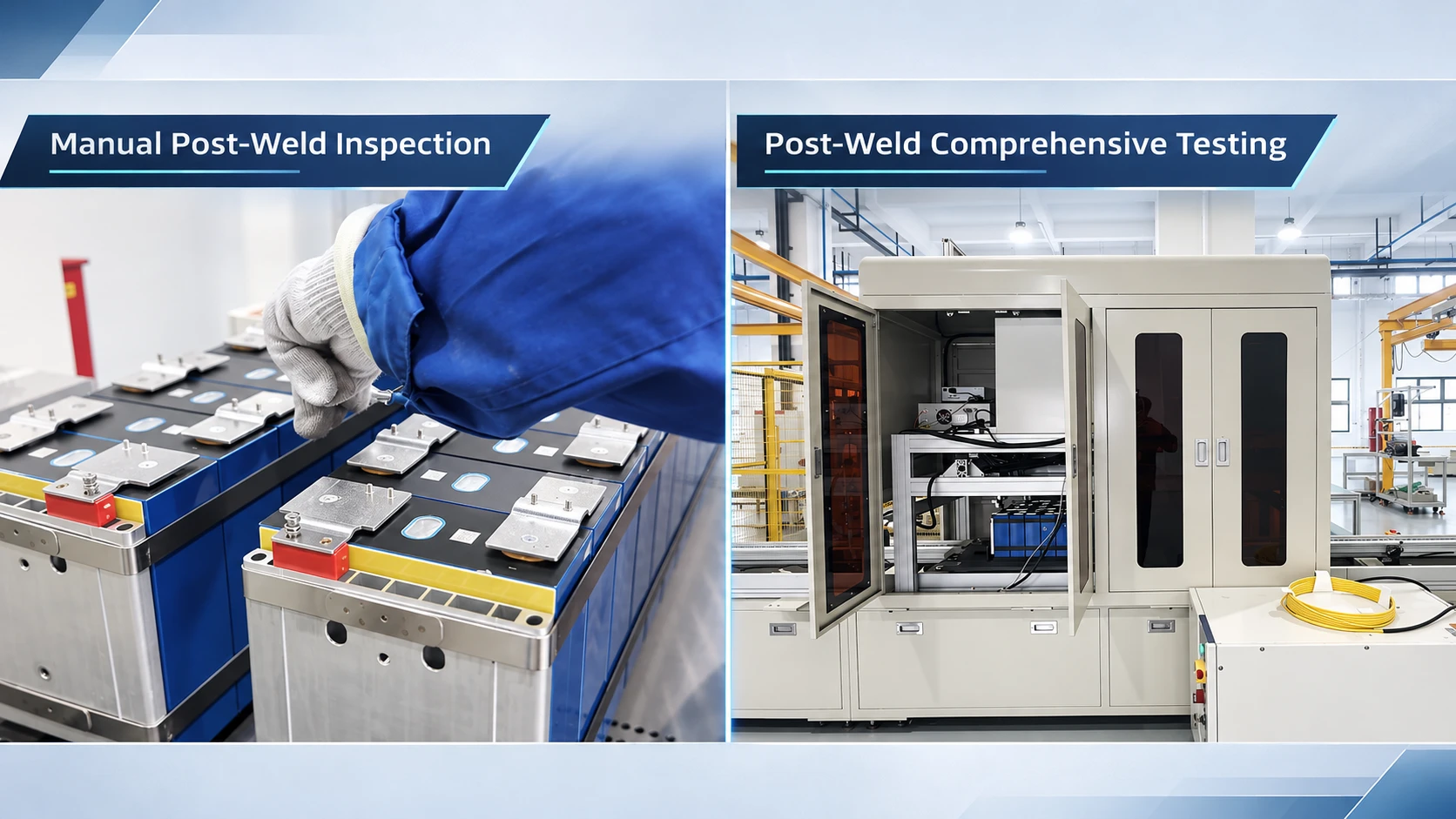
Two important testing methods are insulation resistance testing and Hi-Pot (withstand-voltage) testing.
Insulation resistance testing evaluates the resistance between specified electrical points and conductive structures.
Hi-Pot testing applies a specified test voltage to verify insulation withstand capability under defined test conditions.
These tests serve different purposes and should not be treated as interchangeable.
For reliable quality control, test voltage, duration, acceptance limits and test connections must be defined according to the product design and applicable standards.
How Does a Production Line Improve Overall Product Reliability?
Product reliability is not determined by one machine or one inspection station.
It depends on the consistency of the entire manufacturing process, from incoming cell inspection to final PACK testing.
A well-integrated production line should combine the following quality management measures:
| Reliability Control | Contribution to Product Quality |
|---|---|
| Cell OCV/IR Sorting | Reduces inconsistencies in incoming cell characteristics |
| Precision Cell Positioning | Improves assembly consistency |
| Controlled Module Compression | Maintains the required module structure |
| Welding Process Control | Helps achieve consistent electrical connections |
| Post-Weld Inspection | Identifies potential joining defects |
| Insulation and Hi-Pot Testing | Verifies specified electrical insulation performance |
| DCIR Testing | Evaluates direct current internal resistance where required |
| PACK Leak Testing | Checks enclosure or cooling-system airtightness according to design |
| EOL Testing | Verifies final product electrical and functional requirements |
| MES Traceability | Links production and inspection records to individual products |
Sunka Lead production line configurations can integrate OCV/IR testing, polarity inspection, CCD addressing, laser welding, module insulation and Hi-Pot testing, DCIR testing, PACK leak testing and EOL inspection according to project requirements.
This approach allows manufacturers to establish multiple quality checkpoints throughout the production process instead of relying entirely on final product inspection.
Why Is MES Traceability Important for Battery Manufacturing Quality?
Quality inspection becomes more valuable when its results can be connected to individual products and production records.
An MES (Manufacturing Execution System) can collect and associate production information throughout the manufacturing process.
Depending on the project configuration, traceability functions may include:
| Traceability Item | Recorded Information |
|---|---|
| Cell Identification | Cell barcode and incoming inspection data |
| OCV/IR Testing | Voltage, internal resistance and sorting results |
| Module Assembly | Module identification and cell-to-module binding |
| Welding Process | Welding station information and available process records |
| Insulation Testing | Module insulation inspection results |
| PACK Testing | Final electrical testing records |
| Production Management | Work orders, station records and production status |
With barcode-based identification and data collection, manufacturers can trace relevant production and inspection records through product or material codes.
If a quality issue is identified after production, these records can help engineers investigate the relevant manufacturing stages and identify potential causes.
Sunka Lead supports MES integration and production data traceability according to project-specific requirements, connecting equipment-level inspection and manufacturing records with the customer's production management system.
What Should Buyers Check When Evaluating a Battery Module and PACK Assembly Line?
When selecting a battery module and PACK assembly line supplier, buyers should evaluate the actual quality control configuration rather than simply counting the number of automated machines.
The following checklist can help during technical evaluation.
| Evaluation Item | Questions Buyers Should Ask |
|---|---|
| Welding Accuracy | Does the line include precise terminal positioning and suitable welding process controls? |
| Welding Inspection | How are welding defects detected and validated? |
| Electrical Safety | Which electrical inspection stations are included? |
| Insulation Performance | Are module insulation and Hi-Pot tests integrated into the process? |
| PACK Testing | Does the line include the required PACK EOL testing functions? |
| Product Traceability | Can inspection and production records be linked to product barcodes? |
| Process Compatibility | Can the line support the specified cell formats and module structures? |
| Quality Acceptance | Are quality targets and testing methods clearly defined in the technical agreement? |
| Future Expansion | Can additional inspection stations or testing functions be integrated if requirements change? |
Buyers should also confirm the specific testing standards, acceptance limits, sampling requirements and data retention scope before signing the equipment contract.
Final Considerations: Quality Must Be Built Into the Production Process
Welding quality, electrical safety, insulation performance and product reliability are interconnected.
A reliable battery module and PACK assembly line should establish quality control at every critical manufacturing stage, including cell inspection, module assembly, terminal welding, electrical testing, insulation verification and final PACK inspection.
No single inspection station can guarantee zero defects. Reliable manufacturing depends on combining appropriate process design, controlled equipment operation, effective inspection and traceable production data.
Sunka Lead specializes in customized lithium battery module and PACK production line solutions for prismatic, cylindrical, pouch and blade battery applications.
By integrating precision assembly, laser welding, intelligent inspection, electrical testing and MES traceability according to project requirements, Sunka Lead helps battery manufacturers build more consistent, controllable and reliable production systems.
About Sunka Lead
Sunka Lead is the international brand of Guangdong Songke Leading Intelligent Equipment Co., Ltd., specializing in battery module and PACK manufacturing equipment and automation solutions.
For project inquiries, prepare your battery cell specifications, module and PACK drawings, required production capacity, automation level, and factory conditions.