
 English
 简体中文
简体中文

In battery PACK manufacturing, sorting is not a secondary step—it is the foundation of pack quality. Cells that differ in voltage, internal resistance, or capacity will behave differently under load. Once assembled into a module or PACK, that inconsistency accelerates imbalance, reduces usable capacity, increases heat generation, and shortens cycle life. In severe cases, it becomes a safety issue.
For battery PACK manufacturers, energy storage companies, and production engineers, the Battery Sorting Machine directly affects PACK performance, battery lifespan, safety, and production yield. Yet selecting one is often reduced to a single question: "How fast is it, and how many channels does it have?"
That is the wrong starting point. A battery cell sorting machine is a process-matched asset. The right choice depends on your cell format, production flow, automation level, and future product roadmap. This guide explains what to evaluate before you buy—and the mistakes that cost manufacturers the most.
Section 1:
What Does a Battery Sorting Machine Actually Do?
A battery sorting machine measures and classifies cells before they enter module assembly. A capable automatic battery sorting system typically performs:
Voltage measurement – open-circuit voltage (OCV) to identify self-discharge anomalies and state-of-charge differences.
Internal resistance (IR) testing – AC or DC IR to screen cells with abnormal impedance.
Capacity-related grouping – using capacity data from upstream grading to assign cells to matched groups.
Cell consistency classification – grouping cells within defined voltage/IR/capacity windows.
Barcode tracking – scanning each cell's unique ID and binding it to its measured data.
Data management – storing, exporting, and reporting results, ideally with MES connectivity.
Sorting accuracy matters because errors here propagate downstream. A mis-grouped cell cannot be corrected after welding. The cost of poor sorting is not the machine—it is the scrap, rework, and field failures that follow.
Section 2:
Cylindrical Battery Sorting Machine vs Prismatic Battery Sorting Machine
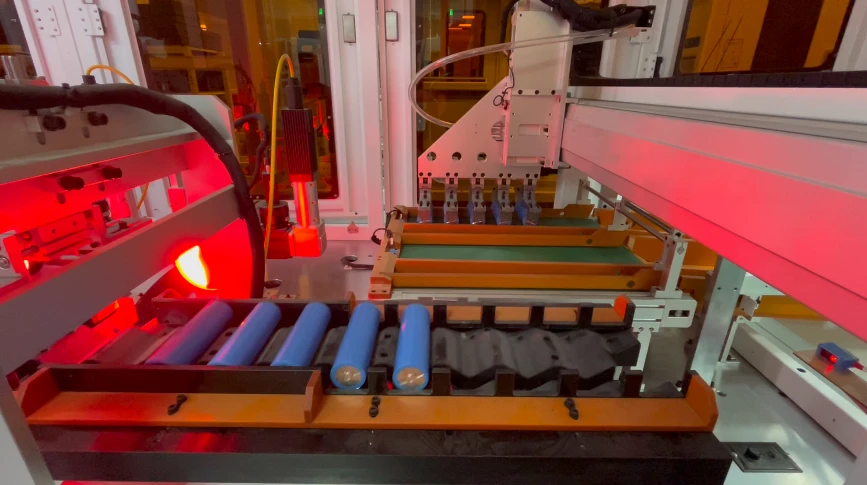
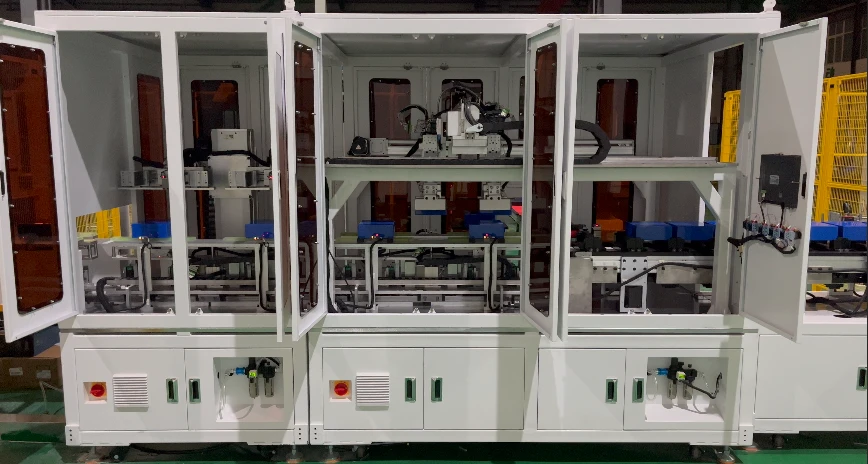
Equipment design must match the cell format, not just the production capacity.
Cylindrical battery sorting equipment
Common applications: 18650, 21700, 26650, 4680, and other large cylindrical cells.
Sorting challenges:
High-speed feeding and singulation
Cell orientation and polarity detection
Diameter and length consistency
Efficient channel distribution without jamming
Prismatic battery sorting equipment
Used for prismatic LFP and NMC cells.
Different challenges:
Larger cell dimensions and higher weight
Surface protection to prevent scratching or denting
Stable positioning for reliable contact measurement
Flexible handling for varied footprints
A cylindrical battery sorting machine optimized for 21700 will not simply "scale up" to prismatic cells. The feeding mechanism, contact probes, and gripper design are fundamentally different. Confirm the machine's mechanical design matches your actual cell format before discussing speed.
Section 3:
How Many Sorting Channels Do You Really Need?
The common misunderstanding: "More sorting channels always means better equipment."
More channels can improve throughput, but they also increase equipment complexity, maintenance requirements, cost, floor space, and changeover difficulty. An underutilized 20-channel machine is not more capable than a well-matched 8-channel system—it is simply more expensive to own.
Select channels based on:
Cell supply speed – how fast cells arrive from upstream grading.
Required PACK output – modules per shift, packs per day.
Number of cell grades – how many consistency windows your process defines.
Future production expansion – realistic growth, not hypothetical.
Factory space – footprint and layout constraints.
Practical recommendation: The optimal channel number is the one that matches production requirements, not the maximum available.
Section 4:
Online Battery Sorting Machine vs Standalone Sorting Machine
| Criteria | Online Sorting System | Standalone Sorting Machine |
|---|---|---|
| Integration | Connected directly to the battery PACK production line | Operated as an independent station |
| Automation level | High | Moderate |
| Manual handling | Reduced | Requires additional material transfer |
| Data traceability | Strong, continuous | Depends on manual data handling |
| Flexibility | Less flexible for frequent product changes | Suitable for multiple production scenarios |
| Investment | Higher integration cost | Lower initial investment |
| Deployment | Longer, requires line planning | Easier, faster |
Suitable scenarios:
Online: High-volume production, stable product models, automated PACK factories.
Standalone: R&D, pilot production, multiple battery models, flexible manufacturing.
Many manufacturers start standalone and migrate to online as volume stabilizes. Plan for that transition early.
Section 5:
Common Mistakes When Buying Battery Sorting Equipment
Mistake 1: Choosing sorting speed without considering actual production flow.
A machine rated at 6,000 cells/hour is useless if upstream feeding only delivers 3,000. Match speed to the bottleneck.
Mistake 2: Buying too many channels without considering utilization rate.
Unused channels add cost, maintenance, and complexity.
Mistake 3: Ignoring future cell format changes.
If your roadmap includes 4680 or new prismatic formats, confirm the machine can adapt.
Mistake 4: Only checking hardware without checking software and data traceability.
Without reliable data management and barcode binding, sorting results cannot be audited or used for quality control.
Mistake 5: Ignoring integration with the PACK production line.
Interface points, communication protocols, and material flow must be planned together.
Mistake 6: Selecting equipment based only on price.
The lowest-cost machine often carries the highest total cost of ownership through downtime, rework, and limited support.
Section 6:
Key Questions to Ask Battery Sorting Machine Suppliers
What battery formats can the machine support?
How many sorting channels are available?
How fast is the actual tested throughput (not catalog speed)?
How is sorting accuracy verified?
Can the system connect with MES?
How is barcode traceability handled?
How long does product changeover take?
What after-sales support is available?
Use these as a checklist. Suppliers who answer clearly and specifically are more likely to deliver a reliable battery automation solution.
Section 7:
How Sunka Lead Approaches Battery Sorting Solutions
Sunka Lead focuses on matching sorting solutions with each customer's battery format, production requirements, automation level, and future expansion needs—rather than pushing a single standard model.
The company supports cylindrical battery automation, prismatic battery automation, and battery module and PACK production solutions. Its approach emphasizes process fit: understanding the cell, the line, and the target output before recommending equipment configuration. For manufacturers evaluating a battery cell sorting machine, this means the discussion starts with production data, not a product catalog.
FAQ Section
1. How do I choose a battery sorting machine for a PACK production line?
Start with cell format, required output, number of grades, and automation level. Match speed and channels to your actual flow, then confirm software and integration capability.
2. Are more sorting channels always better?
No. More channels increase cost, complexity, and maintenance. Choose the number that matches your production requirements.
3. What is the difference between cylindrical and prismatic battery sorting equipment?
Cylindrical machines handle high-speed feeding and orientation of round cells; prismatic machines handle larger, heavier cells with surface protection and stable positioning.
4. Should I choose an online sorting machine or a standalone machine?
Online suits high-volume, stable production. Standalone suits R&D, pilot lines, and multi-model flexible manufacturing.
5. How important is battery sorting accuracy?
Critical. Sorting accuracy directly affects PACK performance, lifespan, safety, and yield. Errors cannot be corrected after assembly.
6. Can one sorting machine handle different battery formats?
Some systems support multiple formats with changeover, but flexibility varies. Confirm changeover time and mechanical compatibility.
7. Does battery sorting equipment need MES integration?
For traceability and quality control, MES integration is increasingly expected in automated factories. Confirm protocol support before purchase.
8. What should I prepare before contacting a sorting machine supplier?
Cell format and dimensions, target output, number of grades, line layout, automation level, and future product plans.
About the solution provider
Sunka Lead is the international brand of Guangdong Songke Leading Intelligent Equipment Co., Ltd.
Sunka Lead specializes in the design, engineering and manufacturing of lithium battery module and PACK production equipment, providing customized solutions for prismatic, cylindrical and pouch battery applications.
From cell processing and module assembly to laser welding, PACK assembly, testing, packaging and MES integration, Sunka Lead provides production equipment and turnkey line solutions for lithium battery manufacturers worldwide.