
 English
 简体中文


How Do You Choose a Pouch Cell Sorting Machine for Accurate OCV and IR Grading?
When selecting a pouch cell sorting machine, buyers should look beyond the number of sorting channels.
The real question is whether the system can deliver accurate measurement, reliable cell classification, efficient material handling, and complete data traceability.
Here are three critical areas worth evaluating.
1. Accurate OCV and IR Testing
Reliable sorting starts with reliable measurement.
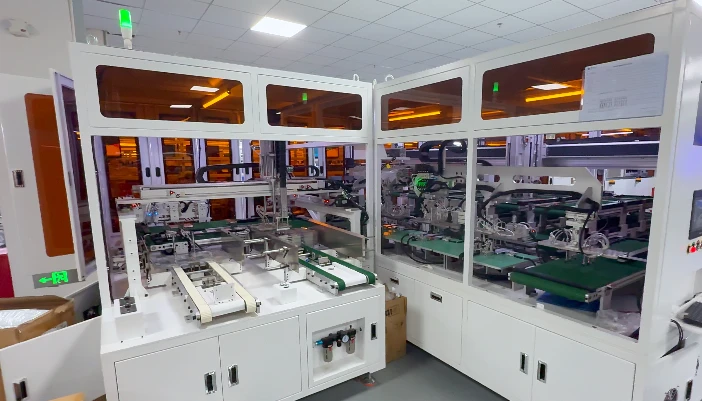
In this customized pouch cell production line, each cell undergoes barcode identification and OCV/IR testing.
Key testing specifications include:
Voltage accuracy: ±0.01% rdg ±5 dgt
Internal resistance accuracy: ±0.5% rdg ±5 dgt
Barcode identification linked to individual test results
Local storage of OCV/IR inspection data
The probe contact is designed to penetrate surface oxidation on cell terminals, helping reduce measurement errors and false grading.
2. Automatic Cell Sorting and NG Separation
After testing, cells are automatically transferred to their corresponding grading positions according to the measurement results.
Cells identified with voltage NG, IR NG, or barcode errors are directed to dedicated NG buffer positions.
This process helps maintain consistent cell classification and prevents nonconforming cells from entering downstream module assembly.
3. Multi-Channel Sorting and Buffer Configuration
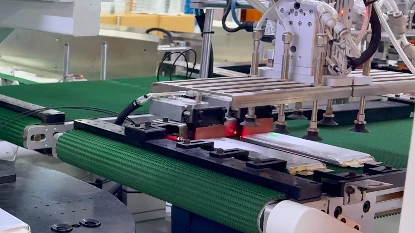
Channel configuration is another important factor in evaluating sorting efficiency.
This project features:
| Configuration | Project Specification |
|---|---|
| Sorting Channels | 10 |
| Buffer Capacity | Up to 8 cells per channel |
| Conveyor Arrangement | Two-level buffer conveyor |
| NG Handling | Dedicated NG buffer positions |
| Downstream Process | Automatic cell transfer to grouping |
The two-level conveyor arrangement helps optimize equipment footprint while providing structured cell buffering between sorting and downstream grouping.
An important distinction for buyers: Sorting channels are not necessarily the same as simultaneous testing channels. Channel quantity, buffer capacity and actual processing throughput should be evaluated separately.
What Should Buyers Verify Before Purchasing?
Before choosing a pouch cell sorting machine, confirm:
OCV/IR measurement accuracy and repeatability.
Compatibility with your pouch cell dimensions and terminal configuration.
Sorting criteria and NG handling logic.
Sorting channel quantity and buffer capacity.
Barcode-to-test-data traceability.
Integration with downstream module and PACK production processes.
How Does Sunka Lead Address These Requirements?
Sunka Lead integrates barcode identification, OCV/IR testing, automatic cell sorting, NG separation and multi-channel buffering into customized pouch cell module and PACK production line solutions.
Rather than evaluating each station independently, we focus on how testing, sorting and material handling work together within the complete production process.
Looking for a customized pouch cell sorting solution?
Share your cell specifications, grading requirements and production targets with Sunka Lead to discuss a suitable automation configuration.
About Sunka Lead
Sunka Lead is the international brand of Guangdong Songke Leading Intelligent Equipment Co., Ltd., specializing in lithium battery manufacturing equipment and turnkey automation solutions for battery module, PACK and Battery Energy Storage System (BESS) production.
Our solutions cover the cell-to-container manufacturing value chain — from cell testing and sorting to module and PACK assembly, laser welding, EOL Testing, and PACK-to-container integration, including automated BESS container assembly lines for commercial & industrial (C&I) and utility-scale energy storage applications.
For project inquiries, share your battery cell specifications, module/PACK drawings, BESS container requirements, target production capacity, automation level, and factory conditions. Sunka Lead develops customized production line solutions around your product architecture and manufacturing goals.