
 English
 简体中文


How to Plan Factory Layout, Utilities and Material Flow for a Battery PACK Line
Planning a lithium battery pack production facility requires more than selecting suitable production equipment. Factory layout, electrical capacity, compressed air supply, material handling, production flow, and data communication all play important roles in determining the efficiency and stability of the manufacturing operation.
For battery manufacturers planning a new energy storage production facility or expanding an existing factory, these factors should be evaluated before equipment installation begins.
An unsuitable factory layout can lead to unnecessary material transportation, production bottlenecks, inefficient space utilization, and difficulties with equipment maintenance.
A well-planned battery PACK production line should therefore integrate equipment configuration, manufacturing processes, logistics, utilities, and future expansion requirements into one coordinated production system.
This guide explains the key considerations when planning a factory layout for a lithium battery pack production line.
1. Define Your Battery Products and Production Requirements First
Before designing the factory layout, manufacturers should clearly define the battery products they intend to produce.
Different battery products require different production processes, equipment configurations, and factory space.
For example, a prismatic lithium battery PACK production line may be designed for:
Residential energy storage battery modules.
Commercial and industrial energy storage systems.
Large-capacity prismatic battery modules.
Liquid-cooled energy storage PACKs.
Air-cooled energy storage PACKs.
The following information should be confirmed during the initial planning stage.
Planning Parameter | Information Required |
|---|---|
Battery Cell Format | Prismatic, cylindrical, or pouch |
Battery Chemistry | LFP, NMC, or other lithium-ion chemistries |
Cell Capacity | Rated capacity in Ah |
Cell Dimensions | Length × Width × Height |
Module Configuration | 1P10S, 1P13S, 1P16S, etc. |
PACK Configuration | 1P52S, 1P104S, or customized |
Production Capacity | Required battery cells per minute or finished modules per shift |
Automation Level | Manual, semi-automatic, or fully automatic |
Cooling Structure | Liquid-cooled or air-cooled |
Future Expansion | Additional products or production capacity |
These specifications provide the foundation for equipment selection and factory layout design.
A factory should be designed around the actual products and production targets, rather than selecting equipment first and attempting to fit everything into the available space afterward.
2. Design the Production Process Flow
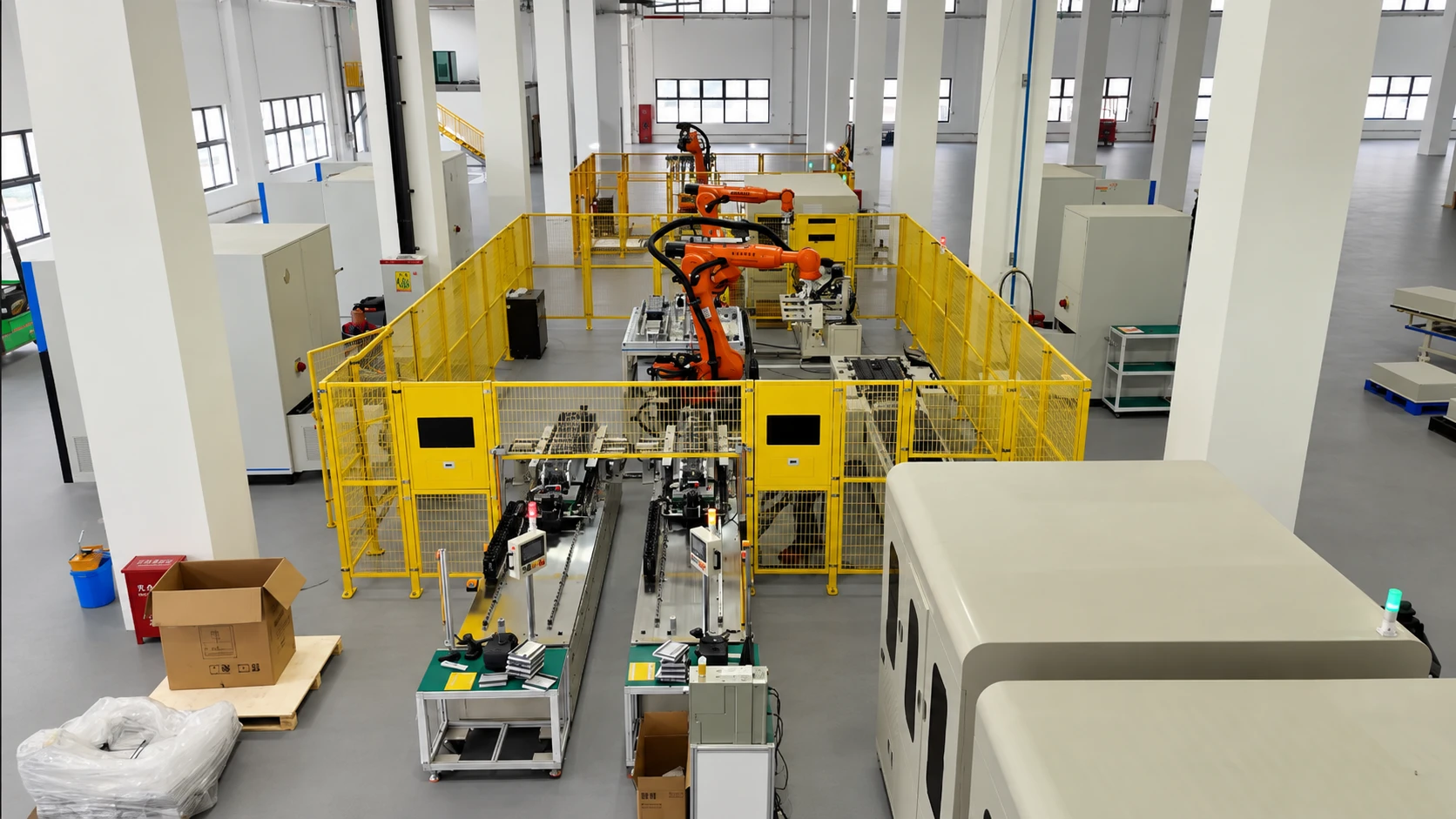
The next step is to establish a complete production process flow.
A typical prismatic lithium battery module and PACK production line may include three main production sections.
2.1 Battery Cell Processing Section
This section prepares incoming battery cells for module assembly.
Typical processes include:
Automatic battery cell loading.
Barcode scanning and identification.
OCV and internal resistance testing.
NG battery cell rejection.
Battery cell polarity detection.
Polarity correction or flipping.
Insulation tape application.
Battery cell positioning and transfer.
The purpose of this section is to ensure that incoming cells meet the required electrical and physical specifications before entering module assembly.
2.2 Battery Module Assembly and Welding Section
This section transforms individual battery cells into battery modules.
Typical processes include:
Battery cell stacking.
End plate installation.
Module compression.
Steel strip installation and strapping.
Terminal positioning.
Laser cleaning.
CCS installation.
CCS laser welding.
Sense wire welding.
Post-welding inspection.
Insulation and Hi-Pot testing.
Module unloading.
The equipment arrangement should minimize unnecessary product transfers between stations.
For fully automated production lines, industrial robots, conveyor systems, and dedicated fixtures can be integrated to improve positioning accuracy and production continuity.
2.3 Battery PACK Assembly Section
The PACK assembly section integrates battery modules into the final battery enclosure.
Depending on the product design, the process may include:
PACK enclosure cleaning.
Liquid cooling plate air leak testing.
Automatic enclosure gluing.
Accessory installation.
Module loading into the enclosure.
Module fixing.
Copper busbar installation.
BMU/BMS harness installation.
Upper cover installation.
PACK air leak testing.
PACK EOL Testing.
DCIR testing.
Finished PACK unloading.
For energy storage applications, the production line may also need to accommodate different enclosure sizes, cooling structures, and electrical connection configurations.
The final process flow should be confirmed before determining the physical arrangement of the equipment.
3. Choose the Right Material Handling System
Material transportation is one of the most important considerations in battery PACK factory layout planning.
The two common approaches are conveyor-based transportation and AGV-based material handling.
3.1 Roller Conveyor or Double-Speed Chain Conveyor
Conveyor systems are commonly used when the production process follows a relatively fixed sequence.
Advantages include:
Continuous material transfer.
Stable workstation positioning.
Predictable production rhythm.
Relatively straightforward integration between stations.
Reduced manual transportation.
Conveyor systems are particularly suitable for production lines with stable product configurations and clearly defined process sequences.
3.2 AGV Material Handling Systems
Automated Guided Vehicles (AGVs) provide greater flexibility in material transportation.
They can transfer products between different workstations without requiring every process to be connected through a fixed conveyor.
Depending on the system design, AGVs can support:
Automatic material transfer.
Workstation-to-workstation transportation.
Production scheduling.
Fixture cart circulation.
Integration with central dispatching systems.
Communication with warehouse management systems.
AGV-based systems are particularly useful when manufacturers need flexible production layouts or want to reduce fixed conveyor infrastructure.
However, factory planning must also consider AGV travel routes, workstation docking positions, charging locations, traffic management, and safety protection.
3.3 How Should Manufacturers Choose?
Comparison | Conveyor System | AGV System |
|---|---|---|
Material Flow | Fixed transportation routes | Flexible transportation routes |
Layout Flexibility | Relatively limited | Higher |
Production Integration | Suitable for continuous production | Suitable for flexible workstation transfer |
Floor Space | Requires fixed conveyor installation | Requires vehicle travel and docking areas |
Best Application | Stable, sequential production | Flexible and modular production |
The choice should be based on production volume, product variety, factory dimensions, investment considerations, and future expansion plans.
4. Calculate Factory Space Requirements
Factory space planning should consider both equipment dimensions and the additional space required for production operations.
The equipment footprint is not the same as the total factory space requirement.
Manufacturers should reserve additional space for:
Equipment maintenance.
Operator access.
Battery cell storage.
Incoming material inspection.
WIP (Work in Process) storage.
NG material handling.
Finished product storage.
Forklift transportation.
AGV movement.
Electrical control cabinets.
Safety protection zones.
Reference Dimensions for Different PACK Production Line Configurations
Based on three representative Sunka Lead technical configurations, the following reference dimensions can help manufacturers understand how production capacity and automation configuration affect factory space requirements.
Production Line Configuration | Rated Cell Processing Capacity | Assembly Line Dimensions | Installed Power |
|---|---|---|---|
8 PPM Standard | ≥8 PPM | 52 m × 7.5 m × 4 m | 70 kW |
10 PPM Enhanced | ≥10 PPM | 75 m × 12 m × 4 m | 90 kW |
12 PPM Premium | ≥12 PPM | 91 m × 13 m × 4 m | 115 kW |
Reference: Sunka Lead 8 PPM Standard Roller Conveyor, 10 PPM Enhanced AGV, and 12 PPM Premium AGV Module and PACK Production Line technical agreements.
Important: The PPM values above refer to the battery cell processing capacity specified in the technical agreements, not the number of completed PACK units per minute.
The dimensions represent the reference assembly line envelope, not the total factory building area.
The actual factory footprint must be determined after considering equipment access, maintenance clearance, material storage, transportation routes, safety requirements, and the final 3D layout.
5. Plan Electrical and Compressed Air Utilities
Utility planning should be completed before equipment installation.
Insufficient electrical capacity or unstable compressed air supply may affect equipment operation and production stability.
5.1 Electrical Power Supply
The electrical system should be designed according to the total equipment configuration.
For reference, the three production line configurations above have the following installed power ratings:
8 PPM Standard: 70 kW.
10 PPM Enhanced: 90 kW.
12 PPM Premium: 115 kW.
The technical agreements specify AC 220 V / 50 Hz and AC 380 V / 50 Hz.
Before installation, the customer should confirm the actual electrical distribution requirements, incoming power capacity, circuit protection, grounding, and cable routing with the equipment supplier.
5.2 Compressed Air Supply
Compressed air is commonly used for pneumatic actuators, clamping mechanisms, positioning devices, and other automated equipment.
The reference technical configurations specify an air pressure range of 0.4–0.7 MPa.
Factory planning should consider:
Compressed air supply capacity.
Air pressure stability.
Air piping layout.
Air filtration and moisture removal.
Air connection positions at individual workstations.
The actual air consumption should be confirmed through the equipment utility requirements.
5.3 Cooling and Welding-Related Utilities
Some battery PACK production processes involve laser welding and other equipment that may require additional supporting utilities.
Depending on the selected configuration, manufacturers may need to reserve space and connections for:
Laser cooling systems.
Industrial chillers.
Welding fume extraction.
Dust collection systems.
Equipment ventilation.
Laser safety enclosures.
These requirements should be confirmed individually rather than assumed to be identical across all production lines.
6. Organize Material Flow and Logistics
Efficient material flow helps reduce unnecessary transportation and work-in-process accumulation.
A well-designed factory should establish clear routes for incoming materials, production materials, finished modules, and finished PACK products.
6.1 Incoming Battery Cell Management
Incoming battery cells are typically delivered on pallets.
The factory should reserve suitable unloading and temporary storage areas.
Depending on the equipment configuration, forklifts may transport pallets to the automatic loading station.
The loading area should provide sufficient space for:
Incoming battery cell pallets.
Pallet positioning.
Forklift operation.
Empty pallet recovery.
Material inspection.
6.2 Work-in-Process Management
WIP management is important for maintaining production continuity.
The factory should reserve suitable areas for intermediate materials, including:
Battery cells awaiting processing.
Modules awaiting welding.
Modules awaiting inspection.
PACK enclosures.
Liquid cooling plates.
Copper busbars.
BMU/BMS harnesses.
Other assembly components.
The quantity of WIP storage should be determined according to production rhythm and material replenishment frequency.
6.3 Finished Product Transportation
Finished battery modules and PACK products may require dedicated transportation equipment because of their weight and dimensions.
Manufacturers should plan suitable transfer routes, lifting equipment, forklift access, and finished product storage areas.
For larger energy storage products, transportation space and floor loading capacity should be checked during the factory design stage.
7. Integrate MES and Production Data Management
Modern battery PACK manufacturing increasingly depends on production data collection and traceability.
An MES (Manufacturing Execution System) can connect different production processes and help manufacturers monitor production performance.
A properly configured system may support:
Battery cell barcode scanning.
OCV and internal resistance data collection.
Battery cell identification and grading.
Module production recipe management.
Product and material traceability.
Compression data recording.
Welding process records.
Inspection results.
Production dashboard monitoring.
Work order completion tracking.
For example, when a battery cell barcode is scanned, the system can associate its test information with the corresponding production record.
During module assembly, additional process data can be linked to the module identification code.
This allows manufacturers to trace production information across different manufacturing stages.
The production line should also reserve suitable communication interfaces for integration with the customer's central management system.
8. Consider Safety, Maintenance, and Future Expansion
A production line should be designed not only for current manufacturing requirements but also for long-term operation.
Important considerations include:
Equipment safety
Production equipment should incorporate appropriate emergency stop devices, safety light curtains, safety door switches, and electrical protection according to the equipment design and applicable safety requirements.
Maintenance access
Maintenance personnel should be able to access motors, sensors, electrical cabinets, fixtures, and other components without unnecessary equipment disassembly.
Operator accessibility
Manual workstations should provide sufficient operating space and appropriate ergonomic conditions.
Future expansion
If the manufacturer plans to increase production capacity or introduce additional battery products, the factory should reserve suitable expansion areas and utility capacity.
Production flexibility
Modular equipment configurations and programmable recipes can help manufacturers adapt to changing product requirements.
9. What Information Should You Prepare Before Requesting a PACK Line Layout?
Before asking an equipment supplier to design a complete production line, it is advisable to prepare the following information.
Required Information | Purpose |
|---|---|
Factory CAD Drawing | Confirms available building dimensions |
Factory Height | Determines equipment installation clearance |
Battery Cell Drawings | Confirms cell compatibility |
Module Drawings | Defines module assembly requirements |
PACK Drawings | Defines final assembly requirements |
Target Production Capacity | Determines equipment configuration |
Automation Requirements | Determines conveyor, robot, and AGV configuration |
Electrical Supply Information | Supports electrical system planning |
Compressed Air Information | Supports pneumatic system planning |
Material Handling Requirements | Defines logistics routes |
MES Requirements | Determines data integration scope |
Future Expansion Plan | Supports long-term factory planning |
A professional equipment supplier should evaluate these materials before finalizing the equipment layout.
The process should ideally include 2D layout planning, 3D equipment layout, utility planning, material flow analysis, and technical confirmation.
Frequently Asked Questions
Q1: How much factory space is required for a lithium battery PACK production line?
The required space depends on production capacity, automation level, battery cell format, module dimensions, PACK structure, and material handling methods.
For reference, Sunka Lead's documented 8 PPM, 10 PPM, and 12 PPM production line configurations have assembly line dimensions ranging from 52 m × 7.5 m × 4 m to 91 m × 13 m × 4 m. Additional factory space is required for logistics, maintenance, storage, and safety access.
Q2: What utilities are required for a battery PACK production line?
Typical requirements include electrical power, compressed air, communication networks, and process-specific supporting utilities.
Laser welding systems may also require cooling and fume extraction equipment, depending on the configuration.
Q3: Is an AGV system necessary for a fully automated PACK production line?
Not always. Conveyor-based transportation can also support automated production. AGV systems are particularly useful when flexible material transportation and modular workstation arrangements are required.
Q4: Why is MES integration important in battery PACK manufacturing?
MES integration supports production monitoring, process control, product identification, and full-process data traceability. It helps manufacturers maintain consistent quality management across different production stages.
Q5: Should factory layout design be completed before purchasing equipment?
Yes. Factory layout and equipment configuration should be evaluated together before investment decisions are finalized. This helps avoid space conflicts, insufficient utility capacity, and unnecessary material transportation.
Conclusion
Planning a battery PACK manufacturing facility requires coordination between production processes, equipment configuration, factory space, utilities, material transportation, and manufacturing data management.
The most effective factory layout is not necessarily the one that fits the largest number of machines into the available space. It is the one that creates a balanced production system with efficient material flow, reliable equipment operation, convenient maintenance, and sufficient flexibility for future development.
For manufacturers entering the energy storage market or expanding existing battery production capacity, working with an experienced lithium battery PACK equipment supplier during the early planning stage can significantly improve project coordination.
About Sunka Lead
Sunka Lead is the international brand of Guangdong Songke Leading Intelligent Equipment Co., Ltd., specializing in lithium battery manufacturing equipment and turnkey automation solutions for battery module, PACK and Battery Energy Storage System (BESS) production.
Our solutions cover the cell-to-container manufacturing value chain — from cell testing and sorting to module and PACK assembly, laser welding, EOL testing, and PACK-to-container integration, including automated BESS container assembly lines for commercial & industrial (C&I) and utility-scale energy storage applications.
For project inquiries, share your battery cell specifications, module/PACK drawings, BESS container requirements, target production capacity, automation level, and factory conditions. Sunka Lead develops customized production line solutions around your product architecture and manufacturing goals.