
 English
 简体中文


Can One Battery Stacking Machine Handle Both LFP and NMC Electrodes?
As battery manufacturers expand their product portfolios, one common question arises: Can the same battery stacking machine process both Lithium Iron Phosphate (LFP) and Nickel Manganese Cobalt (NMC) battery products?
The answer depends on the type of stacking equipment, the battery manufacturing process, and the physical specifications of the products.
However, there is an important technical distinction that buyers should understand before selecting equipment.
In battery manufacturing, electrode stacking and battery module stacking are two different processes. They use different equipment and have different compatibility requirements.
This article focuses primarily on battery module stacking in lithium battery pack manufacturing, while also explaining the distinction between electrode stacking and module assembly.
1. LFP and NMC: What Are the Main Differences?
LFP and NMC are two widely used lithium-ion battery chemistries.
LFP stands for Lithium Iron Phosphate, while NMC refers to Nickel Manganese Cobalt.
Both technologies are used in energy storage and electric mobility applications, but their material systems and battery characteristics differ.
Comparison | LFP Battery | NMC Battery |
|---|---|---|
Full Name | Lithium Iron Phosphate | Nickel Manganese Cobalt |
Cathode Material | Lithium iron phosphate | Lithium nickel manganese cobalt oxide |
Common Applications | Energy storage, commercial vehicles, industrial applications | Electric vehicles, power applications, portable energy systems |
Typical Characteristics | High thermal stability and long cycle life | High energy density and different performance characteristics depending on formulation |
Manufacturing Considerations | Depends on cell design and production requirements | Depends on cell design and production requirements |
These differences influence battery cell design, manufacturing processes, and product specifications.
However, chemistry alone does not determine whether a stacking machine can process a battery.
The physical structure and mechanical requirements of the finished cells are equally important.
2. Electrode Stacking vs. Battery Module Stacking
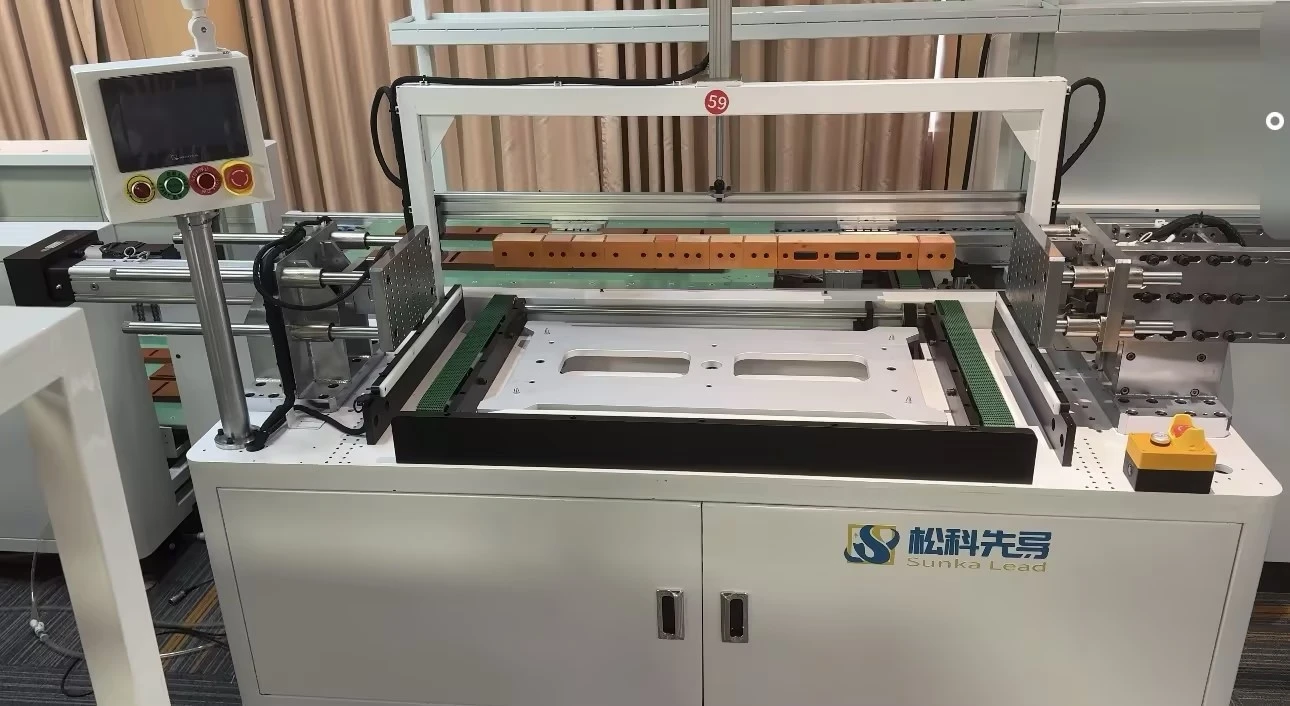
This distinction is particularly important when discussing equipment compatibility.
Electrode stacking machines
Electrode stacking machines are used in lithium battery cell manufacturing.
They arrange positive and negative electrode sheets with separator materials to form the internal electrode assembly of a battery cell.
The process requires precise control of:
Electrode sheet dimensions.
Electrode thickness.
Separator positioning.
Positive and negative electrode alignment.
Tab positioning.
Stacking accuracy.
Tension and handling conditions.
These machines belong to the upstream battery cell manufacturing process.
Battery module stacking machines
Battery module stacking machines are used in downstream battery PACK manufacturing.
They handle finished battery cells rather than individual electrode sheets.
The equipment arranges cells into a predefined module configuration, followed by compression, positioning, and potentially steel strip installation.
The main considerations include:
Cell dimensions and weight.
Number of cells per module.
Cell orientation and polarity.
Module dimensions.
Compression force.
Positioning fixtures.
Production cycle time.
Therefore, if a buyer is purchasing equipment for battery PACK manufacturing, the correct equipment terminology is generally battery cell module stacking machine or prismatic battery module stacking and pressing machine, rather than electrode stacking machine.
3. Can One Module Stacking Machine Handle Both LFP and NMC Cells?
In principle, a machine may be engineered to process both LFP and NMC battery cells.
However, this depends on whether the two battery products fall within the machine's mechanical and process compatibility range.
For example, if both products have similar dimensions, weight, module arrangements, and mechanical requirements, a shared machine platform may be feasible.
If their specifications differ significantly, additional fixtures, positioning adjustments, or process modifications may be necessary.
The following factors should be evaluated.
3.1 Battery Cell Dimensions
Cell dimensions are one of the first parameters to check.
Buyers should provide:
Cell length.
Cell width.
Cell height.
Terminal positions.
Cell weight.
Dimensional tolerances.
Even when two cells have the same rated capacity, their physical dimensions may differ between manufacturers.
A machine should therefore be evaluated using actual cell drawings rather than capacity ratings alone.
3.2 Module Configuration
Different battery products may require different module arrangements.
For example:
1P10S
1P12S
1P13S
1P16S
The equipment should support the required number of cells, stacking sequence, positioning method, and final module dimensions.
If different module configurations are required, buyers should verify whether the machine supports recipe management and convenient product changeover.
3.3 Compression Force and Mechanical Requirements
LFP and NMC cells should not automatically be assigned the same compression parameters.
The appropriate compression force depends on the cell manufacturer's specifications, cell structure, module design, and process requirements.
A suitable machine should provide adjustable and controllable compression parameters.
Buyers should confirm:
Required compression force.
Pressure adjustment range.
Compression stroke.
Pressure holding time.
Final module length.
Pressure monitoring and recording.
Fixture locking and positioning accuracy.
The equipment supplier should determine the appropriate process parameters through technical evaluation and, where necessary, sample testing.
3.4 Positioning Fixtures and Changeover
If LFP and NMC products have different physical dimensions, dedicated changeover fixtures may be required.
The equipment should be evaluated for:
Fixture replacement.
Positioning adjustment.
Recipe selection.
Changeover time.
Error-proofing functions.
Product identification.
For manufacturers planning multiple battery product families, these functions can significantly affect production flexibility.
4. What About Processing Different Battery Capacities?
Battery capacity is another common concern among equipment buyers.
For example, manufacturers may want to produce modules using 280 Ah, 314 Ah, or higher-capacity prismatic cells.
However, different Ah ratings do not automatically mean different machine requirements, nor do identical Ah ratings guarantee compatibility.
The following information is more useful for evaluating the machine:
Technical Parameter | What Buyers Should Confirm |
|---|---|
Cell Capacity | Rated capacity in Ah |
Cell Dimensions | Length × Width × Height |
Cell Weight | Individual cell weight |
Cell Format | Prismatic, cylindrical, or pouch |
Module Configuration | Number of cells and series/parallel arrangement |
Module Dimensions | Final length, width, and height |
Compression Requirements | Force, stroke, and pressure profile |
Changeover Requirements | Fixture and recipe adjustment |
For example, Sunka Lead's documented energy storage PACK line configurations use prismatic LFP cells with reference capacities including 280 Ah, 314 Ah, 587 Ah, 628 Ah, and 688 Ah.
The specified module compatibility range is 1P10S to 1P16S, with PACK configurations including 1P52S and 1P104S.
These are documented LFP reference configurations. NMC compatibility should be assessed separately using the actual battery cell drawings, module design, and process requirements rather than assumed from the LFP configuration.
5. How to Evaluate a Machine for Multiple Battery Products
If your factory plans to manufacture both LFP and NMC battery products, it is advisable to evaluate equipment compatibility before confirming the investment.
The following process can help.
Step 1: Collect battery cell specifications
Prepare technical drawings and specifications for each battery cell model.
Do not rely only on rated capacity or battery chemistry.
Step 2: Define module configurations
Confirm the number of cells per module, cell arrangement, end plate structure, and final module dimensions.
Step 3: Confirm mechanical compatibility
Ask the supplier to evaluate the machine's positioning range, fixture design, compression force, and adjustment capabilities.
Step 4: Evaluate changeover requirements
Determine whether different products require fixture replacement, mechanical adjustment, or separate production recipes.
Step 5: Conduct sample testing
Provide actual battery cells and module components for equipment testing.
Verify positioning accuracy, compression stability, final module dimensions, and production cycle time.
Step 6: Confirm production acceptance criteria
Define measurable acceptance standards for each product configuration before equipment delivery.
6. Can One Production Line Support Different Battery Chemistries?
The possibility of processing multiple battery chemistries should also be considered at the production line level.
A flexible battery pack production line may be designed with adjustable fixtures, programmable production recipes, product identification, and modular workstation configurations.
However, the compatibility of each production process must be verified separately.
For example:
Cell loading may require different gripping fixtures.
OCV testing may require different voltage ranges and test specifications.
Stacking may require different positioning arrangements.
Compression may require different pressure settings.
laser welding may require process validation for different materials and joint structures.
EOL Testing may require different electrical test parameters.
A flexible production line should therefore be designed around the customer's actual product portfolio rather than relying on a general statement that it supports all battery types.
Frequently Asked Questions
Q1: Is LFP battery stacking different from NMC battery stacking?
The fundamental module stacking process can be similar, but the actual machine parameters depend on cell dimensions, module configuration, mechanical requirements, and the manufacturer's process specifications.
Q2: Can a 314 Ah LFP stacking machine process 314 Ah NMC cells?
Not necessarily. The same capacity rating does not guarantee identical dimensions, weight, terminal positions, or module structure. Compatibility must be confirmed using the actual cell drawings.
Q3: Does changing from LFP to NMC always require a new machine?
No. Depending on the equipment's adjustment range and product design, a shared machine platform may be feasible. Additional fixtures, recipes, or process modifications may be required.
Q4: What is the difference between an electrode stacking machine and a module stacking machine?
An electrode stacking machine arranges electrode sheets and separator materials during battery cell manufacturing. A module stacking machine arranges finished battery cells during battery PACK manufacturing. They are different equipment categories.
Q5: What should I provide to a supplier for a compatibility assessment?
Provide cell drawings, cell dimensions, weight, capacity, chemistry, module drawings, cell quantities, target production capacity, and required compression parameters.
Conclusion
Whether one battery stacking machine can handle both LFP and NMC products depends on the equipment's intended manufacturing process and the actual product specifications.
For battery PACK manufacturers, the key consideration is not simply whether the machine supports LFP or NMC chemistry. It is whether the equipment can reliably handle the required finished battery cells, module configurations, positioning tolerances, and compression conditions.
A properly engineered machine platform can potentially support multiple product configurations, provided that mechanical compatibility and process requirements are verified.
About Sunka Lead
Sunka Lead is the international brand of Guangdong Songke Leading Intelligent Equipment Co., Ltd., specializing in lithium battery manufacturing equipment and turnkey automation solutions for battery module, PACK and Battery Energy Storage System (BESS) production.
Our solutions cover the cell-to-container manufacturing value chain — from cell testing and sorting to module and PACK assembly, laser welding, EOL testing, and PACK-to-container integration, including automated BESS container assembly lines for commercial & industrial (C&I) and utility-scale energy storage applications.
For project inquiries, share your battery cell specifications, module/PACK drawings, BESS container requirements, target production capacity, automation level, and factory conditions. Sunka Lead develops customized production line solutions around your product architecture and manufacturing goals.