
 English
 简体中文


Lithium Battery Stacking Machine Reviews: What Buyers Should Verify Before Purchase
Choosing a lithium battery stacking machine is an important decision for battery manufacturers, especially those producing prismatic lithium-ion battery modules for energy storage systems (ESS), electric vehicles (EVs), and industrial applications.
A machine may look impressive in a product demonstration, but its real performance depends on much more than appearance or advertised production speed. Cell compatibility, stacking accuracy, compression force, positioning stability, automation level, and integration with downstream processes all affect production efficiency and final product quality.
For manufacturers planning to invest in a battery module stacking machine, understanding these factors before purchasing can help avoid unnecessary equipment modifications, production interruptions, and additional investment.
This guide explains the key technical considerations buyers should evaluate when comparing lithium battery stacking machines.
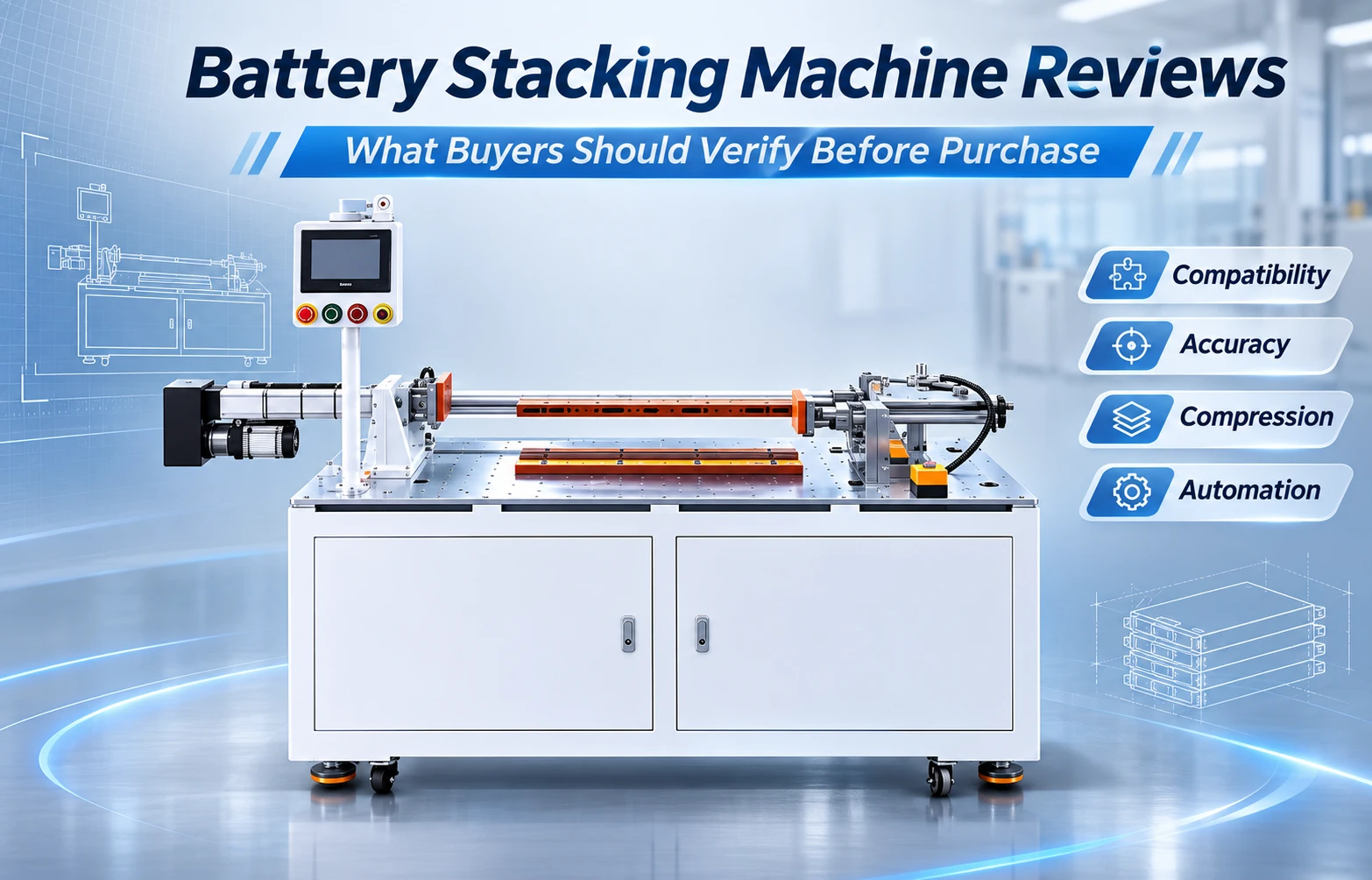
1. Understand the Difference Between Battery Stacking and Module Compression
Before comparing equipment, it is important to understand the actual production process.
In lithium battery pack manufacturing, battery cell stacking and module compression are closely related but serve different purposes.
Battery cell stacking involves arranging individual battery cells according to a predefined module configuration. The cells must be positioned accurately to maintain consistent spacing, alignment, and module geometry.
Module compression applies controlled mechanical pressure to the assembled cells, bringing the module to its specified dimensions and maintaining structural stability.
Depending on the production line configuration, these operations may involve separate stations or integrated equipment.
A typical prismatic battery module assembly process includes:
Battery cell preparation and inspection.
Adhesive or double-sided tape application.
Battery cell stacking according to the production recipe.
End plate installation.
Module compression and positioning.
Steel strip installation or strapping.
Module transfer to the next production process.
Some production lines use manual stacking followed by automatic servo compression, while higher-automation configurations use industrial robots to perform cell stacking.
The equipment configuration should therefore be evaluated according to the actual production process rather than simply the machine name.
2. Verify Battery Cell and Module Compatibility
Cell compatibility is one of the most important factors when selecting a stacking machine.
A machine designed for one battery module specification may not automatically accommodate another, even when both products use the same cell chemistry.
Buyers should provide the following information:
Battery cell format: prismatic, cylindrical, or pouch.
Cell dimensions: length, width, and height.
Individual cell weight.
Number of cells per module.
Module configuration, such as 1P10S, 1P13S, or 1P16S.
Final module dimensions.
End plate structure and steel strip requirements.
For example, a stacking machine designed for a 1P13S prismatic battery module may require different positioning fixtures and compression parameters when processing a different cell size or module configuration.
It is also important to distinguish between cell capacity and mechanical compatibility.
A 314 Ah cell and a 280 Ah cell may have different physical dimensions, depending on the manufacturer and product design. Capacity alone cannot determine whether a machine can process both.
Buyers should request a clearly defined compatibility range rather than relying on general statements such as "suitable for multiple battery models."
3. Evaluate Stacking Accuracy and Positioning Stability
Stacking accuracy directly affects the consistency of the finished battery module.
If individual cells are not positioned correctly, the resulting module may experience dimensional deviations, uneven compression, or alignment problems during subsequent welding and assembly processes.
Important parameters include:
Positioning accuracy
The equipment should consistently position cells according to the specified module arrangement.
Fixture accuracy
The stacking platform and positioning fixtures should maintain stable geometry throughout repeated production cycles.
Robot repeatability
For automatic stacking systems, robot repeatability is an important parameter affecting cell placement consistency.
Recipe management
Different module configurations may require different stacking programs. The control system should support parameter adjustment and production recipe management.
Buyers should also verify whether the machine can maintain stable positioning during continuous operation, not just during a single demonstration cycle.
4. Check Compression Force and Control Accuracy
Compression is not simply about applying as much pressure as possible.
The required force depends on cell characteristics, module structure, end plate design, and the battery manufacturer's process requirements.
Excessive compression may damage cells or affect their mechanical integrity. Insufficient compression may result in unstable module dimensions or inadequate structural retention.
A suitable module compression system should provide:
Adjustable compression force.
Stable pressure control.
Pressure sensing and monitoring.
Consistent final module dimensions.
Reliable fixture locking during compression.
Protection against abnormal operating conditions.
For reference, a module compression station specified in one of Sunka Lead's production line technical configurations uses a compression pressure range of 100–2,000 kgf.
This is a project-specific equipment specification, not a universal requirement for all battery modules. The actual compression range should be determined according to the customer's cell specifications and module design.
Pressure data and the module length after compression can also be recorded and uploaded to the MES system, supporting process monitoring and quality traceability.
5. Compare Manual, Semi-Automatic, and Fully Automatic Stacking
The automation level of a stacking machine directly affects labor requirements, production rhythm, and investment costs.
Configuration | Main Characteristics | Suitable Applications |
|---|---|---|
Manual stacking | Operators arrange battery cells using dedicated fixtures | Small-scale production and flexible manufacturing |
Semi-automatic stacking | Manual cell placement with automatic compression and positioning | Medium-volume production |
Fully automatic stacking | Industrial robots perform cell handling and stacking | High-volume automated production |
For example, a standard production configuration may use manual stacking followed by servo compression, while a higher-automation configuration can use a six-axis robot and alternating stacking platforms.
Automatic systems can also incorporate error-proofing functions at both the PLC and robot control levels to reduce incorrect operations.
However, automation should be selected according to actual production demand.
A fully automatic machine is not necessarily the most economical choice for every factory. Product variety, production volume, labor availability, and future expansion plans should all be considered.
6. Check Production Capacity and Actual Operating Performance
Advertised production speed is not the same as actual production output.
When evaluating a stacking machine, buyers should clarify how production capacity is calculated.
Important questions include:
How many battery cells can be processed per minute?
How many cells are stacked in each cycle?
What is the actual cycle time?
Does the stated capacity include manual loading and unloading?
How much time is required for product changeover?
What happens when a cell is incorrectly positioned?
Can the machine maintain stable operation during continuous production?
It is also important to evaluate the equipment together with the upstream and downstream stations.
A fast stacking machine cannot improve overall production capacity if the cell loading, compression, strapping, or module transfer stations become bottlenecks.
7. Consider MES Integration and Production Traceability
Modern battery manufacturing increasingly requires accurate production data and quality traceability.
A stacking and compression system should ideally support communication with the production line control system and MES platform.
Depending on the configuration, relevant data may include:
Product and module identification.
Battery cell barcode information.
Production recipe.
Compression force.
Final module dimensions.
Production status.
Abnormal alarms.
Process records.
For manufacturers producing multiple battery module specifications, data traceability can help identify process deviations and improve production management.
Buyers should confirm which functions are included in the equipment scope and which require additional software or integration work.
8. What Should Buyers Request Before Purchasing?
Before placing an order, buyers should prepare a technical information package and ask the equipment supplier to verify compatibility.
Information | Why It Matters |
|---|---|
Battery cell drawings | Confirms cell dimensions and mechanical characteristics |
Module assembly drawings | Defines the stacking arrangement |
Number of cells per module | Determines stacking configuration |
Required compression force | Defines the press specification |
Final module dimensions | Determines fixture and positioning requirements |
Required production capacity | Determines automation level and cycle time |
Steel strip requirements | Confirms whether strapping is included |
Production line interface | Determines conveyor and transfer integration |
MES requirements | Defines data collection and traceability scope |
Whenever possible, buyers should also request sample production using their actual battery cells.
A factory acceptance test (FAT) should verify the agreed product specifications, machine functions, operating cycle, safety functions, and acceptance criteria.
Frequently Asked Questions
Q1: What is the difference between a battery stacking machine and a battery compression machine?
A battery stacking machine arranges individual cells into a specified module configuration. A battery compression machine applies controlled pressure to achieve the required module dimensions and structural stability. Some production systems integrate these processes, while others use separate stations.
Q2: Can one stacking machine process different prismatic battery cell sizes?
Potentially, yes. However, compatibility depends on the equipment's adjustment range, positioning fixtures, module dimensions, and compression capabilities. Different products may require dedicated changeover fixtures and production recipes.
Q3: Is automatic stacking always better than manual stacking?
Not necessarily. Automatic stacking is more suitable for manufacturers requiring higher production volumes and reduced manual handling. Manual or semi-automatic configurations may offer better flexibility for smaller production volumes or frequent product changes.
Q4: Why is compression force important in battery module assembly?
Compression force affects the final module dimensions and mechanical stability. The correct force must be determined according to the battery cell manufacturer's requirements and the module's structural design.
Q5: What information is needed to obtain an accurate equipment quotation?
Buyers should provide battery cell drawings, module drawings, cell quantities, required compression force, production capacity, automation requirements, and downstream process information.
Conclusion
Selecting the right lithium battery stacking machine requires a comprehensive evaluation of mechanical compatibility, positioning accuracy, compression performance, automation level, and production requirements.
For manufacturers planning to expand their battery module production capacity, the most suitable solution is not necessarily the machine with the highest advertised speed. It is the equipment that can consistently process the intended battery products while maintaining the required quality, production efficiency, and operational stability.
About Sunka Lead
Sunka Lead is the international brand of Guangdong Songke Leading Intelligent Equipment Co., Ltd., specializing in lithium battery manufacturing equipment and turnkey automation solutions for battery module, PACK and Battery Energy Storage System (BESS) production.
Our solutions cover the cell-to-container manufacturing value chain — from cell testing and sorting to module and PACK assembly, laser welding, EOL Testing, and PACK-to-container integration, including automated BESS container assembly lines for commercial & industrial (C&I) and utility-scale energy storage applications.
For project inquiries, share your battery cell specifications, module/PACK drawings, BESS container requirements, target production capacity, automation level, and factory conditions. Sunka Lead develops customized production line solutions around your product architecture and manufacturing goals.