
 English
 简体中文


Semi-Automated BESS Container Assembly Line for PACK Integration and Testing
Project Overview
As global demand for Battery Energy Storage Systems (BESS) continues to expand, manufacturers are placing greater emphasis on efficient battery pack integration, reliable electrical connections, system-level testing, and production traceability.
For an overseas energy storage project, Sunka Lead developed a customized semi-automated BESS container assembly and testing line, designed to support the integration of battery PACKs into containerized energy storage systems.
The solution combines heavy-duty container handling equipment, AGV-based material transfer, customized PACK installation equipment, multi-system assembly workstations, and integrated testing processes.
From empty container preparation to battery PACK installation, electrical connections, liquid cooling integration, and final system testing, the line establishes a coordinated manufacturing workflow for BESS container assembly.
1. Project at a Glance
| Project Item | Description |
|---|---|
| Project Type | Overseas BESS Assembly Project |
| Application | Containerized Battery Energy Storage Systems |
| production line | Customized Semi-Automated BESS Container Assembly Line |
| Main Assembly Process | Battery PACK Installation and Container Integration |
| Material Handling | Heavy-Duty Transfer Equipment and AGV Systems |
| Assembly Operations | Mechanical, Electrical, Cooling and Fire Protection Integration |
| Testing Operations | Airtightness Testing, EOL Testing and Container-Level Charge/Discharge Testing |
| Production Management | PLC-Based Control and MES Data Traceability |
| Engineering Scope | Customized Design, Manufacturing, Installation, Commissioning and Technical Support |
2. Project Requirements and Engineering Challenges
BESS container assembly involves considerably more than simply placing battery PACKs inside an enclosure. It requires coordination between heavy-duty material handling, precise positioning, mechanical installation, electrical connections, thermal management, fire protection, and system-level testing.
The main engineering considerations for this project included:
| Engineering Requirement | Project Challenge | Solution Direction |
|---|---|---|
| Container Handling | Moving and positioning large, heavy containers between workstations | Heavy-duty transfer equipment and AGV-assisted transportation |
| PACK Installation | Accurate positioning and installation of battery PACKs inside the container | Customized lifting and insertion equipment with assisted positioning |
| Mechanical Assembly | Securing PACKs and installing supporting components | Dedicated assembly station s and fastening tools |
| Electrical Integration | Connecting busbars, high-voltage cables, communication wiring and connectors | Sequential electrical assembl y workstations |
| Thermal Management | Integrating liquid cooling connections | Dedicated liquid cooling pipe installation station |
| Fire Protection | Connecting and checking fire protection systems | Dedicated installation and inspection procedures |
| Quality Verification | Verifying assembly integrity and system functionality | Airtightness, EOL and container-level charge/discharge testing |
| Production Traceability | Recording production activities and material information | Barcode scanning and MES-based process management |
3. Customized BESS Container Assembly Solution
Sunka Lead designed the production line around a customized combination of material handling equipment, assembly workstations, and testing systems.
The overall solution consists of the following functional sections:
| System Section | Main Equipment or Function | Engineering Purpose |
|---|---|---|
| Container Transfer | Heavy-duty container transfer equipment | Container unloading, lifting and transportation |
| Container Preparation | AGV transfer and preparation stations | Empty container positioning and inspection |
| PACK Installation | Customized electric lifting and insertion equipment | Assisted battery PACK positioning and installation |
| Mechanical Assembly | Fastening tools and assembly workstations | PACK securing and structural installation |
| Electrical Integration | Electrical assembly workstations | Busbar, cable and connector installation |
| Cooling and Fire Protection | Dedicated connection workstations | Liquid cooling and fire protection integration |
| Quality Testing | Airtightness and EOL testing stations | Assembly and functional verification |
| Container Testing | Charge/discharge testing station | Container-level testing |
| Final Inspection | Inspection and finished-product buffering | Final quality checks and product identification |
4. Complete BESS Container Assembly Workflow
The production process is organized into ten major stages, covering the complete assembly and testing workflow.
| No. | Process Stage | Main Operations |
|---|---|---|
| 01 | Container Transfer | Unloading, lifting and transferring the empty BESS container |
| 02 | Container Preparation | Container inspection, support installation and HVAC/fire protection system inspection |
| 03 | Battery PACK Installation | PACK positioning, alignment and operator-assisted installation |
| 04 | PACK Fixing and Busbar Assembly | PACK fastening, busbar installation, harness assembly and connector mating |
| 05 | Electrical Connection | High-voltage power cable and communication cable installation |
| 06 | Cooling and Fire Protection Integration | Liquid cooling pipe and fire protection system connections |
| 07 | Airtightness and Fire Protection Inspection | Airtightness testing, fire protection system inspection and filling |
| 08 | EOL Testing | End-of-Line testing according to customer-defined procedures |
| 09 | Container-Level Charge/Discharge Testing | Connecting testing systems and conducting charge/discharge tests |
| 10 | Final Inspection and Offloading | Visual inspection, nameplate labeling and finished-container buffering |
4.1 Container Handling and AGV Transportation
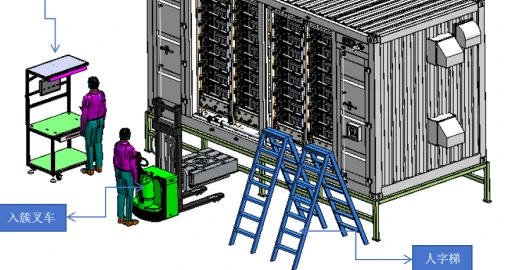
The container handling system coordinates unloading, lifting, positioning and transportation between designated workstations.
AGV-based transportation supports the movement of containers and associated handling fixtures throughout the assembly workflow.
This arrangement helps coordinate material movement with workstation operations and provides a structured transportation solution for large-format BESS container assembly.
4.2 Battery PACK Installation and Positioning
Battery PACK installation is one of the most critical operations in BESS container integration.
The project adopts customized electric lifting and insertion equipment to assist operators in positioning and installing battery PACKs.
Assisted alignment, visual guidance and controlled insertion functions support accurate positioning during installation.
The installation process uses a semi-automated, operator-assisted approach rather than a fully unattended robotic insertion process.
4.3 Mechanical and Electrical Integration
After PACK installation, the container moves through a series of assembly stations.
The main operations include:
Battery PACK fastening and securing.
Busbar installation.
Electrical harness assembly.
Connector mating.
High-voltage power cable connections.
Communication cable installation.
Digital fastening tools and barcode-based data collection support standardized assembly operations and process traceability.
4.4 Liquid Cooling and Fire Protection Integration
Thermal management and fire protection are essential subsystems in containerized battery energy storage systems.
The assembly line includes dedicated operations for:
Liquid cooling pipe installation and connection.
Fire protection system connection.
Related system inspection and filling operations.
Airtightness testing and process verification.
These operations are organized into dedicated workstations to support systematic container integration.
4.5 EOL and Container-Level Testing
Testing is incorporated into the downstream assembly workflow to verify the completed container before final inspection.
| Testing Stage | Main Purpose |
|---|---|
| Airtightness Testing | Verify the specified airtightness requirements |
| Fire Protection Inspection | Check the installation and condition of the fire protection system |
| EOL Testing | Perform end-of-line verification according to customer SOP |
| Charge/Discharge Testing | Conduct container-level electrical testing |
| Final Inspection | Check the completed product before offloading |
Testing procedures and acceptance criteria are configured according to customer-defined requirements and the applicable testing systems.
5. Production Control and MES Traceability
Beyond mechanical assembly and equipment integration, production data management is another important part of the BESS container assembly solution.
The line adopts PLC-based equipment control and an MES system to support production information collection and process management.
| Function | Description |
|---|---|
| Barcode Scanning | Identifies containers, products and related materials |
| Process Management | Records the completion status of individual workstations |
| Data Collection | Collects relevant production and operation information |
| Product Traceability | Supports process history retrieval using product identification codes |
| Material Traceability | Links material information with production records |
| Production Monitoring | Provides production status monitoring and visualized information |
| System Integration | Supports customized data exchange with the customer's central management or traceability system |
This digital management approach helps establish a more transparent production process and supports quality management throughout BESS container assembly.
6. Customized Engineering for BESS Manufacturing
Different BESS manufacturers may have different container dimensions, battery PACK configurations, installation structures, electrical interfaces, and testing requirements.
Therefore, BESS container assembly lines should be engineered according to the actual product structure and manufacturing process.
For this project, the solution was designed around an agreed reference container and battery PACK configuration, with consideration for future engineering upgrades.
Key customization considerations include:
| Design Consideration | Required Engineering Information |
|---|---|
| Container Structure | Container dimensions, structural design and installation interfaces |
| Battery PACK | PACK dimensions, weight and installation arrangement |
| Mechanical Integration | Mounting positions, fixing structures and insertion requirements |
| Electrical Integration | Busbar, connector and cable interfaces |
| Thermal Management | Liquid cooling system connections |
| Fire Protection | Fire protection system configuration and installation requirements |
| Testing | EOL procedures and container-level testing requirements |
| Factory Conditions | Workshop layout, floor loading and utility requirements |
| Digital Integration | MES interface and production data requirements |
This project-based engineering approach allows the equipment configuration and workstation arrangement to be matched to the customer's manufacturing requirements.
7. Sunka Lead's BESS Automation Engineering Capabilities
As a lithium battery pack automation equipment manufacturer, Sunka Lead provides customized equipment and production line engineering solutions for battery module, PACK and energy storage manufacturing.
Our BESS-related engineering capabilities cover several key areas:
| Engineering Area | Solution Capabilities |
|---|---|
| BESS Container Assembly | Customized container assembly and integration lines |
| Battery PACK Installation | Assisted PACK lifting, positioning and installation equipment |
| Material Handling | AGV transportation and heavy-duty handling solutions |
| Electrical Integration | Busbar, wiring and connector assembly workstations |
| Thermal Management | Liquid cooling system installation and connection |
| Quality Testing | Airtightness, EOL and integrated testing workflows |
| Production Management | PLC control, MES integration and process traceability |
| Project Delivery | Engineering design, manufacturing, installation, commissioning and training |
From individual equipment to customized assembly line integration, Sunka Lead focuses on developing practical automation solutions for evolving battery manufacturing and energy storage applications.
Frequently Asked Questions
1. What is a BESS container assembly line?
A BESS container assembly line is a specialized production system used to install battery PACKs and integrate electrical, cooling, fire protection and related subsystems into a battery energy storage container.
Depending on the project scope, it may include container handling, PACK installation, electrical connections, testing and final inspection.
2. What processes are included in a BESS container integration line?
A typical workflow includes container preparation, battery PACK installation, mechanical fastening, busbar and cable connections, liquid cooling installation, fire protection integration, airtightness testing, EOL testing and container-level charge/discharge testing.
The exact configuration depends on the customer's product design and manufacturing requirements.
3. Is a BESS container assembly line fully automatic?
Not necessarily. Automation levels depend on product structure, production capacity, investment requirements and process complexity.
A semi-automated solution may combine AGV transportation, customized lifting equipment and assisted positioning with operator-performed assembly and connection operations.
4. How are battery PACKs installed inside a BESS container?
Battery PACK installation generally requires customized lifting, positioning and insertion equipment.
Depending on the PACK dimensions, weight and container structure, the solution may incorporate guided alignment, visual assistance and controlled insertion functions to support accurate installation.
5. Does a BESS container assembly line include liquid cooling and fire protection installation?
Yes. These operations can be integrated into dedicated workstations for liquid cooling pipe connections, fire protection system installation, inspection and related testing.
The specific equipment and process scope depend on the BESS system design.
6. What testing is required after BESS container assembly?
Typical testing operations may include airtightness testing, fire protection system inspection, EOL testing and container-level charge/discharge testing.
Test procedures and acceptance criteria should be defined according to the customer's technical specifications and applicable requirements.
7. How is production traceability implemented in a BESS assembly line?
A line-level MES system can collect barcode information, record workstation completion status, link product and material information, and support production process traceability.
Customized interfaces can also be developed to exchange relevant production data with the customer's management system.
8. Can a BESS container assembly line support different battery PACK configurations?
A customized line is generally designed around defined reference product specifications.
Supporting additional PACK sizes, container structures or installation configurations may require engineering validation, dedicated tooling and equipment modifications.
9. What information is required to design a customized BESS container assembly line?
Customers should prepare container drawings, battery PACK dimensions and weights, installation arrangements, electrical and cooling interfaces, fire protection requirements, testing procedures, target production capacity and workshop layout information.
These details help determine the appropriate handling equipment, workstation configuration, automation level and overall line layout.
About Sunka Lead
Sunka Lead is the international brand of Guangdong Songke Leading Intelligent Equipment Co., Ltd., specializing in lithium battery manufacturing equipment and turnkey automation solutions for battery module, PACK and Battery Energy Storage System (BESS) production.
Our solutions cover the cell-to-container manufacturing value chain — from cell testing and sorting to module and PACK assembly, laser welding, EOL testing, and PACK-to-container integration, including automated BESS container assembly lines for commercial & industrial (C&I) and utility-scale energy storage applications.