
 English
 简体中文


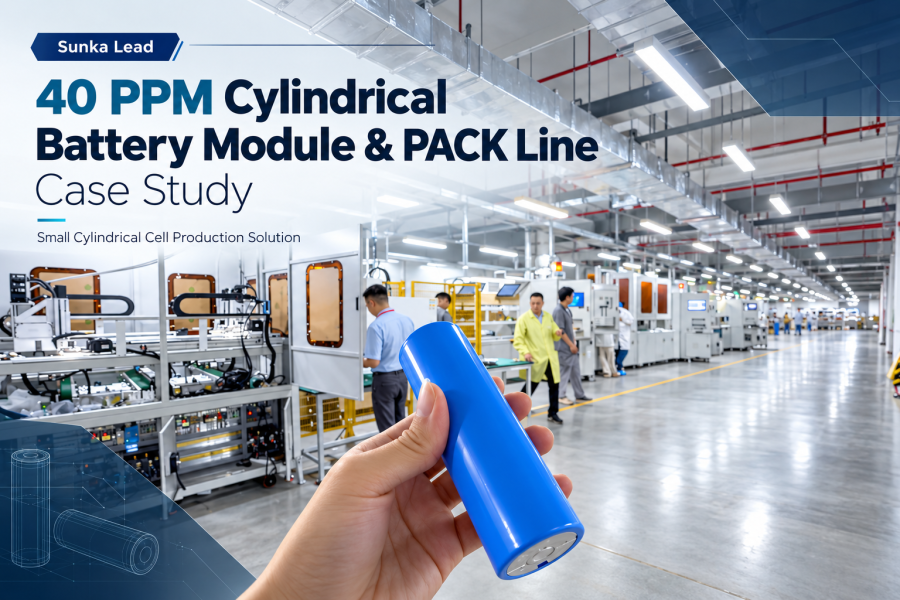
Sunka Lead's small cylindrical battery module and PACK production line is designed for industrial and commercial energy storage applications, with a specified whole-line capacity of 35–40 PPM and a maximum stated capacity of 40 PPM.
The semi-automatic line combines cell inspection, identification, positioning, joining and PACK assembly. Its configuration is designed around the required output, compatible cell formats and product structure.
1. Production Line Overview
The line is designed to support small cylindrical lithium battery applications using compatible cell formats including 18650, 21700, 26650, 14500 and 10440.
Key design characteristics include:
Specified whole-line capacity: 35–40 PPM
Application: industrial and commercial energy storage module and PACK production
Automation level: semi-automatic
Inspection and identification: OCV testing, code scanning and CCD polarity inspection
Joining processes: double-sided spot welding, automatic soldering and gantry spot-welding rework
Production data: MES data upload and product-level traceability
The stated PPM capacity should be evaluated against the product configuration and measurement conditions defined in the technical agreement. It should not automatically be interpreted as 40 finished PACKs per minute.
2. Compatible Products
The documented configuration supports multiple cylindrical cell formats and module arrangements.
| Item | Documented specification |
|---|---|
| Compatible cell formats | 18650, 21700, 26650, 14500, 10440 |
| Module configurations | 1P4S, 1P8S, 1P12S, 1P16S, 1P20S, 1P24S, 1P28S, 1P32S |
| PACK configurations | 1P24S, 1P36, 1P48, 1P64, 1P96 |
| Maximum compatible PACK dimensions | 680 × 550 × 160 mm |
| Main line envelope | Up to 36 m long × 3 m wide × 2.5 m high |
Actual compatibility should be confirmed against the customer's cell dimensions, module drawings, tooling requirements and final product specification.
3. Production Process
The line integrates several operations into a coordinated production flow:
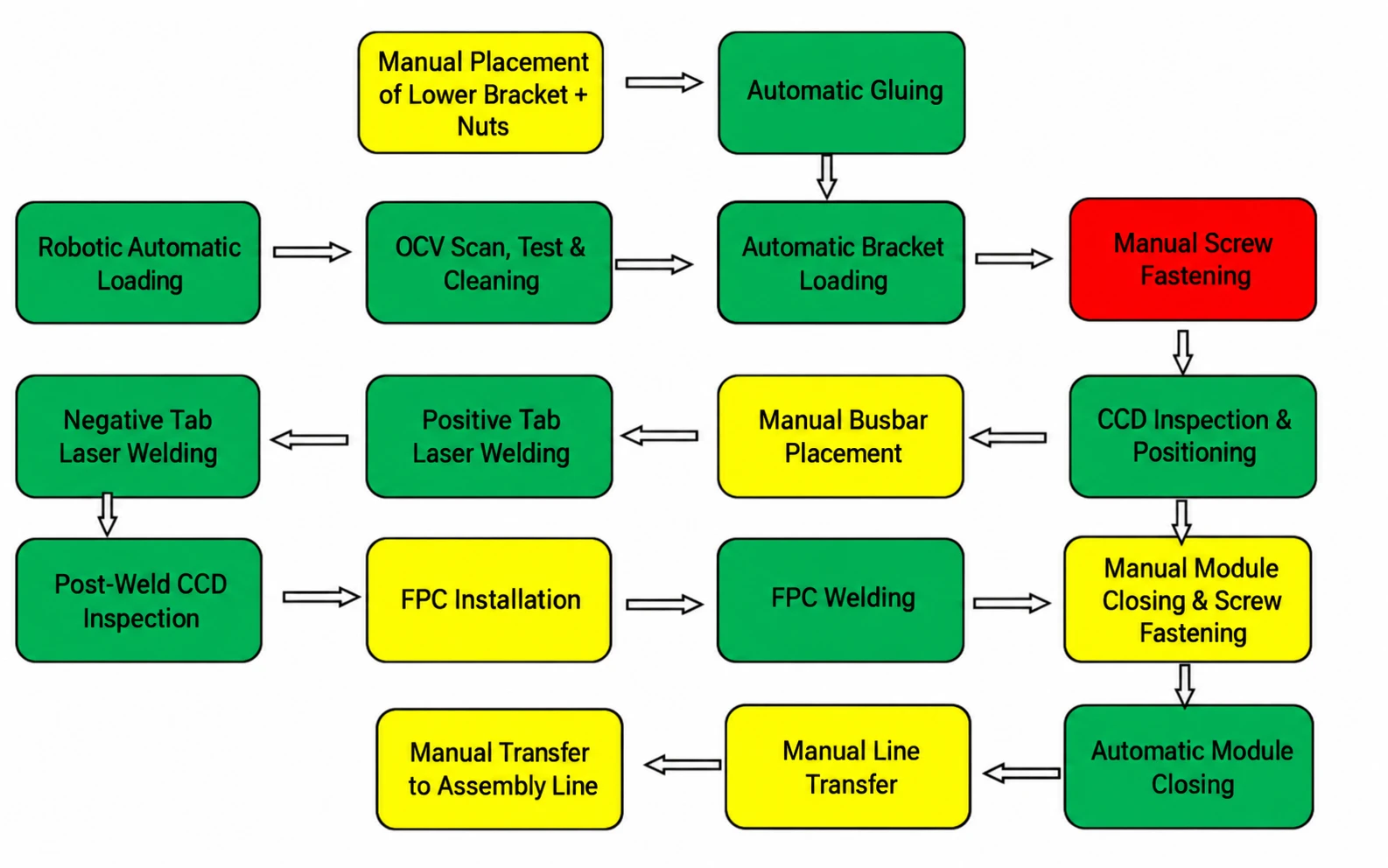
| Section | Process Sequence & Automation |
| Cell & Bracket Preparation | Manual placement of lower bracket and nuts — Manual |
| Automatic gluing — Automatic | |
| Robotic automatic loading — Automatic | |
| OCV scanning, testing and cleaning — Automatic | |
| Automatic bracket loading — Automatic | |
| Module Assembly | Screw fastening — Manual |
| CCD inspection and guide pin insertion — Automatic | |
| Busbar placement — Manual | |
| Module Welding & Inspection | Positive tab laser welding — Automatic |
| Negative tab laser welding — Automatic | |
| CCD post-weld inspection — Automatic | |
| FPC & Module Closing | FPC installation — Manual |
| FPC welding — Automatic | |
| Module closing and screw fastening — Manual | |
| Automatic module closing — Automatic | |
| Material Transfer | Manual line transfer — Manual |
| Manual transfer to the assembly line — Manual |
This configuration places automation at key inspection and joining stages while retaining manual PACK assembly.
The objective is to coordinate throughput and process control without assuming that every operation must be fully automated. The final automation scope should reflect product variety, production requirements and the customer's investment plan.
4. Quality and Equipment Performance
The product brochure specifies the following performance targets:
| Item | Specified target |
|---|---|
| Product qualification rate | ≥99.8% |
| Final yield | ≥99.9% |
| Single-equipment failure rate | ≤2% |
| Whole-line equipment failure rate | ≤3% |
These figures are specified targets, not a substitute for project-specific acceptance results. Actual performance should be assessed using the agreed product, test method, operating conditions and acceptance criteria.
5. Why Line Balancing Matters at 40 PPM
A high headline capacity does not guarantee stable production.
At a 40 PPM target, cell handling, polarity inspection, joining, rework and downstream assembly must be evaluated together. If one operation becomes the bottleneck, the entire line may fail to maintain its required output.
For this reason, line planning should consider the cycle time of each workstation, product changeover requirements, inspection criteria, rework arrangements and the defined capacity measurement method.
Sunka Lead can configure battery module and PACK equipment according to customer requirements and budget. The appropriate balance between automation, flexibility and throughput should be determined during engineering and confirmed during project acceptance.
6. Is This a Laser Welding Production Line?
This documented 35–40 PPM small cylindrical line uses double-sided spot welding, automatic soldering and gantry spot-welding rework.
It should therefore be described as a spot-welding and soldering configuration, rather than a laser welding line. If a project requires laser welding, the joining process and associated equipment must be specified and validated for that particular application.
Frequently Asked Questions
1.What is the capacity of this cylindrical battery line?
The product brochure specifies a whole-line capacity of 35–40 PPM, with 40 PPM as the upper end of the stated range.
2.Is the line fully automatic?
No. It is a semi-automatic line with automated inspection and joining processes and manual PACK assembly.
3.Which cylindrical cell formats are supported?
The documented formats include 18650, 21700, 26650, 14500 and 10440, subject to the specified product and tooling requirements.
4.Can the line be customized?
The equipment configuration can be evaluated according to the customer's cell format, module design, required output, automation scope and budget.
About Sunka Lead
Sunka Lead is the international brand of Guangdong Songke Leading Intelligent Equipment Co., Ltd., specializing in lithium battery manufacturing equipment and turnkey automation solutions for battery module, PACK and Battery Energy Storage System (BESS) production.
Our solutions cover the cell-to-container manufacturing value chain — from cell testing and sorting to module and PACK assembly, laser welding, EOL testing, and PACK-to-container integration, including automated BESS container assembly lines for commercial & industrial (C&I) and utility-scale energy storage applications.
For project inquiries, share your battery cell specifications, module/PACK drawings, BESS container requirements, target production capacity, automation level, and factory conditions. Sunka Lead develops customized production line solutions around your product architecture and manufacturing goals.