
 English
 简体中文


Powertrac 10 GWh BESS Manufacturing Project in India
An Advanced Battery PACK-to-Container Manufacturing Solution by Sunka Lead
1. Project Overview
Sunka Lead is supplying an advanced battery manufacturing production line for Powertrac Group's proposed 10 GWh Battery Energy Storage System (BESS) manufacturing facility in Gujarat, India.
The project represents a major step in Powertrac Group's expansion from solar PV manufacturing, Engineering, Procurement and Construction (EPC), and renewable energy Independent Power Producer (IPP) operations into the energy storage manufacturing sector.
The planned production platform is designed to process prismatic lithium-ion battery cells into battery PACKs and integrate finished battery systems into containerized BESS products.
Unlike a conventional battery pack assembly line, this project focuses on connecting battery manufacturing with downstream BESS integration, combining automated material handling, robotic assembly, automated inspection and testing, and integrated production management.
| Details | |
|---|---|
| Customer | Powertrac Group |
| Equipment Supplier | Sunka Lead |
| Project Location | Gujarat, India |
| Project Type | BESS Manufacturing Production Line |
| Planned Manufacturing Capacity | 10 GWh |
| Battery Cell Format | Prismatic Lithium-Ion Cells |
| Manufacturing Scope | battery pack assembly and PACK-to-Container Integration |
| Automation Architecture | AGV-Based Material Handling and Robotic Automation |
| Quality Management | Automated Inspection and Testing |
| Target Markets | Commercial & Industrial (C&I) and Utility-Scale BESS |
| Reported System Capacity Range | 10 kWh–5 MWh |
| Project Status | Engineering and Factory Preparation |
2. Project Background: From Solar Manufacturing to Integrated Energy Storage
Powertrac Group has established its business in renewable energy through solar PV manufacturing, EPC services, and independent power production.
Its expansion into BESS manufacturing reflects the growing importance of energy storage in renewable energy integration and modern power infrastructure.
The planned 10 GWh manufacturing facility is intended to support several energy storage applications, including:
For Powertrac, establishing domestic BESS manufacturing capabilities is not simply an equipment investment. It is part of a broader strategy to extend its renewable energy business into battery manufacturing and integrated energy storage solutions.
For Sunka Lead, the project demonstrates the ability to provide customized battery manufacturing automation solutions for international energy storage manufacturers.
3. Manufacturing Architecture: From Battery Cells to Containerized BESS
The key characteristic of this project is its integration-oriented manufacturing architecture.
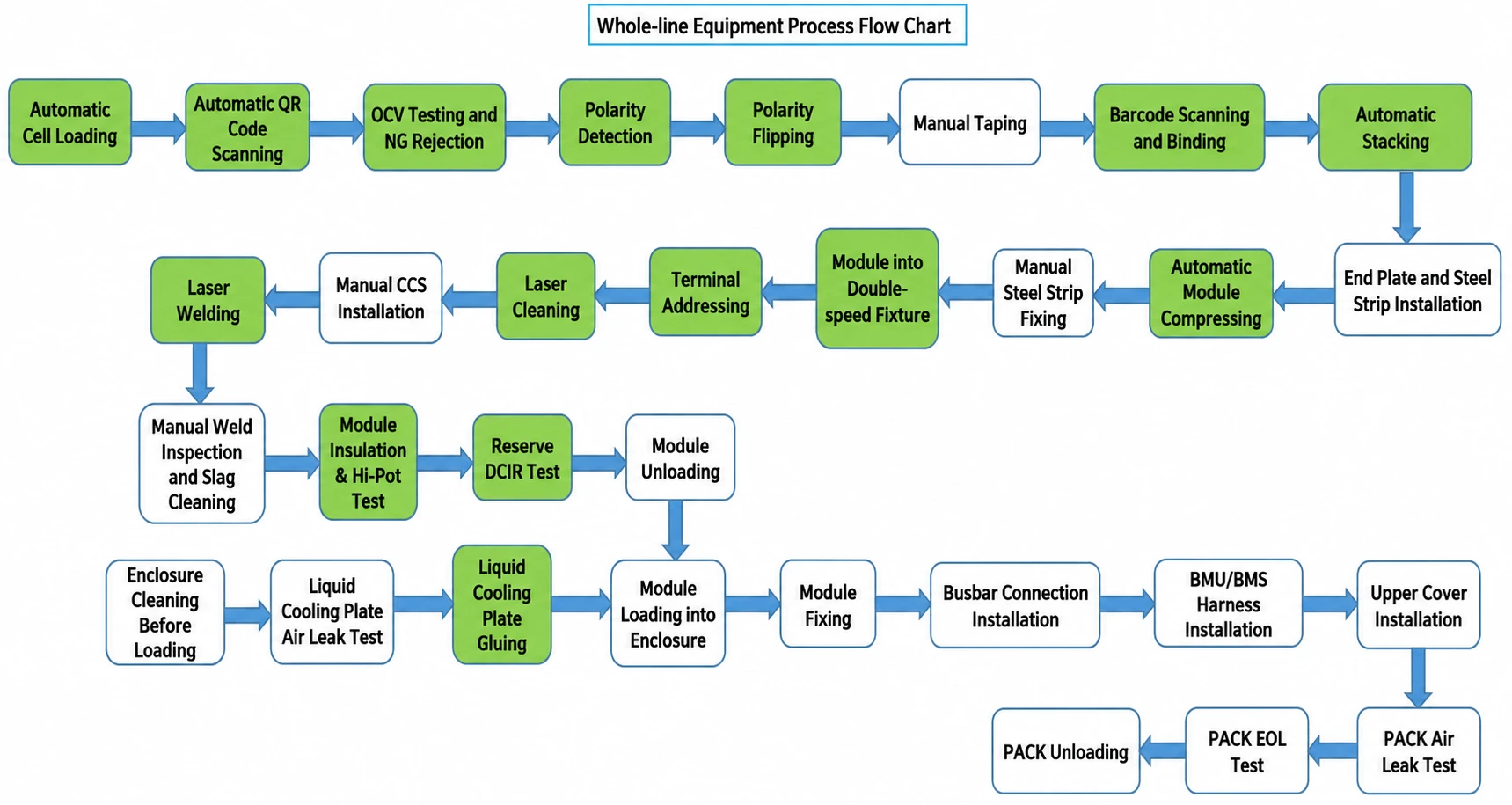
Section | Process Sequence |
|---|---|
Cell Processing | Automatic cell loading → QR code scanning → OCV testing and nonconforming-cell (NG) rejection → Cell polarity detection→ Cell polarity flipping → Cell taping → Barcode scanning and binding → Automatic cell stacking |
Module Assembly | End plate and steel strip installation → Module compression → Steel strip fixing → Module transfer into double-speed fixture |
Module Welding | Terminal addressing → Laser cleaning → CCS installation → laser welding |
Quality Inspection | Post-weld inspection and slag cleaning → Module insulation and Hi-Pot testing → DCIR testing (reserved station) → Module unloading |
PACK Assembly | Enclosure cleaning before loading → Liquid cooling plate air leak testing → Liquid cooling plate gluing → Module loading into enclosure → Module fixing → Busbar connection installation → BMU/BMS harness installation → Upper cover installation |
PACK Testing & Unloading | PACK air leak testing → PACK EOL Testing → PACK unloading |
The production concept connects upstream battery PACK manufacturing with downstream containerized BESS integration.
This is an important distinction between a conventional lithium battery pack production line and a broader BESS manufacturing production platform.
| Manufacturing Stage | Main Function | Manufacturing Objective |
|---|---|---|
| Battery Cell Processing | Battery cell handling and preparation | Establish a controlled cell input process |
| Battery PACK Manufacturing | Battery assembly and integration | Manufacture battery PACK products |
| PACK-to-Container Integration | Integrate battery PACKs into BESS containers | Establish a coordinated battery-to-container workflow |
| Automated Material Handling | AGV-based material transportation | Improve internal logistics efficiency |
| Robotic Assembly | Automated material handling and assembly operations | Improve assembly consistency |
| Inspection and Testing | Automated quality inspection and testing | Verify manufacturing quality |
| BESS System Integration | Integrate battery systems into finished BESS products | Support downstream system delivery |
High-level manufacturing process:
Prismatic Lithium-Ion Battery Cells → Battery PACK Manufacturing → PACK-to-Container Integration → BESS Inspection and Testing → Containerized BESS Products
The actual equipment configuration and detailed station sequence are determined by the approved project engineering design.
4. AGV-Based Intelligent Material Handling
One of the important features of the Powertrac project is the use of Automated Guided Vehicles (AGVs) for intelligent material transportation.
In a high-capacity BESS manufacturing facility, material movement is not simply an auxiliary activity. It directly affects production continuity, workstation utilization, and overall manufacturing efficiency.
Traditional manual material transportation can create unnecessary handling activities, inconsistent delivery timing, and additional labor requirements.
AGV-based logistics provides a more systematic approach to internal material transportation.
| Key Function | Manufacturing Application | Expected Benefit |
|---|---|---|
| Automated Material Transportation | Moving materials between designated production areas | Reduce manual transportation |
| Workstation Material Supply | Delivering materials to designated workstations | Improve material availability |
| Production Flow Coordination | Coordinating material movement with manufacturing operations | Support production continuity |
| Intelligent Dispatching | Coordinating AGV transportation tasks | Improve logistics coordination |
| Production Area Integration | Connecting different manufacturing processes | Support integrated production |
For a BESS manufacturing facility targeting a 10 GWh production scale, AGV planning must consider more than the number of vehicles.
Important engineering considerations include:
The objective is to establish a coordinated material flow system rather than simply introduce automated vehicles into the factory.
5. Robotic Automation for Battery Manufacturing
Robotic automation is another important element of the Powertrac manufacturing architecture.
Battery manufacturing involves repeated handling and positioning operations. As production volume increases, stable material handling and repeatable assembly become increasingly important.
Robotic automation can support manufacturing processes requiring controlled movement, consistent positioning, and coordinated workstation operations.
| Automation Area | Typical Application | Manufacturing Value |
|---|---|---|
| Robotic Material Handling | Battery and component transfer | Reduce repetitive manual handling |
| Automated Loading | Material loading into designated equipment | Improve feeding consistency |
| Robotic Assembly | Repetitive assembly operations | Improve process repeatability |
| Automated Transfer | Moving workpieces between processes | Support continuous production |
| Robotic Coordination | Coordinating equipment and material movement | Improve line integration |
The selection of robotic systems should be based on the battery product structure, payload requirements, positioning accuracy, cycle time, and workstation layout.
For high-volume battery manufacturing, the real value of robotics comes from its integration with the complete production process.
6. Automated Inspection and Testing: Building Manufacturing Quality into the Process
Battery manufacturing quality cannot rely entirely on final inspection.
A well-designed manufacturing system should establish quality control throughout the production process, identifying abnormalities as early as possible.
The Powertrac project has been publicly described as incorporating automated inspection, testing, and integrated quality-control systems.
For battery PACK and BESS manufacturing, important quality-control considerations include:
| Quality Control Area | Key Inspection Objective | Manufacturing Importance |
|---|---|---|
| Battery Cell Inspection | Verify incoming cell condition and relevant electrical characteristics | Prevent unsuitable cells from entering production |
| Assembly Inspection | Verify component positioning and assembly consistency | Reduce assembly-related defects |
| Welding Inspection | Verify welding position and connection quality | Improve electrical connection reliability |
| Electrical Testing | Verify relevant electrical safety and performance characteristics | Support product quality verification |
| PACK Inspection | Verify PACK assembly and enclosure integrity | Reduce downstream quality risks |
| BESS System Testing | Verify integrated system functions according to product requirements | Support final product acceptance |
The inspection architecture should be designed around the product structure, manufacturing process, and customer quality requirements.
For overseas BESS manufacturers, this is particularly important because battery PACK quality directly affects the reliability and long-term operation of the finished energy storage system.
7. AI-Enabled Manufacturing and Intelligent Production Management
The Powertrac manufacturing project has also been publicly described as an AI-enabled manufacturing initiative.
AI-driven manufacturing and intelligent production management are increasingly important in modern battery factories.
Their potential value extends beyond equipment automation.
| Intelligent Manufacturing Area | Potential Application |
|---|---|
| Production Monitoring | Monitoring equipment and production status |
| Process Data Analysis | Analyzing manufacturing data and process variations |
| Quality Management | Supporting quality abnormality identification |
| Production Coordination | Improving production scheduling and resource coordination |
| Intelligent Logistics | Supporting AGV dispatching and material flow coordination |
| Manufacturing Traceability | Supporting product and process data management |
A key consideration is that AI-enabled manufacturing should be supported by reliable equipment data, standardized process information, and consistent communication between production systems.
AI should complement the manufacturing execution system and equipment automation architecture rather than operate as an isolated technology.
The specific AI algorithms, data architecture, and inspection functions of the Powertrac project have not been publicly disclosed and are therefore not presented as confirmed implementation details here.
8. PACK-to-Container Integration: Beyond Conventional Battery PACK Production
One of the most important aspects of this project is the integration of battery PACK manufacturing with containerized BESS production.
A conventional lithium battery pack production line focuses primarily on manufacturing battery modules and PACK products.
A PACK-to-Container integration solution extends the manufacturing process downstream, connecting battery PACK production with the assembly of containerized energy storage systems.
| Comparison | Conventional PACK Production Line | PACK-to-Container BESS Manufacturing |
|---|---|---|
| Main Product | Battery PACK | Containerized BESS |
| Production Scope | Battery assembly and PACK manufacturing | PACK manufacturing and downstream BESS integration |
| Material Flow | Primarily within the PACK production area | Extends into container integration areas |
| Automation Requirements | Battery assembly and inspection automation | Battery assembly, material handling, and system integration |
| Quality Control | PACK-level inspection and testing | PACK-level and downstream system-level verification |
| Final Output | Battery PACK | Integrated containerized energy storage product |
This manufacturing approach requires coordinated engineering across several interfaces.
| Integration Interface | Key Engineering Consideration |
|---|---|
| Battery PACK and Container | Mechanical dimensions, positioning, and installation compatibility |
| PACK and Electrical Systems | Electrical connections and interface compatibility |
| Battery and Thermal Management | Cooling system integration |
| Material Handling and Assembly | Transfer routes, lifting operations, and workstation coordination |
| Production and Testing | Test requirements and product quality verification |
Powertrac's wider facility plan has also been publicly reported to include in-house container fabrication.
Container shell fabrication should be distinguished from the battery PACK manufacturing and integration equipment supply scope. The exact division of equipment responsibilities should be confirmed against the approved project scope.
9. Target BESS Applications
The Powertrac facility is intended to serve both commercial and industrial energy storage markets and utility-scale energy storage applications.
Public project reporting describes a product/system capacity range from 10 kWh to 5 MWh.
| Application | Typical Energy Storage Requirement | Potential Value |
|---|---|---|
| Commercial Energy Storage | Commercial facility energy management | Reduce electricity costs and improve energy utilization |
| Industrial Energy Storage | Industrial load management | Support peak-load management and power reliability |
| Solar-Plus-Storage | Renewable energy integration | Improve renewable energy utilization |
| Utility-Scale BESS | Large-scale grid energy storage | Support grid stability and energy balancing |
| Grid Ancillary Services | Grid support and operational flexibility | Support modern power system requirements |
The ability to serve different energy storage applications requires suitable battery product configurations, system integration, and manufacturing quality control.
10. Project Engineering and Implementation Progress
A large-scale BESS manufacturing project requires coordinated work across equipment engineering, factory infrastructure, automation integration, and installation preparation.
Following the order announcement, Sunka Lead's technical team visited the Powertrac factory campus to advance project engineering coordination.
The publicly reported engineering activities include:
| Engineering Workstream | Key Activities |
|---|---|
| Detailed Engineering | Production requirements and equipment engineering |
| Plant Layout | Manufacturing area and equipment arrangement |
| Utilities and Electrical Infrastructure | Factory utility and electrical preparation |
| Production Line Integration | Coordination of manufacturing processes |
| AGV and Robotic Automation | Material handling and automation planning |
| Factory Readiness | Preparation for equipment installation |
| Installation Planning | Coordination of installation and commissioning activities |
The project announcement reported the following target schedule:
| Milestone | Publicly Reported Schedule |
|---|---|
| Equipment Order Announcement | September 2026 |
| Expected Equipment Arrival | Third week of November 2026 |
| Target Commercial Production | Third week of January 2027 |
These dates are announced project targets, not confirmation of completed delivery, installation, commissioning, or commercial production.
The project will continue through the relevant engineering, equipment manufacturing, delivery, installation, commissioning, and acceptance stages.
11. Why This Project Matters for International BESS Manufacturers
The Powertrac project demonstrates an important direction in the development of battery manufacturing: moving beyond standalone battery PACK assembly toward integrated BESS manufacturing.
For manufacturers planning to establish or expand their energy storage production capabilities, several engineering considerations are particularly important.
| Key Consideration | Why It Matters |
|---|---|
| Manufacturing Capacity Planning | Production capacity must match market demand and product configuration |
| Battery Product Compatibility | Equipment must be designed around actual battery cell and PACK specifications |
| Automated Material Handling | Internal logistics directly affect production continuity |
| Robotic Automation | Supports repeatable assembly and material handling |
| Automated Inspection | Helps identify process abnormalities and improve manufacturing consistency |
| PACK-to-Container Integration | Connects battery manufacturing with finished BESS production |
| Production Management | Supports coordinated equipment operation and manufacturing visibility |
| Factory Infrastructure | Utilities, electrical systems, layout, and installation readiness affect project execution |
A successful BESS manufacturing project is not determined by the number of automated machines alone.
It depends on how effectively the complete manufacturing architecture connects equipment, material flow, product assembly, quality control, and downstream system integration.
12. Frequently Asked Questions About the Powertrac 10 GWh BESS Project
Q1. What is the Powertrac 10 GWh BESS manufacturing project?
Powertrac Group has placed an order with Sunka Lead for a proposed 10 GWh BESS manufacturing production line in Gujarat, India. The project focuses on manufacturing battery PACKs from prismatic lithium-ion cells and integrating them into containerized energy storage systems.
Q2. Who is supplying the Powertrac BESS production line?
Sunka Lead, the international brand of Guangdong Songke Leading Intelligent Equipment Co., Ltd., is the publicly identified production-line equipment supplier.
Q3. Where will the Powertrac BESS manufacturing facility be located?
The facility is planned for Gujarat, India. pv magazine India has identified Surendranagar district as the planned installation location.
Q4. What type of battery cells will the production line process?
Public project information identifies prismatic lithium-ion battery cells as the input format for battery PACK manufacturing.
Q5. What is the difference between a battery PACK assembly line and a BESS manufacturing line?
A conventional battery PACK assembly line focuses on assembling battery cells into battery PACK products.
A broader BESS manufacturing production line extends beyond PACK assembly to include downstream integration of battery systems into containerized energy storage products, together with relevant inspection and testing processes.
Q6. What automation technologies are planned for the Powertrac project?
The publicly announced manufacturing architecture includes AGV-based material handling, robotic assembly and material handling, automated inspection and testing, integrated quality-control systems, and AI-enabled manufacturing management.
Q7. What is the reported product capacity range of the Powertrac BESS facility?
Public reporting by pv magazine India describes an energy storage product range from 10 kWh to 5 MWh. Final product configurations and specifications should be confirmed against Powertrac's approved product portfolio.
Q8. Is the Powertrac 10 GWh production line already operational?
The project was announced in September 2026. Publicly reported targets indicated equipment arrival in November 2026 and commercial production in January 2027. These are planned milestones rather than confirmation of completed production.
Q9. Does the 10 GWh figure represent the output of a single machine?
No. The 10 GWh figure describes the planned manufacturing capacity of the overall BESS manufacturing project. It should not be confused with an individual machine's processing speed, which is normally expressed using production cycle time or PPM.
Q10. Does Sunka Lead provide customized BESS manufacturing production lines?
Sunka Lead specializes in customized lithium battery module and PACK production equipment and automated production-line solutions. Equipment configuration can be evaluated according to battery cell specifications, product design, production capacity, automation requirements, factory layout, and integration scope.
13. About Sunka Lead
Sunka Lead is the international brand of Guangdong Songke Leading Intelligent Equipment Co., Ltd.
Sunka Lead specializes in the design, engineering, and manufacturing of lithium battery module and PACK production equipment, providing customized automation solutions for prismatic, cylindrical, pouch, and blade battery applications.
Its solution portfolio covers battery cell processing, module assembly, laser welding, PACK assembly, testing, packaging, and MES integration.
From individual battery manufacturing equipment to integrated production-line solutions, Sunka Lead supports battery manufacturers in developing automated, scalable, and product-oriented manufacturing systems.
Sunka Lead — Engineering Intelligent Manufacturing Solutions for the Global Battery Industry.
14. Project Media Coverage and Public References
The Powertrac–Sunka Lead 10 GWh BESS manufacturing project has received coverage from several energy industry publications.
| Media Publication | Coverage |
|---|---|
| pv magazine India | Powertrac orders 10 GWh BESS manufacturing line from Sunka Lead |
| Energetica India | Powertrac places order with Sunka Lead for 10 GWh BESS manufacturing line |
| ESS News | India's Powertrac orders 10 GWh BESS production line from Sunka Lead |
These independent publications provide additional public references for the project announcement and its manufacturing objectives.
For further information about Sunka Lead's lithium battery manufacturing equipment and customized BESS production-line solutions, please contact our engineering team.
About Sunka Lead
Sunka Lead is the international brand of Guangdong Songke Leading Intelligent Equipment Co., Ltd., specializing in lithium battery manufacturing equipment and turnkey automation solutions for battery module, PACK and Battery Energy Storage System (BESS) production.
Our solutions cover the cell-to-container manufacturing value chain — from cell testing and sorting to module and PACK assembly, laser welding, EOL testing, and PACK-to-container integration, including automated BESS container assembly lines for commercial & industrial (C&I) and utility-scale energy storage applications.
For project inquiries, share your battery cell specifications, module/PACK drawings, BESS container requirements, target production capacity, automation level, and factory conditions. Sunka Lead develops customized production line solutions around your product architecture and manufacturing goals.