
 English
 简体中文
简体中文

This is a cylindrical battery PACK production line customized for a customer from Zhejiang.
The specified cell processing capacity is 20-25 PPM.
In this project, PPM refers to cylindrical cell processing throughput rather than finished battery PACK output per minute.
When the same pressure head can be used for positive and negative terminals, the line can reach up to 25 PPM; when the pressure head needs to be changed, the designed capacity is about 20 PPM.
The line is designed for large cylindrical cells and supports both same-side and opposite-side terminal structures. It is compatible with cylindrical cell formats including 40135, 42135, 44135, 46140, 48172, 50172, 52172, 56172, 60150, 60180 and 65180.
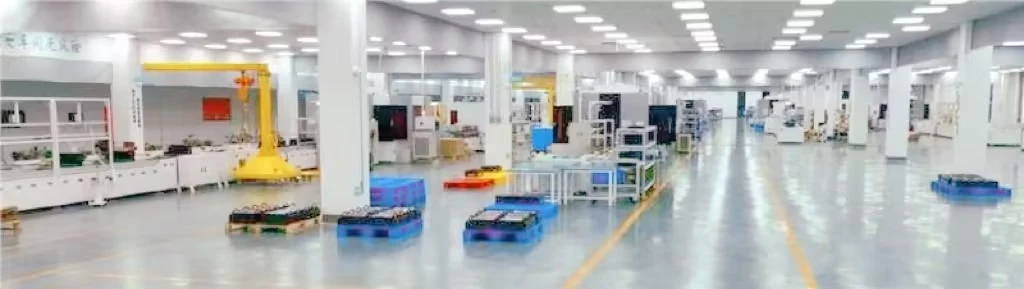
Live shot: overview of the cylindrical PACK production line
Key project specifications
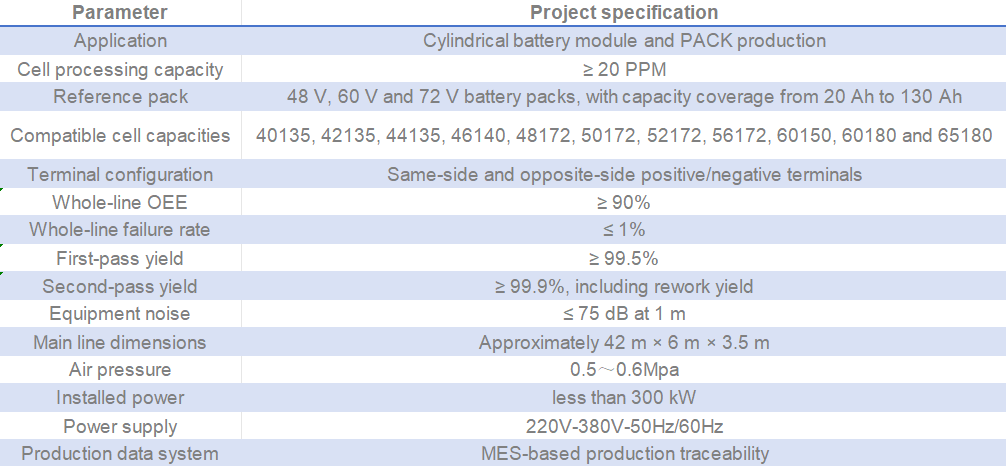
Key specifications:
The line is designed for 20-25 PPM cylindrical cell processing. It supports multiple 48 V, 60 V and 72 V PACK products, cylindrical cell diameters from 40 mm to 65 mm, and cell heights from 135 mm to 180 mm. The total installed power is designed within 300 kW, equipment utilization is specified above 90%, first-pass yield is specified at ≥99.5%, second-pass yield at ≥99.9%, line failure rate below 1%, and changeover time below 8 hours after the first changeover.
The reference PACK products include 48 V, 60 V and 72 V battery packs, with capacity coverage from 20 Ah to 130 Ah according to the product portfolio in the technical agreement.
Equipment layout
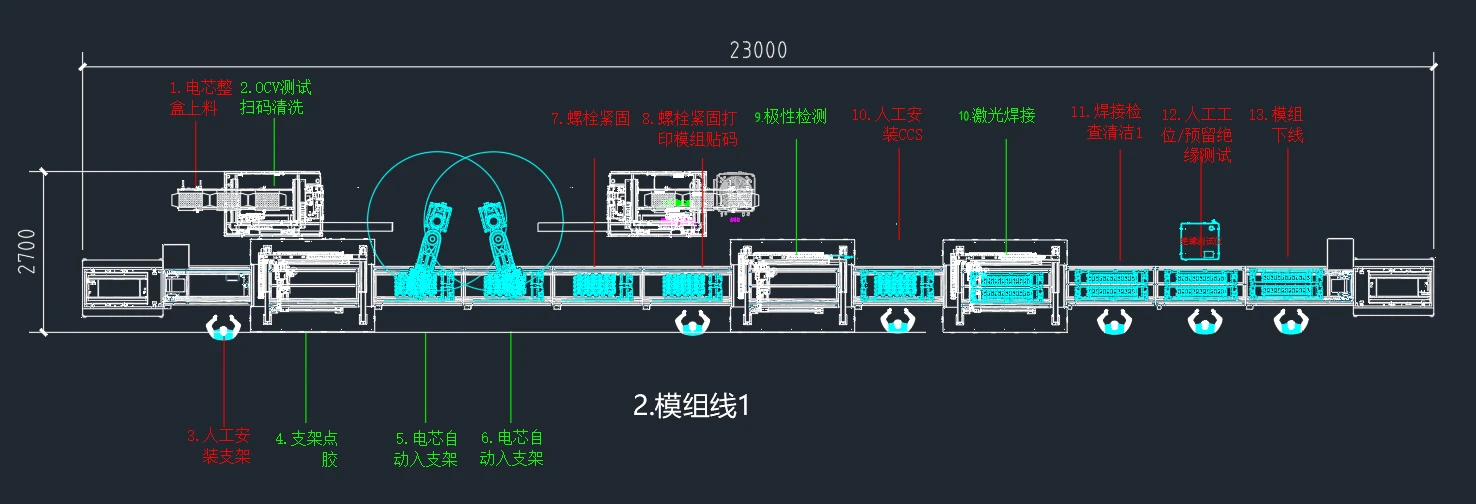
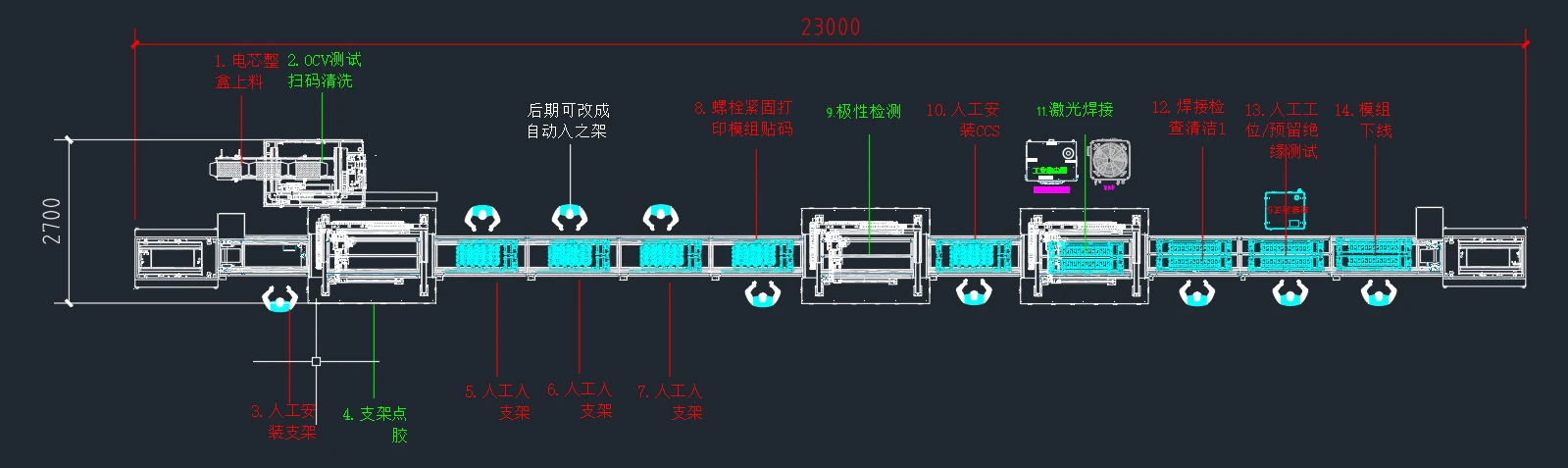
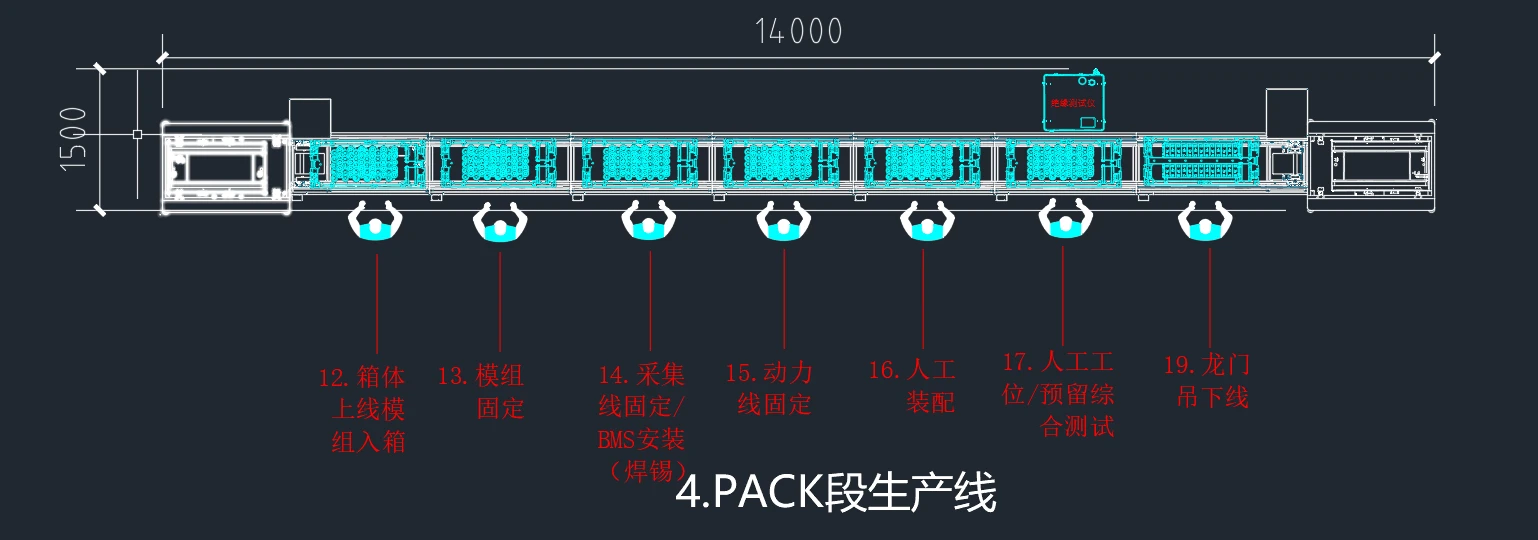
2D layout plan
The production system is organized around OCV testing and sorting, module assembly and welding, PACK assembly, cover installation, testing, repair, packaging and MES data management. The module and PACK sections use double-layer speed-chain conveyors with pallet circulation. Module pallets are designed around 1200 mm x 600 mm, while PACK pallets are designed around 800 mm x 600 mm.
The layout reserves manual operating positions for flexible assembly while automating high-risk and quality-critical operations such as OCV testing, cell cleaning, NG separation, CCD addressing, laser welding, data binding and traceability.
Production flow chart
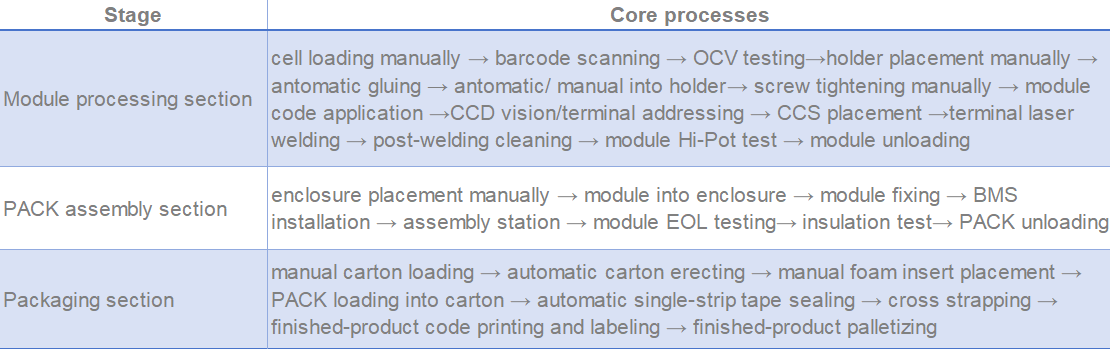
The production line is divided into three interconnected sections: module processing section, PACK assembly section, packaging section with MES traceability.
Module processing section: cell loading manually → barcode scanning → OCV testing→holder placement manually → antomatic gluing → antomatic/ manual into holder→ screw tightening manually → module code application →CCD vision/terminal addressing → CCS placement →terminal laser welding → post-welding cleaning → module Hi-Pot test → module unloading.
PACK assembly section: enclosure placement manually → module into enclosure → module fixing → BMS installation → assembly station → module EOL Testing→ insulation test→ PACK unloading
Packaging section: manual carton loading → automatic carton erecting → manual foam insert placement → PACK loading into carton → automatic single-strip tape sealing → cross strapping → finished-product code printing and labeling → finished-product palletizing
Production line features
1. Throughput was matched to cylindrical cell handling and welding requirements.
The 120-150 PPM capacity is based on cell-level processing. This avoids confusing cell throughput with finished PACK output and makes the line specification easier to evaluate for real production planning.
2. Compatibility was designed around the actual product portfolio.
The line supports 48 V, 60 V and 72 V battery packs, multiple 20 Ah to 130 Ah product variants, and a wide range of cylindrical cell formats. It also covers same-side and opposite-side terminal cells, which is important for manufacturers with multiple market-facing PACK models.
3. Automation was concentrated on quality-critical processes.
Cell barcode scanning, OCV/IR testing, laser cleaning, NG sorting, automatic dispensing, robot cell insertion, CCD polarity inspection, addressing and laser welding are automated or semi-automated, while selected assembly steps remain manual for product flexibility.
4. CCD addressing connects inspection data directly with welding execution.
The CCD system identifies terminal coordinates, polarity arrangement, Mark points and height information, then transfers addressing data to the laser welding station. The addressing accuracy is specified better than ±0.2 mm, and photos, measurement data and position information can be stored for traceability.
5. Laser welding was designed as a controlled, traceable process.
The welding station uses a ≥3000 W laser, CCD positioning, height measurement, nitrogen protection, enclosed laser safety protection and dust extraction. Welding data such as barcode, time, process parameters, equipment information, date and shift can be traced by time or module barcode.
6. MES traceability from cell to finished PACK.
The project includes line-level MES functions for user and role management, production batches, process routing, station management, scheduling, OCV sorting, cell-to-module binding, polarity addressing, welding data upload, PACK testing, packaging, warehousing and forward/reverse traceability.
Together, these decisions create a cylindrical battery pack production line designed around real product compatibility, quality gates and traceable manufacturing rather than a simple list of standalone machines.
7.Manual assembly preserves product flexibility
Manual cell insertion is retained where multiple product configurations make fast adaptation more important.
Frequently asked questions
1. What is the production capacity of this cylindrical battery pack line?
The specified cell processing capacity is 20-25 PPM. This refers to cylindrical cell processing throughput, not finished PACK output per minute.
2.Why use both automatic and manual cell insertion in the same battery production project?
Because the two methods serve different production scenarios.
Automatic insertion is better suited to stable, high-volume production of the same product, while manual insertion provides greater flexibility when multiple battery models need to be produced.
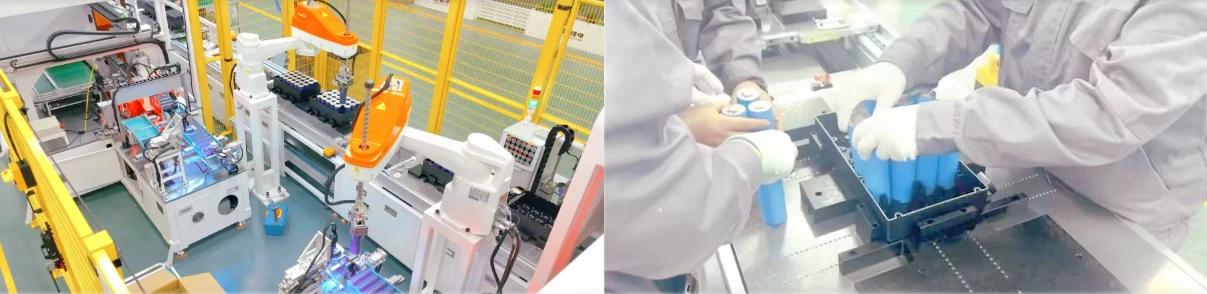
automatic cell into holder+manual cell into holder
3.When should robotic cell insertion be considered?
Robotic insertion is particularly suitable when production volume is high, the product structure is stable and the same module configuration will be manufactured continuously.
4.When is manual cell insertion more suitable?
Manual insertion can be suitable when production involves multiple product models, frequent changeovers or variable module configurations.
5.Does manual cell insertion mean the production line is low-tech?
No.
Automation should be evaluated according to manufacturing requirements.
In this project, quality-critical processes such as OCV testing, polarity inspection, terminal positioning and laser welding remain automated even when cell insertion is performed manually.
6.Can the same production line support different cylindrical cells?
The project is designed to support multiple large cylindrical cell models, including 40135 through 65180 configurations specified for the project, subject to the corresponding tooling and product requirements.
7. Which cylindrical cell formats can the line support?
The compatible cell formats include 40135, 42135, 44135, 46140, 48172, 50172, 52172, 56172, 60150, 60180 and 65180 cylindrical cells, covering cell diameters from 40 mm to 65 mm and heights from 135 mm to 180 mm.
8. Which PACK products can the line support?
The line is designed around multiple 48 V, 60 V and 72 V PACK products, with capacities from 20 Ah to 130 Ah according to the product list in the technical agreement.
9. Is this production line fully automatic?
No. It is a semi-automatic cylindrical PACK line. Automation is applied to key quality and efficiency processes such as OCV/IR testing, barcode identification, laser cleaning, NG separation, dispensing, robot loading, CCD addressing and laser welding. Manual work remains in selected assembly, inspection, PACK installation and packaging steps to support product flexibility.
10. How are NG cells handled?
Cells with barcode, OCV or IR issues are automatically separated to NG buffer positions. OCV/IR data is bound with barcode information, stored locally and uploaded to the system for quality tracking.
11. How does the CCD polarity inspection and addressing station reduce welding risk?
The station scans the module code, photographs the module frame and cell terminals, checks polarity arrangement, identifies terminal center positions and measures terminal height. If polarity, distance, offset or height difference is abnormal, the station can alarm and prevent downstream errors.
12. What are the key welding controls in this project?
The welding station uses CCD positioning, sensor height measurement, adjustable pressure, nitrogen protection, enclosed safety protection and dust extraction. The welding qualification rate is specified at ≥99.9%, and the single-terminal shear force requirement is listed as ≥1800 N subject to the customer product.
13. Does the line include MES?
Yes. The line includes MES data connection and a MES server. The MES scope covers production preparation, batch management, station management, OCV sorting, cell grouping and binding, polarity addressing, welding data, PACK testing, packaging, warehousing and forward/reverse traceability.
14. What PACK tests can be connected to the system?
The project includes or reserves data functions for PACK insulation withstand-voltage testing, charge-discharge aging, comprehensive testing, appearance inspection and packaging checks. The equipment list also includes a comprehensive tester with communication and an airtightness tester for the PACK section.
About the solution provider
Sunka Lead is the international brand of Guangdong Songke Leading Intelligent Equipment Co., Ltd.
Sunka Lead specializes in the design, engineering and manufacturing of lithium battery module and PACK production equipment, providing customized solutions for prismatic, cylindrical and pouch battery applications.
From cell processing and module assembly to laser welding, PACK assembly, testing, packaging and MES integration, Sunka Lead provides production equipment and turnkey line solutions for lithium battery manufacturers worldwide.