
 English
 简体中文


Case Study: 8 PPM Prismatic Energy Storage Module & PACK Production Line | Sunka Lead
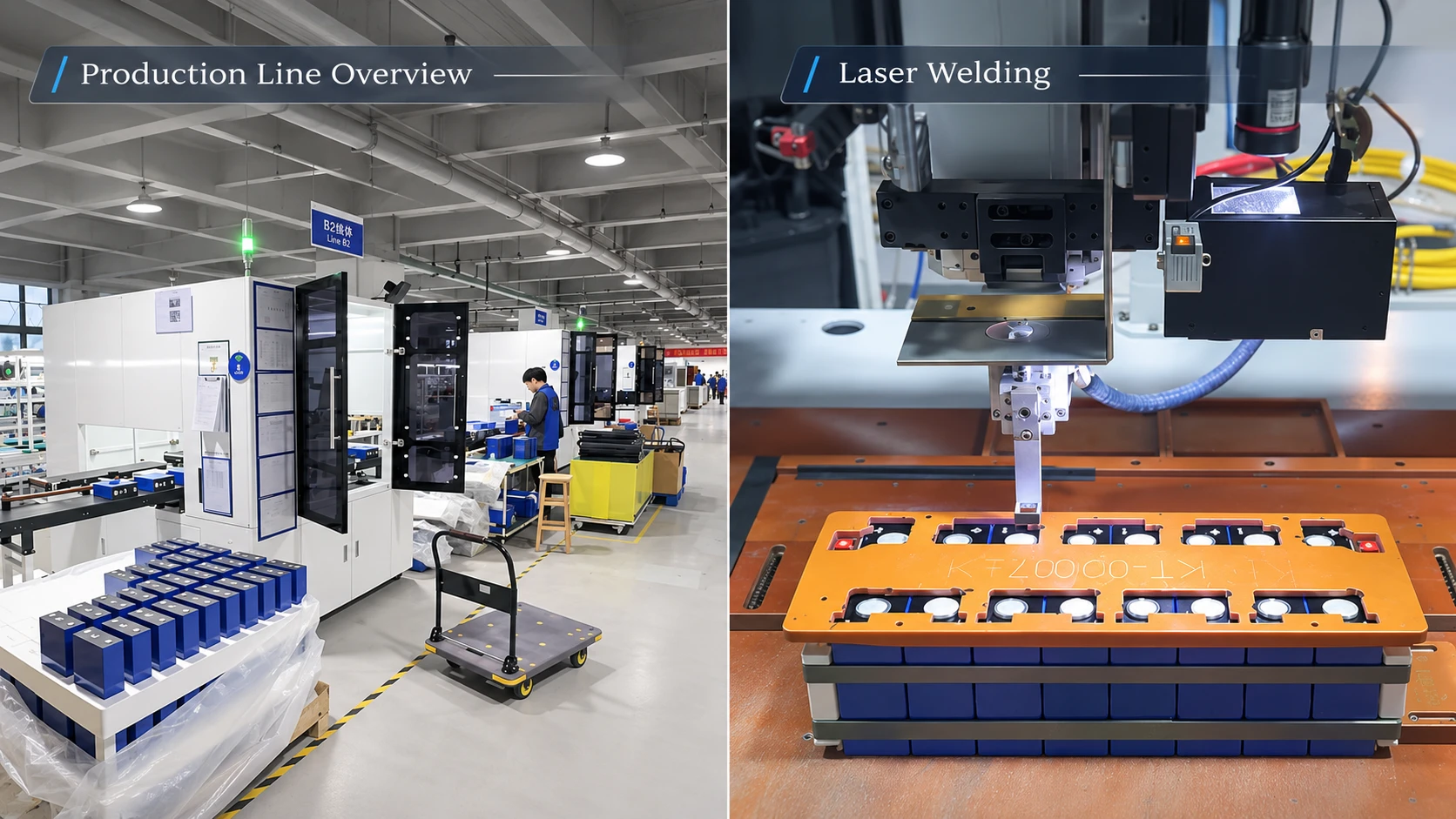
This case study presents a customized semi-automatic prismatic lithium battery energy storage module and PACK production line engineered by Sunka Lead.
The production line is designed around 280 Ah prismatic lithium battery cells, with a reference configuration of 1P8S modules and 2P8S air-cooled PACKs.
The specified production capacity is 8 PPM for cell processing and 45 UPH for module production. The overall solution integrates cell testing and sorting, module assembly, quality inspection, laser welding and automated material transfer, combining automation with flexible manual assembly operations.
Key Project Specifications
| Item | Project Specification |
|---|---|
| Application | Prismatic energy storage battery module and PACK production |
| Battery Cell Type | Prismatic lithium battery cells |
| Reference Cell Capacity | 280 Ah |
| Reference Cell Dimensions | 174 × 72 × 207 mm |
| Reference Cell Weight | 5.43 ± 0.20 kg |
| Module Configuration | 1P8S |
| PACK Configuration | 2P8S |
| Cooling System | Air-cooled |
| Finished PACK Weight | Less than 80 kg |
| Cell Processing Capacity | 8 PPM |
| Module Production Capacity | 45 UPH |
| Production Configuration | Semi-automatic |
| Total Installed Power | ≤ 40 kW |
| Overall Line Dimensions | 20,000 × 2,750 × 2,800 mm |
The above specifications represent the reference product and project design requirements. Compatibility with additional cell formats, module configurations and PACK designs requires separate engineering evaluation.
Specified Whole-Line Performance Targets
| Performance Indicator | Design or Acceptance Target |
|---|---|
| Cell Processing Capacity | 8 PPM |
| Module Production Capacity | 45 UPH |
| Equipment Utilization Rate | > 90% |
| First-Pass Yield | ≥ 99% |
| Second-Pass Yield, Including Rework | ≥ 99.5% |
| Whole-Line Equipment Failure Rate | ≤ 2% |
These figures are specified design or acceptance requirements in the project technical agreement, not independently verified production results.
The stated yield targets exclude defects caused by incoming materials. The whole-line equipment failure rate is calculated based on cumulative equipment failure time over 30 days relative to available line operating time.
Production Line Configuration
The production system is designed as an integrated manufacturing solution covering three major functions:
| Production Section | Main Functions |
|---|---|
| Cell Processing | Cell feeding, barcode identification, electrical testing and cell sorting |
| Module Assembly | Cell stacking, module assembly, compression and fastening |
| Module Joining & Quality Control | Polarity verification, terminal positioning, busbar joining and weld inspection |
| Material Handling | Pallet circulation, conveyor transfer and module unloading |
The line adopts a semi-automatic production configuration. Automation is concentrated on key inspection, processing and material transfer functions, while selected assembly operations remain manual to accommodate the reference product structure.
Production Process Flow
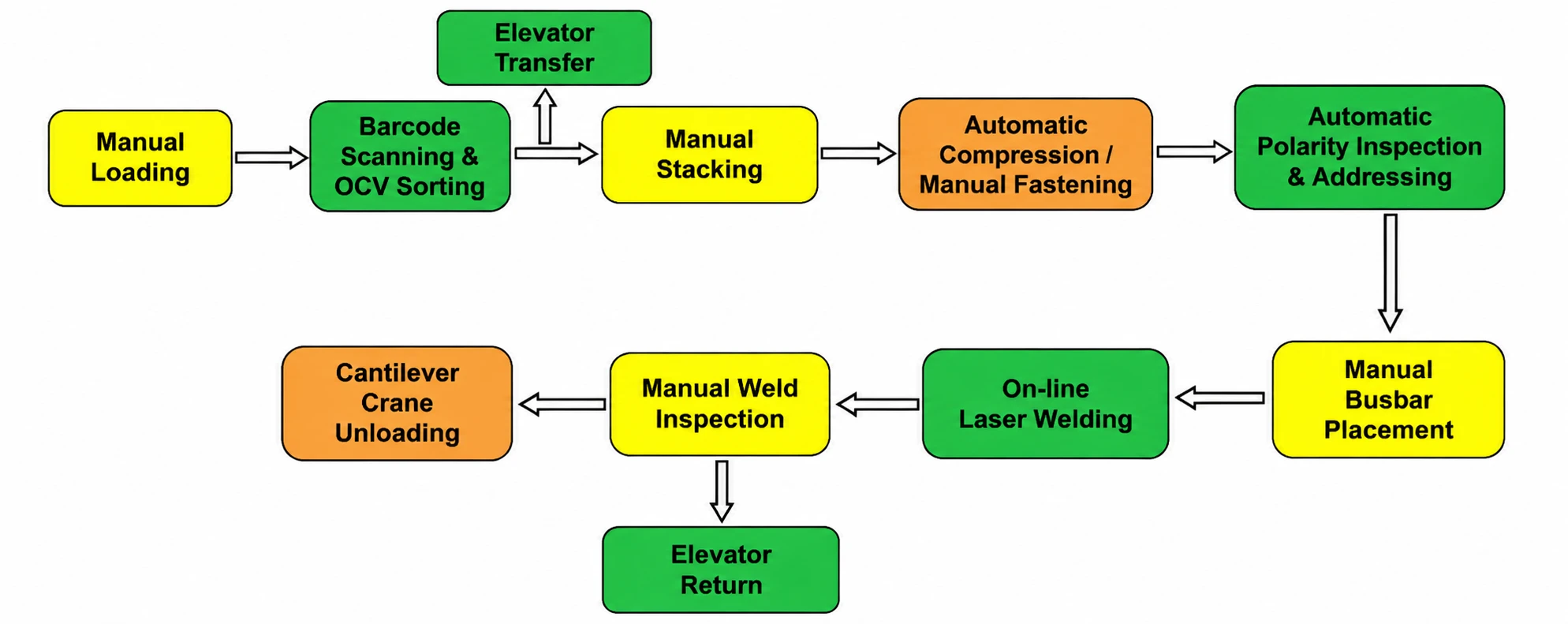
The overall manufacturing workflow is organized as follows:
| Production Section | Process Sequence |
|---|---|
| Cell Processing | Manual Cell Loading → Barcode Scanning → OCV & Internal Resistance Testing → Automatic OK/NG Sorting |
| Module Assembly | Manual Module Stacking and Box Loading → Automatic Compression → Manual Fastening or Strapping |
| Polarity Inspection | Automatic CCD Polarity Detection → Terminal Addressing |
| Busbar Installation & Welding | Manual Busbar Placement → Laser Welding |
| Final Inspection & Transfer | Manual Weld Inspection → Cleaning → Cantilever Crane Unloading |
The production system also incorporates double-layer speed-chain conveyors, automatic lifting mechanisms and pallet circulation to coordinate material movement across the line.
Production Data and System Integration
The project includes barcode-based cell identification and industrial PC-based local data storage during cell testing and sorting.
A reserved MES interface is specified in the installation requirements.
The technical agreement specifies local data storage and a reserved interface. It does not define a completed MES integration or a fully implemented production traceability system.
Frequently Asked Questions
1. What type of battery cells does this production line support?
The reference project is designed for 280 Ah prismatic lithium battery cells measuring 174 × 72 × 207 mm.
2. What are the module and PACK configurations?
The reference module configuration is 1P8S, while the finished PACK configuration is 2P8S with an air-cooled design.
3. What is the production capacity of this line?
The specified cell processing capacity is 8 PPM, and the module production capacity is 45 UPH. These are two different production indicators and should not be interpreted as finished PACK output per minute.
4. Is this a fully automatic production line?
No. This is a semi-automatic production line. It combines automated processing, inspection and material handling with manual operations at selected assembly stages.
5. What is the overall equipment footprint?
The specified overall line dimensions are 20,000 × 2,750 × 2,800 mm, with total installed power not exceeding 40 kW.
6. What are the specified whole-line quality targets?
The project specifies an equipment utilization rate above 90%, first-pass yield of at least 99%, second-pass yield of at least 99.5%, and a whole-line equipment failure rate not exceeding 2%. These are project design or acceptance targets.
7. Can this line manufacture different prismatic battery products?
The reference configuration is designed around the specified 280 Ah cell, 1P8S module and 2P8S PACK. Additional product configurations require engineering evaluation based on cell dimensions, module drawings, PACK structure and production requirements.
8. Does the production line include MES integration?
The project specifies local production data storage and a reserved MES interface. A completed MES integration and full production traceability system are not included as confirmed deliverables in the available technical agreement.
About Sunka Lead
Sunka Lead is the international brand of Guangdong Songke Leading Intelligent Equipment Co., Ltd., specializing in lithium battery manufacturing equipment and turnkey automation solutions for battery module, PACK and Battery Energy Storage System (BESS) production.
Our solutions cover the cell-to-container manufacturing value chain — from cell testing and sorting to module and PACK assembly, laser welding, EOL Testing, and PACK-to-container integration, including automated BESS container assembly lines for commercial & industrial (C&I) and utility-scale energy storage applications.
For project inquiries, share your battery cell specifications, module/PACK drawings, BESS container requirements, target production capacity, automation level, and factory conditions. Sunka Lead develops customized production line solutions around your product architecture and manufacturing goals.