
 English
 简体中文


Case study: ≥10 PPM pouch cell module and PACK production line | Sunka Lead
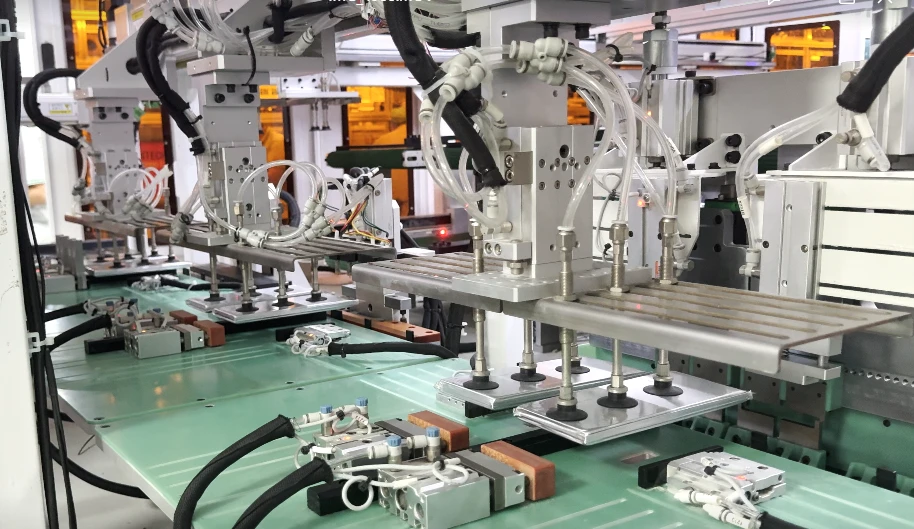
This is a customized pouch cell module and PACK production line engineered by Sunka Lead for a battery manufacturing project.
The specified cell processing capacity is at least 10 PPM, based on a reference module containing 13 pouch cells.
In this project, PPM refers to individual pouch cell processing throughput rather than completed battery modules or finished PACKs per minute.
The line integrates automatic cell feeding, barcode scanning, OCV/IR testing, sorting, tab trimming and flattening, adhesive application, automatic stacking, laser welding and CCD post-weld inspection. Selected module assembly operations and all PACK assembly operations remain manual.
The configuration is intended for single-side-tab pouch cells within the defined dimensional range.
Key project specifications
Item | Project Specification |
|---|---|
Battery Cell Type | Pouch lithium battery cells |
Production Capacity | ≥ 10 PPM, based on cell processing |
Reference Module | 13 cells per module |
Cell Tab Configuration | Single-side tabs only |
Compatible Cell Length | 150–350 mm, including tabs |
Compatible Cell Width | 70–200 mm |
Compatible Cell Thickness | 4–15 mm |
Compatible Module Length | 100–350 mm |
Compatible Module Width | 70–200 mm |
Compatible Module Height | 150–350 mm, including tabs |
Incoming Blister Tray Length | 300–500 mm |
Incoming Blister Tray Width | 180–350 mm |
Line Configuration | Semi-automatic module and PACK production |
Laser Welding | Two 3000 W-class welding stations |
Production Data | Local storage and reserved data interfaces |
Approximate Line Layout | 15 m × 8 m × 2.2 m |
These figures are project design specifications. Final compatibility depends on the approved reference cells, incoming trays, module drawings and tooling configuration.
Specified line performance targets
Performance Indicator | Design or Acceptance Target |
|---|---|
Overall Equipment Effectiveness (OEE) | ≥ 95% |
First-Pass Yield | ≥ 99.3% |
Second-Pass Yield, Including Rework | ≥ 99.67% |
Whole-Line Equipment Failure Rate | ≤ 3% |
Equipment Noise | ≤ 75 dB at a distance of 1 m |
The stated yield targets exclude defective incoming materials and defects not attributable to the equipment. These values are contractual design or acceptance requirements, not independently verified production results.
Equipment layout
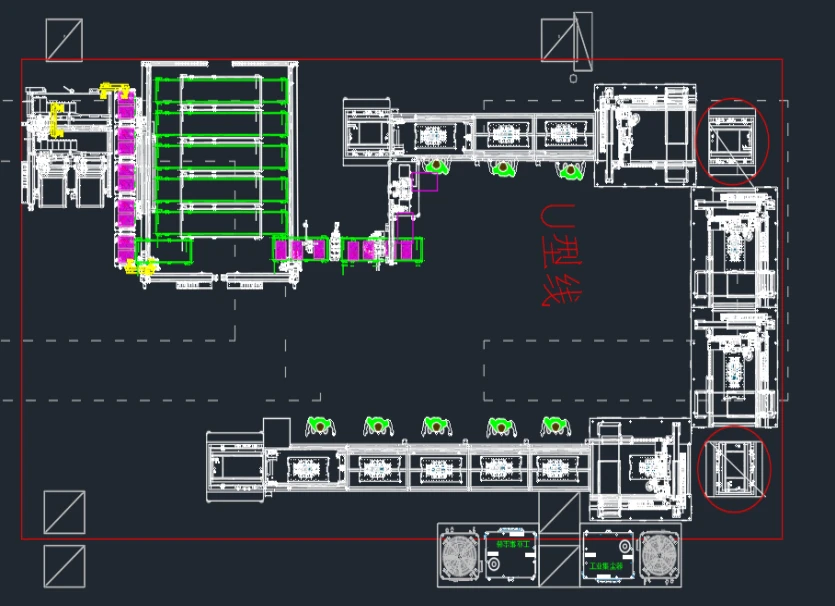
The production system is divided into three functional sections: pouch cell processing, module assembly and welding, and manual PACK assembly.
Automatic operations are concentrated on cell handling, testing, sorting, tab preparation, adhesive application, stacking, welding and post-weld visual inspection.
Manual operations are retained for module bundling, plate insertion, tab bending, post-weld handling and PACK assembly.
The equipment layout is designed around coordinated product flow, with conveyor transfer and pallet circulation between relevant workstations.
Production process flow
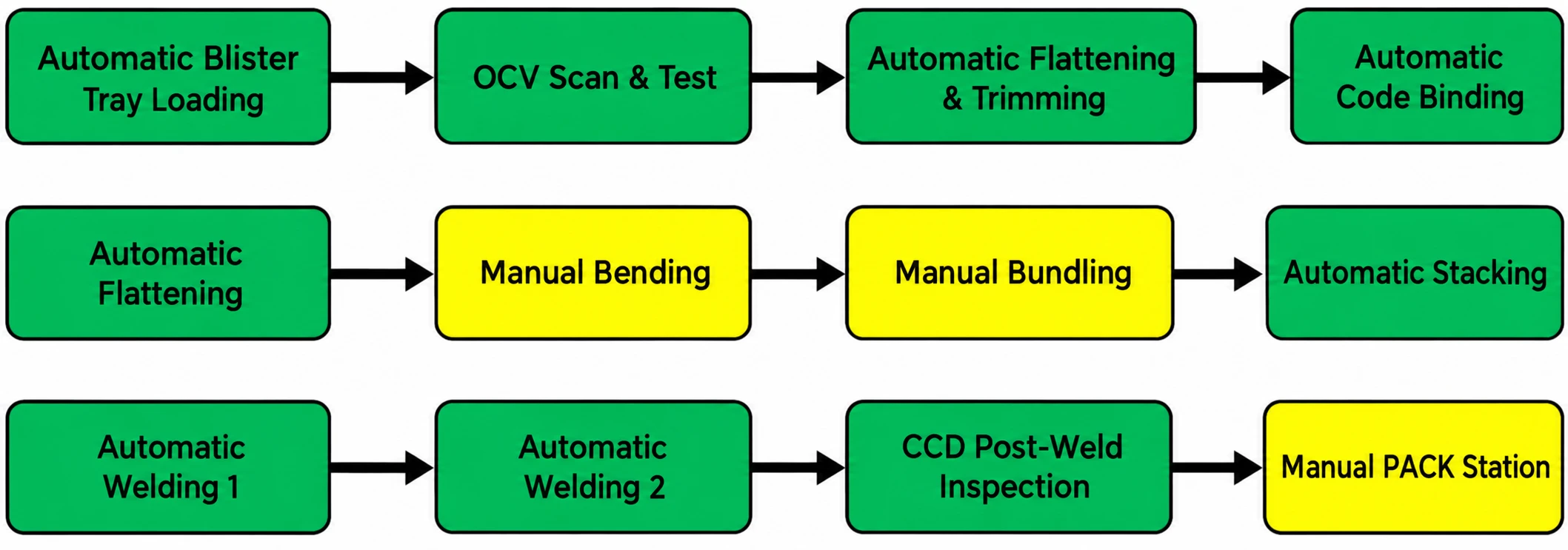
| Section | Process Sequence & Automation |
| Cell Processing | Blister tray loading and automatic cell pick-up — Manual tray placement; automatic cell handling |
| Barcode scanning and OCV/IR testing — Automatic | |
| Cell sorting and nonconforming-cell separation — Automatic | |
| Tab flattening and trimming — Automatic | |
| Cell grouping, code binding and orientation adjustment — Automatic | |
| Module Assembly | Adhesive application and cell stacking — Automatic |
| Module bundling and plate insertion — Manual | |
| Tab bending — Manual | |
| Module Welding | Tab flattening before welding — Automatic |
| Laser welding station 1 — Automatic | |
| Laser welding station 2 — Automatic | |
| Quality Inspection | CCD post-weld surface inspection — Automatic inspection; manual removal of rejected products |
| PACK Assembly | Final PACK assembly and handling — Manual |
The process combines automated quality-critical equipment with selected manual operations according to the reference product and manufacturing requirements.
Production line features
1. Throughput is defined at cell level.
The designed capacity is ≥10 pouch cells per minute under the agreed reference product conditions.
The reference module contains 13 cells, but this does not mean the production line produces 10 completed modules or PACKs per minute.
For production planning, manufacturers should evaluate cell throughput, workstation cycle time, module output and manual PACK assembly capacity separately.
2. Cell compatibility is designed around a defined product range.
The line is designed for single-side-tab pouch cells with lengths from 150 to 350 mm, widths from 70 to 200 mm and thicknesses from 4 to 15 mm.
The incoming cell dimensions, tab position, packaging trays and module structure must match the approved reference specifications. Product compatibility does not mean unrestricted handling of every pouch cell format.
3. Automatic OCV testing and sorting support upstream quality control.
Incoming cells are identified by barcode and tested for voltage and internal resistance.
Sorting results are used to direct cells into the appropriate groups or nonconforming-product buffer positions.
The specified sorting equipment provides 10 sorting channels with a two-layer buffer arrangement to reduce floor-space requirements.
Cell identification and test results can be associated and stored locally for quality tracking.
4. Automatic tab preparation and stacking improve process consistency.
The cell processing section integrates tab flattening, trimming, orientation adjustment, adhesive application and automatic stacking.
After stacking, selected module preparation tasks are performed manually, allowing the manufacturing sequence to accommodate the defined assembly structure.
The automatic stacking flatness requirement is specified at ±0.8 mm.
5. Two laser welding stations support the module joining process.
The welding section includes two 3000 W-class laser welding stations.
The process incorporates CCD-based positioning, height measurement, controlled clamping, nitrogen shielding and welding fume extraction.
The welding arrangement is designed around the approved tab and connection-material requirements. Final weld quality must be validated using the actual customer product and materials.
6. CCD inspection provides a defined post-weld quality gate.
After laser welding, the module passes through a CCD inspection station.
The inspection scope covers visible surface defects such as surface blowholes, missing welds and surface cracks, subject to validation with representative defective samples.
The system is not specified to identify internal weld defects or every possible quality issue. Nonconforming products are removed manually.
Post-weld image records can be linked to the module identification and stored locally.
7. The PACK assembly section retains manual flexibility.
PACK assembly is performed manually after the module welding and inspection processes.
The production system uses a conveyor arrangement with workpiece pallet circulation, helping coordinate module transfer and manual assembly.
This configuration applies automation to selected repetitive and quality-critical processes without presenting the entire line as fully automatic.
8. Traceability is based on local production data.
The project includes barcode identification, test-data association, module code generation and local data storage.
Data transmission interfaces are reserved for potential connection to the customer's systems.
The technical agreement does not establish that a complete MES platform is included in this particular project. Any additional MES integration should be defined separately.
Together, these design choices create a customized pouch cell module and PACK production system focused on controlled cell handling, defined joining processes, practical inspection, product compatibility and coordinated assembly operations.
Frequently asked questions
1. What is the production capacity of this pouch cell PACK line?
The specified capacity is ≥10 PPM at the individual cell-processing level, based on a reference module containing 13 cells. It is not a claim of 10 finished modules or PACKs per minute.
2. Is this a fully automatic pouch cell PACK production line?
No. It is a semi-automatic production line. Cell handling, testing, sorting, stacking, welding and selected inspection processes are automated, while designated module operations and the entire PACK assembly section remain manual.
3. Which pouch cell dimensions can the line support?
The project specifies cell lengths of 150–350 mm including tabs, widths of 70–200 mm and thicknesses of 4–15 mm, subject to the approved tooling and reference product.
4. Does the line support pouch cells with tabs on both ends?
No. The documented configuration is designed for pouch cells with tabs on one side only.
5. How are cells tested before module assembly?
Cells are identified by barcode and undergo OCV and internal resistance testing. Results support sorting and local quality records before downstream assembly.
6. Is the line equipped with automatic pouch cell stacking?
Yes. The process includes automatic adhesive application and stacking. Subsequent module bundling, plate insertion and tab bending are performed manually.
7. What welding equipment is used?
The project includes two 3000 W-class laser welding stations with CCD positioning, height measurement and protective process functions. The actual joining parameters require product-specific validation.
8. What defects can the CCD system inspect?
The documented inspection scope includes visible surface blowholes, missing welds and surface cracks. Internal welding quality is outside the stated CCD visual inspection scope.
9. Does the line include a complete MES system?
The documented configuration stores production data locally and reserves data interfaces. A fully integrated MES platform is not explicitly included in the specified equipment scope.
10. Does the project include automatic EOL Testing for finished PACKs?
The technical agreement describes manual PACK assembly and does not clearly specify a separate automatic finished-PACK EOL testing system. Any additional EOL testing requirements must be confirmed as part of the project scope.
11. What are the key performance requirements?
The agreement specifies OEE ≥95%, first-pass yield ≥99.3%, second-pass yield ≥99.67% including rework, and a whole-line equipment failure rate ≤3%. These are project performance targets, not independently confirmed operating results.
12. Can Sunka Lead customize a pouch cell module and PACK line for other battery products?
Yes. Sunka Lead develops customized lithium battery production equipment according to cell specifications, module architecture, manufacturing processes, required throughput and automation needs. The compatibility and process scope of each project must be evaluated separately.
About Sunka Lead
Sunka Lead is the international brand of Guangdong Songke Leading Intelligent Equipment Co., Ltd., specializing in lithium battery manufacturing equipment and turnkey automation solutions for battery module, PACK and Battery Energy Storage System (BESS) production.
Our solutions cover the cell-to-container manufacturing value chain — from cell testing and sorting to module and PACK assembly, laser welding, EOL testing, and PACK-to-container integration, including automated BESS container assembly lines for commercial & industrial (C&I) and utility-scale energy storage applications.
For project inquiries, share your battery cell specifications, module/PACK drawings, BESS container requirements, target production capacity, automation level, and factory conditions. Sunka Lead develops customized production line solutions around your product architecture and manufacturing goals.