
 English
 简体中文


A cylindrical battery pack assembly production line combines cell inspection, positioning, electrical connection and final PACK assembly.
The required equipment depends primarily on the cylindrical cell format, battery pack structure, connection method, target production capacity and automation level.
Small cylindrical cells and large cylindrical cells have different handling and interconnection requirements. Therefore, a single equipment configuration should not be assumed to fit every cylindrical battery application.
1. Main Equipment for Cylindrical Battery PACK Manufacturing
The main equipment categories generally include:
| Equipment Category | Manufacturing Function |
|---|---|
| Cell Testing and Sorting | Verify cell electrical characteristics and classify cells |
| Cell Feeding and Positioning | Arrange cells in the required holders or fixtures |
| Polarity Inspection | Verify cell orientation and positioning |
| Welding Equipment | Complete electrical connections according to the PACK design |
| Assembly Equipment | Support module and PACK assembly |
| Inspection and Traceability | Verify manufacturing quality and retain production information |
The exact equipment list should be determined by the battery structure and manufacturing process.
2. Differences Between Small and Large Cylindrical Battery Lines
Small and large cylindrical battery PACK production require different process arrangements.
| Process | Small Cylindrical Cells | Large Cylindrical Cells |
|---|---|---|
| Cell Inspection | OCV testing and barcode identification | OCV testing, sorting and cleaning |
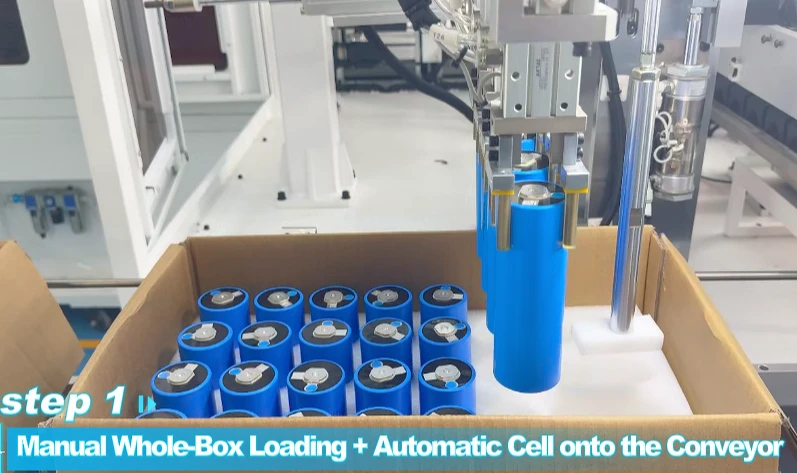
| Cell Positioning | Automatic cell loading into holders | Bracket installation and cell positioning |
| Polarity Inspection | CCD polarity inspection | Polarity testing and addressing |
| Electrical Connection | Double-sided spot welding and soldering where required | laser welding according to the connection design |
| Additional Processing | Welding touch-up where required | Flipping and opposite-side processing where required |
| PACK Assembly | Final PACK assembly | Final PACK assembly |
Sunka Lead's existing line catalogue includes small cylindrical battery solutions for formats such as 18650, 21700 and 26650, as well as separate large cylindrical battery module and PACK production solutions.
These are different manufacturing configurations, not simply different sizes of the same production line.
3. How to Select the Right Welding Equipment
Welding is one of the most important stages in cylindrical battery PACK manufacturing.
The selection depends on the electrical connection design, material, welding position and production requirements.
| Welding Method | Typical Application Considerations |
|---|---|
| Spot Welding | Commonly used for cylindrical cell interconnections with suitable conductive strips |
| Double-Sided Spot Welding | Suitable when the PACK structure requires welding from both sides |
| Laser Welding | Used for designed cell-to-busbar or other specified electrical connections |
| Soldering | Applied where the electrical connection design requires soldering |
Not every cylindrical battery line requires all these processes.
The final selection should be based on the electrical design, material specifications, joint geometry and validated welding process.
4. What Should Be Confirmed Before Purchasing?
| Selection Factor | Information Required |
|---|---|
| Cell Model | 18650, 21700, 26650 or large cylindrical formats |
| Cell Dimensions | Diameter and length |
| PACK Structure | Series and parallel configuration |
| Connection Design | Busbar, nickel strip or other specified connection structure |
| Welding Requirements | Welding method, joint position and material |
| Production Capacity | Target output and operating schedule |
| Automation Level | Manual, semi-automatic or fully integrated automation |
These details help prevent mismatches between equipment configuration and actual battery product requirements.
5. Sunka Lead's Cylindrical Battery Manufacturing Solutions
Sunka Lead develops cylindrical battery module and PACK production line solutions for different cell formats and manufacturing applications.
Our documented small cylindrical line integrates cell inspection, automatic holder loading, CCD polarity inspection, spot welding and soldering processes.
For large cylindrical batteries, the production solution includes cell inspection and sorting, positioning, polarity verification, laser welding and subsequent PACK assembly.
The final line configuration is customized according to cell specifications, module design, production capacity and factory conditions.
FAQ
Can one cylindrical battery PACK line support both 18650 and 21700 cells?
It may be possible with appropriate fixtures and changeover arrangements. Compatibility must be verified against the cell dimensions, feeding method and product structure.
Is laser welding always better than spot welding?
No. The suitable welding process depends on the materials, electrical connection design, joint geometry and quality requirements.
Can a cylindrical battery assembly line be customized?
Yes. Equipment arrangement, automation level, welding processes and material handling can be configured according to the specific manufacturing requirements.
Selecting a cylindrical battery pack assembly line requires understanding the differences between small and large cylindrical cells and matching each manufacturing process to the actual battery structure.
Sunka Lead provides customized cylindrical battery module and PACK production solutions, helping manufacturers integrate cell processing, welding and assembly into a coordinated manufacturing system.
About Sunka Lead
Sunka Lead is the international brand of Guangdong Songke Leading Intelligent Equipment Co., Ltd., specializing in lithium battery manufacturing equipment and turnkey automation solutions for battery module, PACK and Battery Energy Storage System (BESS) production.
Our solutions cover the cell-to-container manufacturing value chain — from cell testing and sorting to module and PACK assembly, laser welding, EOL Testing, and PACK-to-container integration, including automated BESS container assembly lines for commercial & industrial (C&I) and utility-scale energy storage applications.
For project inquiries, share your battery cell specifications, module/PACK drawings, BESS container requirements, target production capacity, automation level, and factory conditions. Sunka Lead develops customized production line solutions around your product architecture and manufacturing goals.